by plittle@westcoastdetectives.us | May 24, 2026 | Blog
Phil Little, President/CEO West Coast Detectives International
Over the course of my 60-year career in the Military, Law Enforcement, Intelligence, and Global Security sectors, I have specialized in corporate and international investigations as well as preventive security strategies.
I quickly learned that NGOs and organizations operating around the world face unique challenges in every country where they work. A one-size-fits-all, “cookie-cutter” approach simply does not work. While the core principles of effective security remain consistent, each nation presents its own distinct risks, cultural considerations, and operational realities.
To create a truly effective action plan for a client, it is essential to thoroughly understand these specific challenges. The plan must address not only protective security measures but also robust preventive strategies. This level of customization requires an agency with broad international intelligence capabilities, combined with reliable local insight in each operating environment—ensuring we help clients operate effectively without inadvertently creating new vulnerabilities.
At West Coast Detectives International, we place intelligence gathering at the foundation of every action plan we develop. We firmly believe that prevention is far less costly than enforcement.
Prepare well. Operate safely. Anywhere in the world.
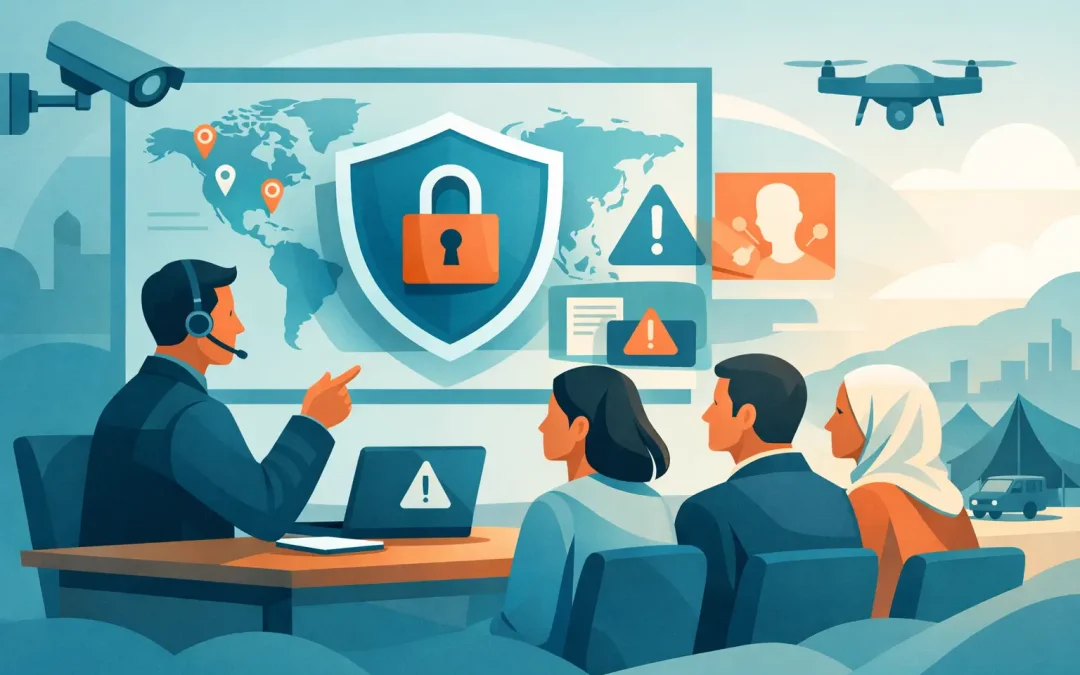
A country director lands in a new operating area with a binder full of policies, a few outdated incident notes, and a 20-minute orientation that says little beyond “stay alert.” That is not a security posture. For organizations working in volatile regions, security briefings for NGOs are not administrative formalities. They are operational tools that shape movement, staffing, communications, and decision-making before a single vehicle leaves the gate.
The gap between a generic briefing and a useful one is often the difference between awareness and exposure. NGOs work in environments where the threat picture shifts quickly, where local perceptions matter as much as physical barriers, and where a team’s humanitarian profile may reduce risk in one district and increase it in the next. A proper briefing does not just describe danger. It helps leadership understand which risks are credible, which are manageable, and which should change the mission itself.
What security briefings for NGOs should actually do
A serious briefing has one purpose: to support informed action. That means it must go beyond broad warnings about crime, terrorism, civil unrest, or kidnapping. Those categories matter, but they are only the beginning. An effective briefing should tell decision-makers how those threats show up in the specific area of operation, who is most exposed, what triggers escalation, and what practical controls are realistic for that mission.
For NGOs, this requires a different lens than the one used for corporate travel or government deployments. Humanitarian and development teams often rely on community access, local goodwill, and field mobility. They may travel with modest profiles, engage with vulnerable populations, and operate with limited protective infrastructure. Security planning cannot be detached from program delivery. If a briefing ignores aid distribution patterns, local partner credibility, checkpoint behavior, or the political meaning of foreign funding, it is incomplete.
A useful product also distinguishes between strategic and tactical information. Strategic intelligence explains the broader environment: armed actors, political fault lines, election cycles, crime trends, hostile propaganda, and regional spillover. Tactical guidance addresses what field personnel need to know now: which roads have become unreliable, what time of day movement risk increases, whether officials are targeting satellite communications, how demonstrations form, and what medical evacuation constraints exist this week.
Why generic briefings fail in the field
Many organizations have received security briefings for NGOs that look polished but provide little operational value. The language is often broad enough to apply to ten countries at once. It may rely heavily on public reporting, omit local nuance, and avoid hard judgments because the author has no confidence in the source picture.
That kind of document can satisfy a procedural requirement while leaving the team underprepared. It creates the illusion of readiness. In practice, field managers still make decisions based on rumor, personal instinct, or fragmented updates from local staff. None of those sources should be dismissed, but none should stand alone either.
The most common failure is poor context. A briefing that says kidnapping risk is elevated tells only part of the story. Is kidnapping politically motivated, financially motivated, or opportunistic? Are expatriates at greater risk than national staff, or is the reverse true? Do abductions occur during road movement, at residences, or after digital surveillance? Is the threat concentrated near border zones, or spreading into urban centers? A credible briefing answers those questions because they determine whether the organization should harden compounds, alter routes, change meeting protocols, or reconsider deployment.
Another failure is treating all NGO personnel the same. The exposure of a senior expatriate donor liaison is not the same as that of a local field monitor, a driver, a medical team, or a contractor handling warehousing. Briefings that flatten these distinctions tend to produce weak controls. Good security work is role-specific.
The components of an effective NGO security briefing
The strongest briefings are built around mission relevance. They start with the operational footprint: where the NGO works, how it moves, who it employs, what assets it uses, and what public profile it carries. From there, the threat assessment becomes practical rather than theoretical.
Threat actors should be identified in plain terms. That may include insurgent groups, criminal kidnappers, corrupt officials, ideological agitators, local power brokers, online harassers, or hostile insiders. Not every threat deserves the same level of attention. A disciplined briefing ranks them by intent, capability, and proximity to operations.
Local atmospherics matter just as much. Communities may view one NGO as neutral and another as politically aligned, even when both consider themselves humanitarian. Religious identity, nationality, funding source, gender composition of field teams, and social media visibility can all shape risk. Security professionals who understand protective operations know that perception can alter threat faster than a formal intelligence indicator.
A strong briefing also addresses infrastructure vulnerability. Roads, airports, telecommunications, fuel availability, hospitals, and safe accommodation can deteriorate quickly in unstable environments. An NGO may accept a moderate threat picture if extraction routes are viable and communications are reliable. The same threat becomes far more serious when movement corridors narrow and emergency support becomes uncertain.
Then there is the issue of decision thresholds. Briefings should define what changes would trigger review or suspension of activity. That may include sustained unrest near project sites, direct threats to staff, detention of NGO personnel, hostile media narratives, closure of air access, or attacks on peer organizations. Without thresholds, teams often normalize deterioration until options shrink.
Security briefings for NGOs must account for access and acceptance
Corporate security models often emphasize hardening, deterrence, and control. NGOs do not always have that luxury, and in some contexts they should not pursue it aggressively. A visible protective posture can undermine community trust, complicate negotiations, and signal political alignment. This is where security briefings for NGOs need experienced judgment rather than imported templates.
Sometimes the safest course is lower visibility, tighter movement discipline, and stronger local engagement rather than heavier guards or conspicuous vehicles. In other settings, a low-profile approach may invite targeting because armed groups interpret it as weakness or because criminal actors assume poor crisis response capacity. It depends on the environment.
That is why acceptance, protection, and deterrence should be weighed together rather than treated as competing ideologies. A mature briefing explains how each approach may affect program delivery and staff safety in that specific setting. It should also reflect the reality that national staff often carry the deepest exposure because they remain in-country long after expatriates depart.
Briefings are not one-time products
The most dangerous assumption in field security is that last month’s picture still applies. In unstable regions, a briefing has a short shelf life. Elections, leadership disputes, sanctions, militia splintering, border closures, social media incitement, and attacks on symbolic targets can shift the operating environment in days.
For NGOs, this means briefings should exist in layers. There is the pre-deployment briefing, which frames the environment and baseline controls. There is the in-country briefing, which refines exposure by location and role. Then there are update cycles tied to incidents, travel plans, public events, and program changes.
This does not mean every update must be long. In fact, concise updates are often more useful. The standard should be relevance, not volume. Field teams need factual, current, actionable reporting. Senior leadership needs implications. Security managers need both.
Organizations that operate in sensitive regions often benefit from outside support because external intelligence providers can test assumptions, verify local reporting, and identify patterns that internal teams may miss. This is especially true where local political dynamics are opaque, where anti-Western or anti-NGO narratives are evolving, or where counter-terrorism concerns intersect with humanitarian access. Firms such as West Coast Detectives International are typically engaged in these situations because the requirement is not generic guarding but tailored intelligence and operational judgment.
What NGO leaders should ask before accepting a briefing
The right question is not whether a briefing exists. It is whether the briefing is decision-grade. Leadership should ask where the information comes from, how recently it was validated, whether it reflects local sources, and what specific decisions it is meant to support.
They should also ask what has been excluded. Every briefing has limits. Some environments are information-poor. Some reporting is politically manipulated. Some local partners may understate risk to preserve funding or overstate it to influence policy. A credible briefer is candid about those gaps.
Finally, leaders should ask whether the recommendations are operationally realistic. Advice that cannot be implemented in the field is decorative, not protective. If the organization cannot sustain armored movement, 24-hour security staffing, or compound hardening, then the briefing must account for that reality and adjust risk controls accordingly.
Security decisions in the NGO world are rarely clean. The mission may still matter when the environment worsens. Access may still be worth preserving when conditions are uncomfortable but not yet prohibitive. That is exactly why the briefing matters. It should not push leadership toward fear or false confidence. It should give them a disciplined read of the ground, a clear view of trade-offs, and enough factual intelligence to act before circumstances make the choice for them.
The best briefings do not simply warn teams about danger. They help serious organizations stay mission-capable without losing sight of what the ground is actually telling them.

by plittle@westcoastdetectives.us | May 23, 2026 | Blog
Early in the development of our Threat Management and protocol action plan for high-risk clients, we quickly determined that secure travel under our direct control was essential. Given the diverse backgrounds and exposure levels of our clients, this represented a significant vulnerability that could not be ignored. A thorough risk assessment was conducted in every case to identify and monitor potential threats.
In many instances, West Coast Detectives personally selected the appropriate aircraft and arranged for its lease under Part 91 regulations. This approach allowed us to place our own highly qualified pilots on the aircraft. As our Threat Management unit expanded, we further enhanced our capabilities by acquiring our own fleet of both armored and regualr limousines and town cars to fully round out the protective detail.
Our standard process begins immediately upon retention. We conduct a comprehensive intelligence workup to assess the specific threat environment and determine the appropriate level of protection required.
By maintaining full operational control over all critical assets — aircraft, vehicles, and personnel — West Coast Detectives is able to deliver a far more comprehensive and secure travel experience. We do not apply a one-size-fits-all approach. Every client is unique and receives a customized protection plan tailored to their specific needs and risk profile.
The following are some of the key lessons we have learned over the past 104 years.
A principal steps off a long-haul flight, clears a private terminal, and heads toward a tightly managed vehicle package. The itinerary is confidential. The route was varied. The lodging profile was controlled. Yet a familiar vehicle appears twice before noon, and the same face is seen again near the hotel perimeter after sunset. This is where surveillance detection for VIP travel stops being a theoretical security layer and becomes a decisive protective function.
For executives, public figures, family offices, legal stakeholders, and NGO personnel operating in elevated-risk environments, travel exposure rarely comes from a single dramatic event. It more often begins with pattern recognition by an adversary. A stalker, hostile media actor, organized criminal group, activist cell, competitor, or lone actor studies movement, identifies routines, and waits for the moment when access is easiest. Surveillance detection is designed to identify that hostile interest early, before an adversary can fix the principal’s habits, vulnerabilities, and protective gaps.
Why surveillance detection for VIP travel matters
Protective travel planning often focuses on aircraft, drivers, hotels, and venue access control. Those elements matter, but they do not answer a more critical question: who is watching, and what are they learning? A sophisticated protective posture is not only about moving securely. It is about denying useful intelligence to anyone attempting to map the principal’s life.
Surveillance serves different purposes depending on the threat actor. In some cases, it is pre-incident reconnaissance before theft, kidnapping, extortion, confrontation, or reputational disruption. In other cases, it is less organized but still dangerous, as with an obsessed individual attempting to confirm a VIP’s room location, restaurant choices, fitness schedule, or family presence. The common factor is intent. Once a hostile party establishes confidence in a principal’s movement pattern, risk increases sharply.
That is why surveillance detection should not be treated as an optional add-on reserved for heads of state. It is relevant whenever there is known threat reporting, public visibility, litigation exposure, insider conflict, activist attention, wealth signaling, or travel into jurisdictions where criminal or political targeting is credible. It also becomes relevant when a principal believes they are “probably fine” because the travel is private. Quiet travel can still be watched.
What surveillance detection actually involves
Surveillance detection is not random observation and it is not cinematic tradecraft performed for show. It is a disciplined process that combines advance intelligence, field observation, behavioral analysis, route and venue planning, and structured reporting. The goal is to determine whether a principal, support staff, family member, vehicle, or lodging site is under observation, and if so, to characterize the surveillance well enough to inform a protective response.
That work starts before wheels up. A capable team studies the destination, known crime and terrorism conditions, local collection risks, airport and hotel vulnerabilities, previous incidents, transportation choke points, and any adversaries with reason to monitor the traveler. Social media review, open-source threat review, and human source reporting can all be relevant depending on the assignment. Protective teams also assess how much of the itinerary is already exposed through assistants, event organizers, publicists, aviation handlers, vendors, or compromised communications.
In the field, surveillance detection depends on pattern analysis. One sighting means little. Repetition under changing conditions means more. An individual seen near the arrival corridor, then near the motorcade route, then near the hotel frontage deserves attention. A vehicle that appears across route shifts, timing changes, or secondary movement deserves closer scrutiny. The work requires calm judgment, because overreaction can disrupt a legitimate movement plan, but underreaction can surrender initiative.
Surveillance detection for VIP travel is never one-size-fits-all
A celebrity on a domestic tour, a CEO entering a contentious labor environment, and an NGO director traveling in a politically unstable country do not face the same surveillance picture. Their threat actors, public profiles, and legal constraints differ. So should the detection plan.
For a highly visible entertainment principal, the threat may come from overzealous followers, paparazzi working beyond legal boundaries, or individuals attempting physical proximity for exposure. For a corporate executive, the greater concern may be protest escalation, competitive intelligence, insider leaks, or opportunistic criminal targeting based on disclosed travel habits. For government-adjacent or humanitarian travel, surveillance may have intelligence collection, ideological, or coercive motives.
This is where experienced judgment matters. Too little surveillance detection creates blind spots. Too much of the wrong kind can make a principal conspicuous, disrupt business objectives, and introduce unnecessary friction. The answer depends on the mission, the destination, the local operating environment, and the nature of the adversary.
How professional teams detect hostile interest without telegraphing concern
The strongest surveillance detection programs are quiet. They do not announce themselves, and they do not force the principal into unnecessarily dramatic movement. Instead, they build a layered picture.
Advance teams may assess likely observation points around airports, hotels, meeting sites, and residential compounds. Protective personnel study lines of sight, foot traffic patterns, parking behavior, rideshare density, and places where static surveillance can blend in. During movement, teams watch for recurring people, vehicles, and timing anomalies, especially when route changes have been introduced specifically to test whether a subject reappears.
Lodging requires special attention. A luxury property may look controlled while still offering multiple opportunities for collection in lobbies, bars, elevators, parking areas, loading zones, and adjoining public spaces. Surveillance is not always focused on an immediate attack. It may be directed at confirming room floor, companion details, meeting attendees, security rhythm, or departure schedule. That intelligence has value to kidnappers, extortionists, stalkers, competitors, and hostile media operators alike.
A professional team also understands the limits of visual observation. Some environments are dense, permissive, and crowded enough that definitive calls are difficult. In those situations, intelligence support, local asset validation, technical review, and protective route discipline become even more important. Security work at this level is rarely about certainty. It is about weighing indicators correctly and acting before risk matures.
Common failures that increase exposure
The most common failure is predictability. The same departure window, the same vehicle profile, the same preferred entrance, and the same public-facing routines make hostile surveillance easier. Many principals assume privacy comes from discretion alone, when in fact privacy often depends on denying patterns.
Another failure is oversharing by the support ecosystem. Assistants, event staff, hotel personnel, drivers, aviation handlers, and even well-meaning family members can expose details that help an observer narrow time and place. A travel plan can be compromised without any dramatic breach. It only takes enough fragments to build a usable picture.
There is also a tendency to treat surveillance concerns as paranoia until an incident forces a response. That is a dangerous delay. The purpose of detection is not to validate fear. It is to identify hostile interest while options still exist. Once an adversary has mapped routines over several days, the principal has already lost ground.
Integrating surveillance detection into executive protection
Surveillance detection works best when it is integrated into the broader protective mission, not separated from it. Advance work, intelligence briefing, transportation planning, venue security, and principal movement all benefit from a shared threat picture. If the surveillance team identifies possible hostile interest, that information should immediately shape route selection, site access, timing, and contingency decisions.
This is also why low-cost, generic security coverage often falls short for high-risk travel. A driver and visible body coverage may create reassurance without creating awareness. Surveillance detection requires trained observation, disciplined reporting, legal judgment, and field experience in distinguishing coincidence from targeting. It is an investigative function as much as a protective one.
Firms such as West Coast Detectives International approach these assignments through that combined lens – protection, intelligence, and factual assessment working together. For clients operating across borders or under heightened public exposure, that integration can mean the difference between routine travel and preventable vulnerability.
When to request surveillance detection for VIP travel
The right time is before a concern becomes obvious. If there is active litigation, a threatening former associate, public controversy, extremist interest, a recent breach of private information, family office visibility, or travel into a jurisdiction with known targeting risks, surveillance detection deserves serious consideration. The same applies when a principal reports recurring sightings, unusual inquiries, unexplained photography, or a sense that movement is being tracked.
Not every assignment requires a full-scale deployment. Sometimes a limited-duration detection effort around arrival, a key event, or a sensitive meeting is sufficient. In other cases, especially with multi-city or international travel, the proper answer is a layered operation with advance intelligence, local coordination, and ongoing field assessment. The work should match the threat, not a template.
VIP travel is rarely compromised all at once. It is compromised in pieces – a sighting here, a routine there, a predictable transfer, a careless disclosure, a familiar face no one challenged early enough. Surveillance detection gives protective teams the chance to see the pattern before an adversary can exploit it, and that margin is often where security is won.
Prevention is much lest costly then dealing with an attack of any type. Travel safe and secure.
by plittle@westcoastdetectives.us | May 22, 2026 | Blog, Current Terrorist Alerts, Phil Little Reports, Terrorism Update
My interest in understanding the sources and root causes of terrorism began in the mid-1970s, when I was on the ground studying intelligence reports coming out of terrorist training camps in Southern Lebanon. During those years, I came to recognize that the terrorism emanating from Southern Lebanon into Israel was not an isolated regional conflict — it was a precursor of what would eventually spread to the rest of the world, including the United States.
In the early 1980s, I began speaking to hundreds of organizations — both NGOs and government agencies — urging them to take the emerging threat seriously and to adopt preventive measures before it was too late. Sadly, most of those warnings went unheeded. As a result, we left ourselves vulnerable, creating soft targets where terrorism was able to take root.
Today, we still face emerging threats that have the potential to be far more devastating than anything we have experienced in the past. The dangers are real. Instead of burying our heads in the sand and hoping the problem goes away or strikes somewhere else, we must learn from our past mistakes and commit to far stronger preventive action.
This is not a scare tactic — it is a call to action for all freedom-loving Americans. We must stand up and speak out, beginning in our own local communities. Please help spread this message by sharing it widely. Let it be our collective gift as we approach America’s 250th birthday. My informed thoughts following.
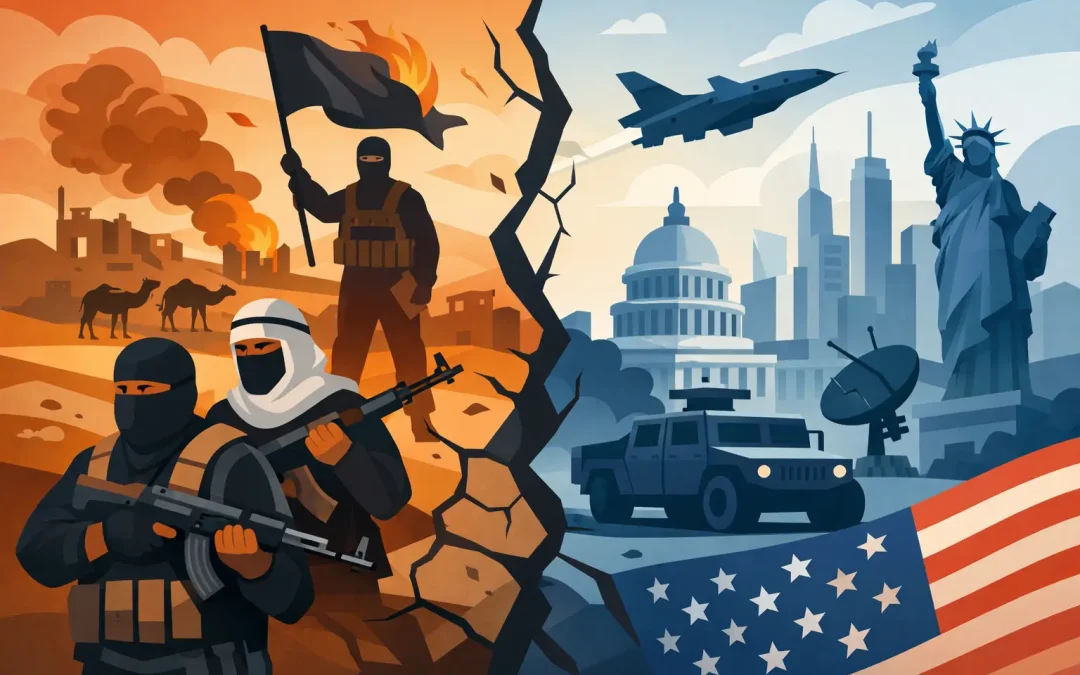
The question is not whether jihadist terrorism has disappeared from the American threat picture. It has not. The real question is how the ISIS & al Qaeda threat to America in 2026 is evolving – and whether decision-makers are looking in the right places.
For government offices, corporate security teams, NGOs, and high-profile travelers, the risk is less about a repeat of 2001 in identical form and more about adaptive, decentralized, lower-signature operations. That distinction matters. A threat does not need to be spectacular to be operationally serious. It only needs intent, enough capability, and a vulnerable target set.
What the ISIS & al Qaeda threat to America in 2026 really looks like
By 2026, both ISIS and al Qaeda remain dangerous, but in different ways. ISIS has shown a greater ability to inspire fast-moving, media-conscious violence through online propaganda, remote facilitation, and calls for opportunistic attacks. Al Qaeda, by contrast, traditionally places greater value on patience, ideological framing, and longer-horizon plotting. Those differences shape the threat environment inside the United States.
ISIS-linked violence often emerges through self-radicalized or loosely enabled actors who require limited tradecraft. Knives, firearms, vehicles, and improvised methods still matter because they are accessible, hard to preempt at scale, and effective against soft targets. Al Qaeda’s model is usually less impulsive. Even when direct command-and-control is degraded, the organization and its affiliates continue to frame the United States as a legitimate target and encourage followers to exploit openings over time.
Neither network should be assessed only by the territory it controls. That was a common analytical error in earlier years. Safe haven matters, but ideology, encrypted communication, prison radicalization, diaspora connections, regional affiliates, and digital propaganda pipelines can preserve operational relevance even when central leadership is under pressure.
Why the threat persists even after years of disruption
A mature threat assessment begins with a simple reality: counterterrorism pressure can reduce capacity without eliminating intent. Drone strikes, arrests, sanctions, watchlisting, and border screening have constrained both groups. They have not ended the movement.
ISIS and al Qaeda survive because they are not just organizations. They function as brands, narratives, and ecosystems. Affiliates in Africa, the Middle East, and parts of Asia can keep the broader movement alive, produce propaganda, build battlefield credibility, and feed a transnational grievance story that resonates online. A lone actor in the United States may never meet a foreign operative in person and still act in service of that ecosystem.
That is one reason broad claims that the threat is “over” are professionally unsound. Threat conditions change. They do not simply vanish because media attention moves elsewhere.
Key drivers of the 2026 risk picture
The most serious driver is the convergence of online radicalization and low-barrier attack methodology. An individual does not need advanced explosives training or overseas travel to become dangerous. He may only need ideological motivation, a target, and enough privacy to prepare.
The second driver is global instability. Conflict zones, weak states, prison breaks, refugee flows, and ungoverned spaces can all give jihadist actors room to recruit, regroup, and project influence. When regional branches gain momentum abroad, their propaganda value increases at home. Success in one theater can energize supporters elsewhere.
A third driver is the strain on intelligence and law enforcement resources. The United States now faces a crowded threat landscape that includes foreign terrorism, domestic violent extremism, cybercrime, hostile state activity, transnational organized crime, and targeted violence. When attention is divided, warning signs can be missed.
There is also a trade-off that serious clients should understand. The more diffuse the threat becomes, the harder it is to detect using traditional indicators. Large conspiracies are vulnerable to interception. Small, self-directed attack planning is often less visible until late in the cycle.
Soft targets remain the most credible concern
For most American organizations, the practical risk is not a complex aviation plot. It is a lower-cost attack against an accessible venue. Public gatherings, religious institutions, retail locations, transportation nodes, hotels, schools, entertainment venues, and symbolic corporate sites remain attractive because they offer visibility and relatively open access.
This is especially relevant for executives, public-facing brands, NGOs operating in contentious environments, and institutions that may become symbolic targets for ideological reasons rather than personal ones. The target is often chosen for meaning, convenience, or media effect – not because it is the highest-value site on paper.
That has implications for private-sector security. An organization can have excellent headquarters controls and still remain exposed through executive travel, conference appearances, charity events, satellite offices, and routine employee movement.
The online battlefield is still producing real-world violence
The ISIS & al Qaeda threat to America in 2026 cannot be assessed without looking carefully at digital ecosystems. Radicalization rarely happens in a neat sequence. It can unfold across mainstream platforms, encrypted messaging apps, fringe forums, gaming channels, and private peer networks.
What matters operationally is not only extremist content itself, but acceleration. Who is moving from rhetoric to fixation? Who is conducting surveillance, discussing weapons acquisition, consuming martyrdom material, or signaling timeline urgency? Those are very different indicators from ideological noise.
This is where many organizations make a costly mistake. They treat online extremism as a public affairs problem rather than a protective intelligence problem. For high-profile individuals and exposed institutions, that is the wrong frame. When threat language intersects with doxing, grievance behavior, unstable mental state, or travel visibility, the risk profile changes fast.
What this means for corporations, NGOs, and high-profile individuals
A credible threat posture in 2026 requires more than generic security. It requires advance work. Protective intelligence, travel risk review, route analysis, event screening, social media exposure assessment, and local-source reporting all matter more when the threat actor may be unknown until late in the cycle.
For multinational firms and NGOs, overseas exposure can also create domestic consequences. An American executive associated with controversial operations, regional disputes, sanctions environments, or ideological narratives may draw attention both abroad and at home. Threats are no longer neatly separated by geography.
For prominent individuals, family offices, legal teams, and entertainment figures, the concern is often reputational visibility combined with accessible routines. Public schedules, predictable habits, loosely managed event entry, and online oversharing create opportunity. Terrorism risk may not be the only concern in those cases, but it must sit inside the broader threat matrix.
Where assessments often go wrong
The first error is overcorrection. After periods of intense focus on domestic extremism or geopolitical rivalry, some stakeholders underweight jihadist threats because they are no longer the headline story. That is not analysis. It is attention drift.
The second error is assuming that lack of central direction means lack of danger. Decentralized actors are harder to map and can still produce casualties, disruption, and strategic fear.
The third is relying on static security plans. Threats change faster than annual policy reviews. A plan built for theft, protest, or workplace violence may not adequately address ideologically motivated surveillance, hostile approach, or attack behavior at public-facing events.
This is where experienced intelligence support becomes valuable. Firms such as West Coast Detectives International operate in the space between raw concern and operational clarity, helping clients understand what is noise, what is escalation, and what requires immediate protection measures.
A disciplined approach to 2026 preparedness
Preparedness does not require panic. It requires disciplined realism. Organizations should review soft-target vulnerabilities, validate incident response protocols, tighten visitor and event screening where appropriate, and ensure that travel and executive protection planning reflects current threat intelligence rather than outdated assumptions.
They should also build reporting pathways that encourage early escalation of suspicious behavior. Many attacks are preceded by fragments of warning that look minor in isolation. A hostile message, odd surveillance, fixation on access points, repeated presence near a principal, or unusual online chatter may not trigger alarm independently. Together, they can.
Finally, leaders should resist binary thinking. The threat is neither omnipresent nor negligible. It is episodic, adaptive, and heavily dependent on exposure, symbolism, location, and timing. That means the right question is not whether America faces risk from ISIS and al Qaeda in 2026. It does. The better question is whether your organization has the intelligence discipline to recognize when general risk becomes a specific problem.
by plittle@westcoastdetectives.us | May 21, 2026 | Blog
I have had the opportunity to work and manage both Covert and Commerical cover assignments. I have found that Commeriecal Cover can be extremely effective in government use as well as in the private sector. I have used covert cover in the private sector, particular when we needed to determine if illegal activities were going on the client company workforce.
In my international work I have found that commeriecal cover provided me deep political information while working a commerical activity. Such as determing if a country was sujitable for our clients involvement in investing or setting up operations in the country. An affective Commerical cover requires the operator to have a company history that can stand a deep background check. Setting up a new LLC as a consulting company can be easily exposed.
Following is some of the things I have learned over the last 50 years.
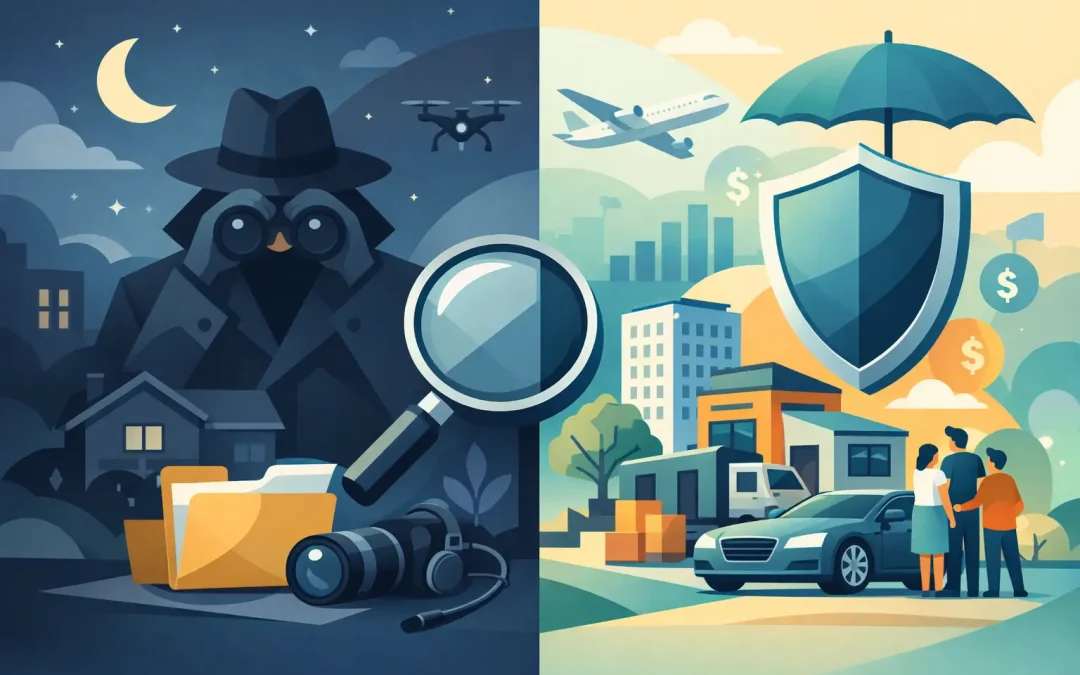
A cover legend is not window dressing. It determines who can enter an environment, what questions can be asked, how long an operation can last, and what happens if scrutiny begins. When clients ask what is the difference in covert and commercial cover in intelligence gathering, they are usually asking a more practical question: which method produces reliable access without creating unnecessary legal, operational, or reputational risk?
The short answer is this. Covert cover is built to conceal the true purpose, affiliation, or identity of the person collecting information. Commercial cover uses a legitimate business role or business pretext to explain presence, contact, travel, meetings, and inquiry. Both can be lawful or unlawful depending on the jurisdiction, the methods used, and the purpose of the assignment. Both can also fail if the operator, sponsor, or client chooses the wrong approach for the environment.
What Is the Difference in Covert and Commercial Cover in Intelligence Gathering?
The difference starts with visibility and plausibility. Covert cover is meant to mask the real mission. The person gathering intelligence may appear to be a tourist, researcher, contractor, journalist, consultant, or private citizen while pursuing a separate objective. The strength of covert cover lies in obscurity. If it works, the target does not recognize that collection is taking place.
Commercial cover is narrower and often more defensible. The collector operates under a business identity that provides a credible reason to be in a market, attend events, conduct meetings, review supply chains, assess counterparties, or ask commercial questions. The key distinction is that the business role itself becomes the access platform. In many cases, the business activity is real, even if it is not the only reason the person is present.
That difference matters because access, scrutiny, and exposure unfold differently in each model. A covert role may allow discreet observation where direct business engagement would raise concern. A commercial role may support repeated meetings, document review, and market entry conversations that a purely covert role could never sustain.
Covert cover is built around concealment
In intelligence terms, covert cover protects the true sponsor or objective from detection. It is designed for environments where direct affiliation would close doors, trigger defensive behavior, or place the collector at risk. In hostile or sensitive settings, that can be the only realistic route to obtaining ground truth.
But covert does not mean careless, and it does not mean theatrical. Effective covert cover depends on consistency. Background, travel pattern, online presence, language ability, financial behavior, and local knowledge all have to align. The more complex the legend, the more points of failure it contains.
This is where many outsiders misunderstand the trade-off. Covert cover can create short-term access, but it also creates heavier demands on operational discipline. If challenged, the collector may have fewer legitimate records, fewer overt relationships, and less room to explain anomalies. Once doubt appears, the cover can collapse quickly.
For private-sector work, covert methods also require strict legal and ethical boundaries. A lawful investigation or due diligence assignment is not a blank check for impersonation, fraud, trespass, or unlawful surveillance. The environment, client objective, and governing law dictate what is permissible.
Commercial cover relies on legitimate business presence
Commercial cover is often better understood as business-based access. A person may operate as an investor representative, market analyst, regional consultant, supplier, security advisor, logistics specialist, or due diligence professional. The cover works because business people routinely travel, ask questions, evaluate partners, and seek information before making decisions.
In many assignments, commercial cover is more sustainable than covert cover. It gives the operator a reason to maintain regular contact, request meetings, observe business processes, and build a relationship over time. In cross-border inquiries, it can also support documentation, invoices, travel records, and introductions that look normal because they are normal.
That said, commercial cover is not automatically safer. A business identity invites its own scrutiny. Sophisticated counterparties may verify company registration, transaction history, executive profiles, procurement patterns, and digital footprint. If the commercial platform is weak or artificial, the target may spot it quickly.
The strongest commercial cover is rooted in a real commercial rationale. It is especially effective in due diligence, source inquiries, supply chain checks, market validation, counterparty vetting, and pre-transaction intelligence work where legitimate business engagement is expected.
When covert cover makes sense and when it does not
Covert cover tends to fit assignments where open inquiry would contaminate the subject’s behavior or end access entirely. Examples may include discreet threat assessments, hostile environment fact-finding, pattern-of-life observation, or early-stage verification where disclosure would create flight, concealment, or retaliation.
Even then, it is not always the preferred option. If the objective can be achieved through lawful records research, structured interviews, overt site visits, commercial inquiry, or protective intelligence methods, those routes are often more durable and easier to defend.
For institutional clients, there is another factor: downstream use. Intelligence that may support legal action, board-level decisions, security planning, or government coordination must withstand scrutiny. A method that produces information but damages admissibility, credibility, or reputation can cost more than it delivers.
What commercial cover does better
Commercial cover usually performs better when the assignment requires repeat contact and a reason to keep returning. It is particularly useful where the target environment expects vendors, investors, consultants, buyers, or advisers to appear and ask detailed questions.
This makes it effective for corporate due diligence, market entry risk reviews, distributor validation, sanctions-adjacent concern screening, executive exposure analysis, and background development around counterparties who maintain a business-facing presence. The collector is not hiding in the shadows. The collector is presenting a credible business purpose that supports information flow.
That purpose can reduce friction, but it also imposes discipline. The business identity must be supportable. The conversation must stay within lawful bounds. The operational team must know when to push, when to pause, and when direct inquiry would create records or reactions the client does not want.
The real issue is risk management, not vocabulary
Clients sometimes treat covert and commercial cover as if they are simply two labels for the same fieldcraft. They are not. The method chosen affects exposure in four directions at once: legal risk, personal safety risk, reputational risk, and intelligence quality.
A covert approach may reduce the chance that a subject recognizes collection, but it can increase operational sensitivity if challenged. A commercial approach may lower legal and reputational risk when built on legitimate activity, but it can alert a subject that interest exists. Neither option is universally superior.
Experienced operators look first at mission requirements. Is the assignment about validation, access, observation, influence resistance, or long-term placement? Does the environment tolerate outside inquiry? Are local services active? Is the target litigious, security-conscious, politically connected, or violence-prone? Those factors matter more than the label attached to the cover.
What is the difference in covert and commercial cover in practice?
In practice, the difference often comes down to what happens when someone asks a simple question: Why are you here?
Under covert cover, the answer is designed to conceal the true intelligence objective. Under commercial cover, the answer is tied to a business role that can reasonably explain meetings, travel, questions, and documentation. One approach depends more heavily on hidden purpose. The other depends more heavily on legitimate business plausibility.
That is why commercial cover is often the preferred option in private investigative and security consulting work. It can be cleaner, more sustainable, and more compatible with due diligence, risk advisory, and executive decision support. Covert cover still has a place, but it belongs in tightly controlled assignments where the benefit clearly justifies the operational burden.
At West Coast Detectives International, this distinction is not academic. High-stakes clients need collection strategies that match the terrain, the law, and the consequence of exposure. Choosing the wrong cover can compromise the assignment before the first conversation begins.
The better question is not which sounds more sophisticated. It is which approach gives you lawful access, credible reporting, and a result your organization can actually use when the pressure is on.
If you have an questions please contact me at plittle@westcoastdetectives.us or my cell 818-262-1312
by plittle@westcoastdetectives.us | May 20, 2026 | Blog

Over the past 50 years, I have witnessed a steady increase in inaccurate and deceptive information on resumes and employment applications. This trend has coincided with a noticeable decline in personal integrity among newer generations entering the workforce.
During this same period, our education system has shifted away from teaching foundational life skills—such as mathematics, reading, writing, and the value of hard work—toward an emphasis on social issues like DEI. The results have been detrimental to employers.
Now, more than ever, it is essential to be proactive in thoroughly vetting the candidates we hire. I have attached some helpful information and resources to support your hiring process.
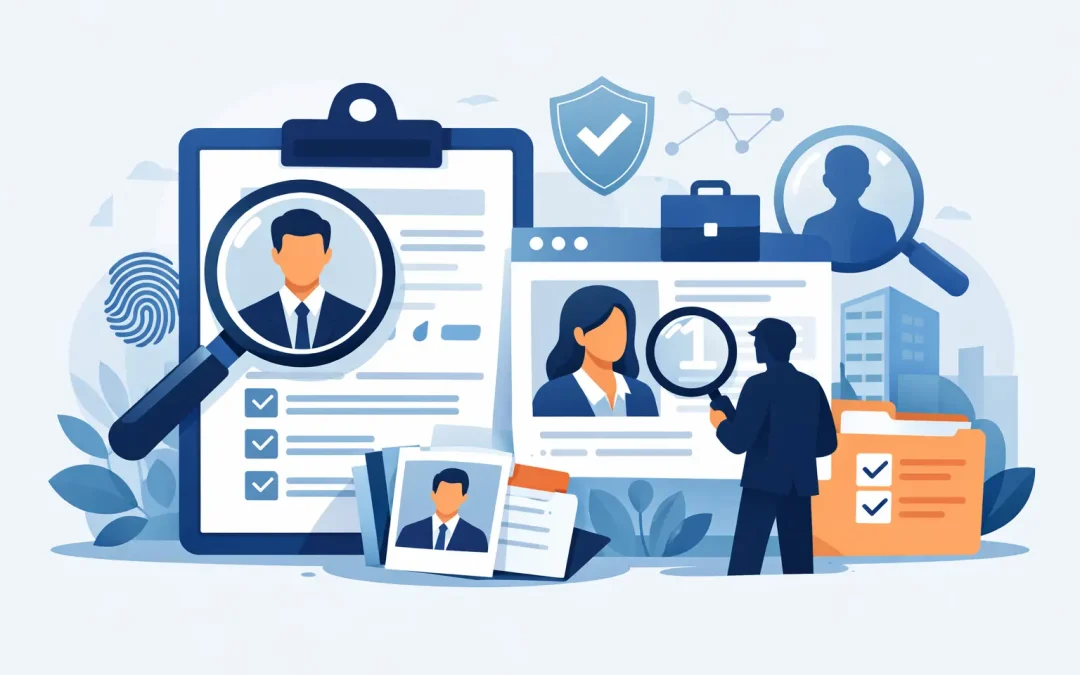
A resume can look polished, a reference can sound confident, and an interview can go exactly as planned. None of that answers the real question facing a serious employer – who are you actually bringing into the organization, and what risk follows that decision? Pre employment screening investigations exist to answer that question before a badge is issued, systems are opened, clients are exposed, or an executive team is put at avoidable risk.
For organizations operating in regulated sectors, high-visibility environments, or internationally exposed roles, screening is not an administrative checkbox. It is a risk control measure. The quality of that measure depends on how well the investigation is scoped, how lawfully it is conducted, and whether the findings are interpreted with discipline rather than guesswork.
What pre employment screening investigations are really for
At a basic level, pre employment screening investigations verify that a candidate is who they claim to be and that material representations are accurate. In practice, the purpose is broader. A proper investigation helps an employer assess integrity, patterns of conduct, reputational exposure, possible conflicts, and indicators that the individual may not be suitable for a role with access, authority, money, information, or vulnerable populations.
That distinction matters. A hiring decision is rarely about one isolated fact. It is about context. An undisclosed termination may mean one thing in a junior role and something very different in a position handling fiduciary responsibility, executive travel, sensitive facilities, or strategic relationships. The same is true of litigation history, license irregularities, identity discrepancies, and public records that suggest instability or deception.
For this reason, stronger screening programs are role-specific. A finance hire, a senior executive, an overseas contractor, and a family office employee should not all be screened at the same depth. The risk profile is different, and the investigation should reflect that reality.
The core components of pre employment screening investigations
Most screening assignments begin with identity and credential verification. That includes confirming legal identity, address history, education, employment chronology, and any professional licenses or certifications relevant to the role. This sounds straightforward, but errors and false claims are common enough that experienced investigators treat every record as something to be verified, not assumed.
Criminal history review is another common component, but it should never be treated as a simple database pull followed by a fast judgment. Names can be shared, records can be outdated, dispositions can be missing, and legal use restrictions vary by jurisdiction. A credible investigative process looks at the underlying record, confirms the match, and considers how any result relates to the actual duties of the position.
Civil litigation, regulatory actions, sanctions exposure, adverse media, and reputation checks can become equally important in senior or externally visible roles. A candidate may have no criminal record and still represent a serious hiring risk because of repeated fraud allegations, undisclosed financial distress, public misconduct, conflict-of-interest concerns, or a pattern of failed fiduciary conduct.
In some assignments, social media and open-source review also play a role. This must be handled carefully. The goal is not casual browsing or subjective moral filtering. The goal is to identify credible indicators of threats, harassment, extremist affiliations, targeted hostility, confidential information misuse, or conduct that directly conflicts with the responsibilities of the role.
Why standard screening often falls short
Many employers rely on high-volume vendors that deliver fast, standardized reports. There is a place for that in low-risk hiring environments. There is far less margin for error when the role involves access to executives, children, secure facilities, donor networks, trade secrets, public trust, or overseas operations.
The weakness in commodity screening is not always bad intent. It is often lack of depth. A report may show what a database contains, but not what an investigator can clarify. It may miss records outside standard coverage areas. It may fail to resolve inconsistencies between disclosed and actual employment history. It may not identify the significance of a pattern that only becomes visible when public records, reference development, open-source intelligence, and contextual analysis are brought together.
That is where bespoke investigative work becomes necessary. A serious screening inquiry is not built around volume. It is built around exposure. If a bad hire could create security, legal, reputational, or operational damage, the screening process must be designed accordingly.
When deeper investigation is justified
Not every hire warrants an extensive investigation. Over-screening can waste time, create legal issues, and send the wrong cultural message. The better approach is proportionality.
A deeper pre employment screening investigation is often justified for executive appointments, board-facing personnel, security-sensitive roles, family office staff, international hires, employees with access to protected data, and personnel working in crisis-prone or politically unstable regions. It is also justified when the hiring process has already surfaced unexplained gaps, conflicting versions of prior employment, unusual reference behavior, identity concerns, or signs of reputational sensitivity.
In these situations, the question is not whether an employer should know more. The question is whether the employer can afford not to.
Legal discipline matters as much as investigative skill
A screening investigation that produces useful facts but ignores legal boundaries creates a second problem while trying to solve the first. Employers and investigative partners must work within applicable federal, state, and local laws governing consent, disclosure, fair use of background information, and adverse action procedures.
There is also the issue of relevance. Not every negative fact should carry weight. Arrests without disposition, stale allegations, protected characteristics, and information unrelated to the role can distort decision-making and expose the employer to challenge. Experienced investigators understand that factual reporting must be accurate, targeted, and professionally restrained.
This is one of the clearest differences between disciplined investigative work and informal vetting. The former is structured, documented, and lawful. The latter is often inconsistent, subjective, and risky.
What sophisticated clients look for in a screening partner
Organizations with meaningful exposure do not just ask what records can be searched. They ask how the inquiry is built, who is doing the work, how findings are verified, and whether the firm understands both reputational risk and operational realities.
That is particularly true in cross-border matters. International candidates, expatriate assignments, overseas vendors, and NGO or corporate personnel deployed abroad present challenges that automated systems rarely solve. Records may be fragmented, inaccessible, or culturally inconsistent. The practical answer often requires local knowledge, source validation, language capability, and disciplined HUMINT-informed fieldwork.
This is why high-consequence clients often favor firms with investigative depth rather than screening volume. West Coast Detectives International operates in that higher-trust category, where discretion, factual reporting, and mission-focused due diligence matter more than mass processing speed.
How employers should use the results
The value of pre employment screening investigations is not in collecting the maximum amount of information. It is in making a sound decision with the right amount of verified intelligence.
Sometimes the outcome is clear. A false identity claim, fabricated degree, undisclosed sanctions issue, or serious record tied directly to job duties may end the process. More often, the result requires judgment. A candidate may have an explainable gap, resolved litigation, or dated conduct that does not meaningfully affect present suitability. The point is not to eliminate every imperfect applicant. It is to identify unacceptable risk and avoid preventable surprise.
That requires mature internal handling. Findings should be reviewed by the right decision-makers, measured against the role, and weighed consistently. Employers that react emotionally to isolated information often make poor calls. Employers that ignore pattern evidence do the same.
Pre employment screening investigations as a prevention strategy
The cost of a weak hiring decision is rarely limited to payroll. In the wrong role, one bad hire can trigger data loss, workplace violence concerns, client distrust, regulatory scrutiny, insider theft, brand damage, or long-term litigation. When the individual has direct proximity to principals, executives, family members, or sensitive operations, the consequences can escalate quickly.
That is why screening should be viewed as part of a broader prevention posture. It sits alongside access control, insider threat awareness, travel risk planning, executive protection, and due diligence. Each function serves the same strategic purpose – reducing uncertainty before it becomes a problem.
The strongest organizations understand this instinctively. They do not treat screening as suspicion. They treat it as stewardship. If a role carries trust, the process for granting that trust should be worthy of the risk.
A careful hiring decision will not remove every future problem. People change, circumstances shift, and no process is perfect. But disciplined pre employment screening investigations narrow the field of unknowns, expose avoidable hazards, and give employers something far more valuable than speed: a reasoned basis for trust.
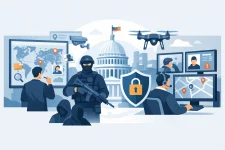
by plittle@westcoastdetectives.us | May 20, 2026 | Blog, Current Terrorist Alerts, Phil Little Reports, Terrorism Update
International travel offers enriching experiences, but as Americans, we must navigate a world where terrorist threats persist. Groups like ISIS affiliates, al-Qaeda, and Iran-linked proxies continue to target Western interests, often focusing on “soft targets” such as tourist sites, transportation hubs, markets, hotels, and events. While the overall risk to any individual traveler remains low, vigilance and preparation are essential—especially with recent global alerts.
Understand the Current Threat Landscape (as of 2026)
The U.S. Department of State issued a Worldwide Caution in March 2026, urging increased vigilance everywhere, with heightened concern in the Middle East. Iran-backed groups may target U.S. interests, diplomatic facilities, or Americans abroad in retaliation for ongoing conflicts. Terrorists often strike with little or no warning in crowded public spaces.
Terrorism remains concentrated in specific regions:
- Sahel region (Burkina Faso, Mali, Niger) and parts of sub-Saharan Africa: High activity from groups like JNIM and ISIS affiliates.
- Middle East (Iran, Iraq, Lebanon, Syria, Yemen): Elevated risks from state-linked actors and militants.
- South Asia (Pakistan, Afghanistan): Significant incidents.
- Other hotspots: Somalia, Libya, parts of Russia, North Korea, Haiti, and more.
The State Department maintains a Level 4: Do Not Travel list for about 18 countries due to terrorism, crime, unrest, kidnapping, and other risks. Popular destinations in Europe, Asia, and Latin America are often at Level 1 or 2 but still carry general threats.
Core Principles for Safe Travel
- Research and Heed Official Advisories Before booking, check the U.S. State Department Travel Advisories for your destination. Levels range from:
- Level 1: Normal precautions.
- Level 2: Increased caution.
- Level 3: Reconsider travel.
- Level 4: Do not travel. Review specific risks (terrorism “T”, crime “C”, unrest “U”, etc.). Re-check closer to departure, as situations evolve quickly.
- Enroll in the Smart Traveler Enrollment Program (STEP) Register your trip at step.state.gov. This allows U.S. embassies to contact you with alerts, locate you in emergencies, and provide assistance. It’s free and highly recommended.
- Plan with Security in Mind
- Avoid high-risk areas: Steer clear of Level 4 countries and conflict zones. In safer places, skip border regions or known hotspots.
- Buy comprehensive travel insurance: Ensure it covers medical evacuation, trip cancellation, and terrorism-related disruptions.
- Share your itinerary: Let trusted contacts know your plans, and use apps for real-time location sharing.
- Prepare documents: Carry digital and physical copies of your passport, visas, and emergency contacts. Consider a second passport or extra ID if needed.
On-the-Ground Best Practices
Situational Awareness is your strongest defense:
- Stay alert in crowds, tourist sites, transportation (airports, trains, subways), markets, hotels, and events—these are common targets.
- Trust your instincts: If something feels off (unattended bags, agitated individuals), leave the area.
- Avoid predictable routines. Vary your schedule and routes.
- Monitor local news and embassy alerts via apps or radio.
- Blend in: Dress conservatively, avoid flashy American-branded clothing or overt displays of wealth/U.S. symbols in sensitive areas.
- Transportation: Use reputable services; avoid unofficial taxis or hitchhiking. In some regions, consider private drivers or rideshares with good reviews.
In Case of an Incident:
- Evacuate the area quickly if safe; seek shelter otherwise.
- Follow instructions from local authorities or U.S. embassy.
- Have emergency apps (e.g., Red Cross, embassy apps) and know local equivalents of 911.
- For medical or security help abroad, contact the nearest U.S. embassy/consulate.
Balancing Risk and Reward
Terrorism is a real but statistically rare threat for tourists compared to everyday risks like traffic accidents or petty crime. Millions of Americans travel internationally each year without issue. Focus on high-value, lower-risk destinations (e.g., much of Europe, Japan, Australia, parts of Southeast Asia at Level 1-2). Domestic travel or “staycations” in the U.S. remain viable alternatives during heightened alerts.
Key Mindset: Informed caution, not fear. Preparation empowers you to enjoy travel responsibly. The world is vast and wonderful—approach it with eyes open, tools in hand, and respect for local contexts.
For the latest, always prioritize official U.S. government sources over social media or news hype. Safe travels! If tensions escalate (e.g., further Middle East developments), reassess plans promptly.
FOR A PERSONALIZED TRAVEL PLAN CONTACT US AT Plittle@westcoastdetectives.us or at 818-262-1312.
Page 11 of 13« First«...910111213»