
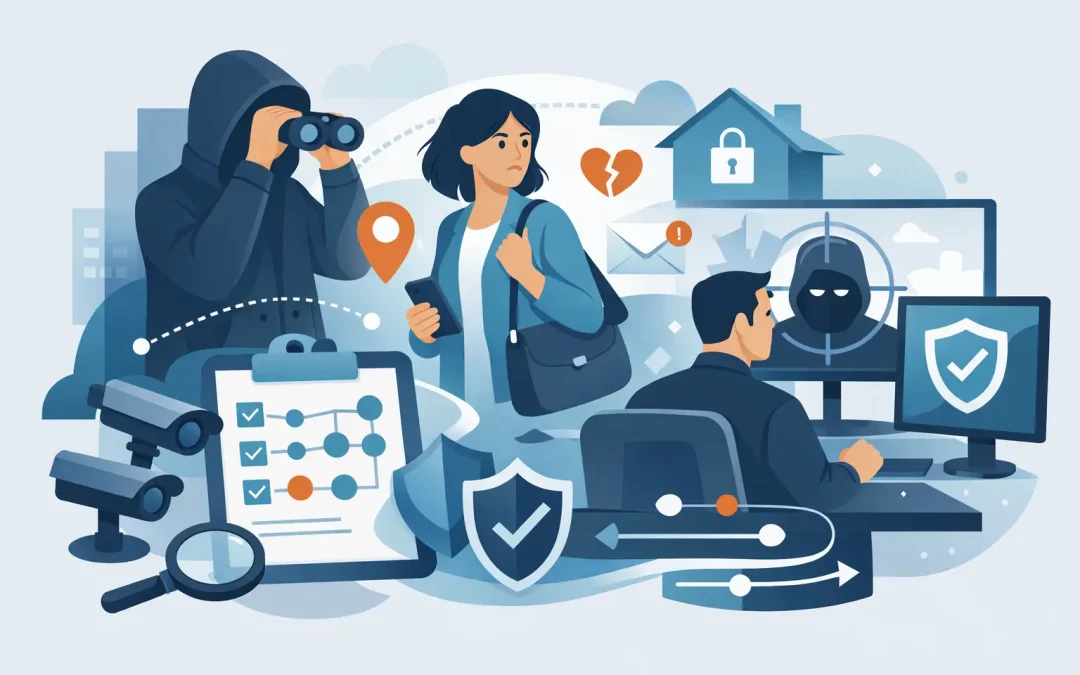
A stalking case rarely stays confined to unwanted messages. It tends to evolve through fixation, testing of boundaries, surveillance, public embarrassment, workplace intrusion, approach behavior, and sometimes direct violence. That is why a stalking threat management plan must be built early, before the subject closes distance, exploits routine, or finds gaps between legal, security, and personal responses.
For executives, public-facing professionals, legal parties, and high-profile families, the mistake is often assuming stalking is simply a police matter or a nuisance issue. In practice, it is a threat management issue. The central question is not whether conduct feels disturbing. The central question is whether the behavior shows persistence, escalation, access, grievance, fantasy attachment, or operational planning that could place the target at risk.
What a stalking threat management plan is designed to do
A stalking threat management plan is a structured framework for reducing vulnerability while improving visibility into the offender’s behavior, capability, and intent. It is not just a file of screenshots or a request for more patrols. A sound plan aligns investigation, protection, documentation, internal reporting, legal strategy, and daily life adjustments so the target is not forced to improvise under pressure.
The most effective plans do two things at once. They lower immediate exposure, and they create an intelligence picture that supports better decisions over time. That distinction matters because some responses provide short-term comfort while making the case harder to assess later. Others generate valuable evidence but leave the target too exposed in the meantime. Good threat management balances both.
Why stalking cases are often mishandled
Stalking is frequently underestimated because individual incidents can look minor when viewed in isolation. A delivery left at a gate, a social media post, a drive-by, a call from a blocked number, a chance appearance at a conference – each event may appear explainable on its own. The threat emerges in the pattern.
Another problem is fragmentation. Human resources may see workplace harassment. Counsel may see a restraining order issue. Local security may focus on a gate or lobby. Family members may respond emotionally and independently. Without a single operational plan, the stalker benefits from the gaps.
This is also where high-profile and corporate cases become more complicated. Public visibility, published schedules, investor events, court appearances, media coverage, and online biographies can all hand the offender an intelligence package. The target may also have staff, multiple residences, assistants, drivers, and children, which expands the attack surface considerably.
Core elements of a stalking threat management plan
Every credible stalking threat management plan begins with case assessment. The behavior must be analyzed as a pattern, not a string of annoyances. That includes frequency, duration, trigger events, communications, physical sightings, known grievances, mental health indicators when available, access to weapons, travel behavior, and any effort to obtain personal information, employment details, family names, or location data.
The next element is target hardening, but not in the simplistic sense. Security upgrades should reflect how the subject is operating. If the stalker relies on digital monitoring, the answer is not merely more cameras. If the offender tests physical access points, the answer is not limited to blocking them online. Protective measures must match the method of approach.
Documentation is equally critical. Evidence must be preserved in a way that supports investigation and legal action, but also internal analysis. Dates, times, screenshots, vehicle details, witness names, package labels, voicemails, images, and location patterns should be centralized. Casual recordkeeping often weakens a case because details get lost, devices are changed, or staff fail to report low-level incidents they assume are unimportant.
Communication control is another essential component. One person or team must manage responses. Mixed messages, emotional replies, staff improvisation, or inconsistent enforcement can encourage continued contact. In many cases, no contact is preferable, but not always. There are circumstances where carefully controlled communication serves an evidentiary or de-escalation purpose. That decision should be deliberate, not reactive.
The assessment phase: what professionals look for
Not every stalker presents the same level or type of risk. Some are intimacy seekers driven by delusion or fantasy. Some are grievance-based and angry. Some are former partners. Some are predatory and use stalking as part of preparation for assault, abduction, or sexual violence. A plan that treats all of these profiles the same is unlikely to hold.
Professionals assess motivation, stressors, loss events, humiliation, fixation intensity, leakage, and adaptability. They also look at whether the subject is deterred by consequences or fueled by them. A restraining order can be necessary and effective in one case, yet provocative in another. Public exposure may shut down one offender and inflame another. There is no serious threat management practice that operates on slogans.
Timing also matters. A subject who has recently lost a job, relationship, status position, immigration pathway, or legal contest may move from messaging to action more quickly than before. Likewise, a target who is about to appear in court, attend a public gala, announce a merger, or travel internationally may face a higher short-term exposure window.
Protective measures that actually reduce risk
The practical side of a stalking threat management plan should feel disciplined, not theatrical. Residence security, route variation, visitor screening, secure transportation, staff briefing, school coordination, event entry control, and workplace reception procedures all have a place when the facts support them. The aim is to reduce predictability and deny easy access.
Digital hygiene often deserves just as much attention as physical security. Stalkers routinely exploit social media posts, metadata, people-finder sites, old press releases, staff biographies, and family accounts. An executive may maintain strict personal discipline while a friend, assistant, or teenager in the household reveals travel, routines, or location clues without realizing it.
There is a trade-off here. Overcorrecting can damage normal life and increase stress to the point that the target feels imprisoned by the response. Under-correcting gives the offender room to experiment. The right balance depends on current behavior, capability, and proximity. Temporary intensive measures are often appropriate during periods of escalation, followed by a more sustainable long-term posture.
Legal action, investigation, and intelligence must work together
One of the most common failures in stalking cases is assuming that a legal filing by itself solves the security problem. Legal remedies matter. They establish boundaries, create consequences, and can support arrest or enhanced enforcement. But legal process is only one lane.
An investigation may identify alias accounts, travel habits, supportive associates, prior incidents, employment details, or physical surveillance patterns that change the entire protective picture. Intelligence work can reveal whether the subject is merely obsessive, actively planning contact, or attempting to recruit information from third parties. Security teams, counsel, family office personnel, and executives should be operating from the same factual brief.
This is where an experienced, discreet investigative and protective team becomes valuable. Firms such as West Coast Detectives International approach stalking as a combined intelligence and protection assignment rather than a one-dimensional complaint file. That distinction is often what allows a case to move from reactive frustration to controlled risk management.
When a stalking threat management plan needs immediate escalation
Some indicators justify rapid strengthening of the plan. The subject appears in person after a long online-only pattern. They approach children, partners, domestic staff, or coworkers. They reference private schedules or nonpublic locations. They show weapon interest, make veiled threats, bypass prior barriers, or accelerate after legal notice.
Escalation is also warranted when the target is entering a period of unusual exposure, such as litigation, media coverage, major travel, leadership transition, termination of an employee, or release of a public statement tied to controversy. In those moments, an offender may interpret visibility as opportunity.
The right response may include temporary close protection, enhanced residential coverage, travel adjustments, expanded monitoring, and a tighter reporting chain. It may also require quiet changes rather than visible ones. Some subjects are deterred by obvious security presence. Others use it as proof of significance and become more determined.
The discipline that makes plans work
A stalking threat management plan fails when it becomes a binder instead of a living process. Cases change. Subjects adapt. New information arrives. Fatigue sets in. Staff rotate. Family members loosen discipline. The plan must be reviewed and updated as behavior shifts.
The most effective posture is calm, factual, and consistent. Panic clouds judgment, but complacency is just as dangerous. The target should not be asked to carry the burden alone, and the response should not depend on whoever happens to answer the phone that day.
Stalking is personal for the victim, but it must be managed professionally. When the response is intelligence-led, well-coordinated, and proportionate to the facts, control begins to move back where it belongs – away from the offender and back to the protected individual. That is the point of the plan, and it is also the standard serious clients should expect.
