
My interest in understanding the sources and root causes of terrorism began in the mid-1970s, when I was on the ground studying intelligence reports coming out of terrorist training camps in Southern Lebanon. During those years, I came to recognize that the terrorism emanating from Southern Lebanon into Israel was not an isolated regional conflict — it was a precursor of what would eventually spread to the rest of the world, including the United States.
In the early 1980s, I began speaking to hundreds of organizations — both NGOs and government agencies — urging them to take the emerging threat seriously and to adopt preventive measures before it was too late. Sadly, most of those warnings went unheeded. As a result, we left ourselves vulnerable, creating soft targets where terrorism was able to take root.
Today, we still face emerging threats that have the potential to be far more devastating than anything we have experienced in the past. The dangers are real. Instead of burying our heads in the sand and hoping the problem goes away or strikes somewhere else, we must learn from our past mistakes and commit to far stronger preventive action.
This is not a scare tactic — it is a call to action for all freedom-loving Americans. We must stand up and speak out, beginning in our own local communities. Please help spread this message by sharing it widely. Let it be our collective gift as we approach America’s 250th birthday. My informed thoughts following.
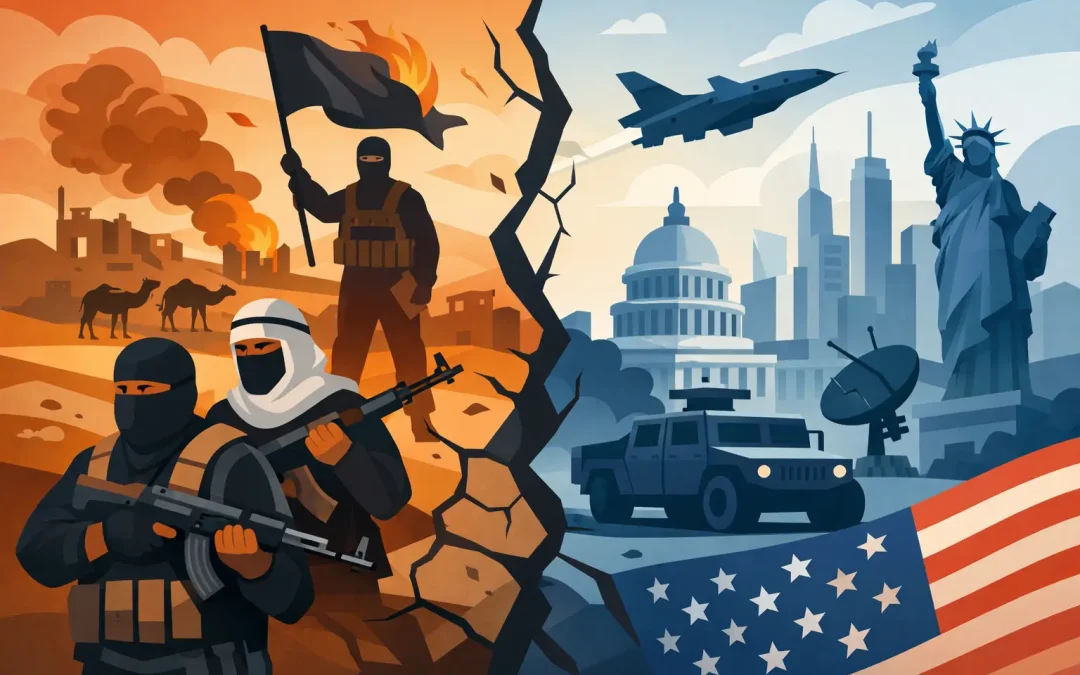
The question is not whether jihadist terrorism has disappeared from the American threat picture. It has not. The real question is how the ISIS & al Qaeda threat to America in 2026 is evolving – and whether decision-makers are looking in the right places.
For government offices, corporate security teams, NGOs, and high-profile travelers, the risk is less about a repeat of 2001 in identical form and more about adaptive, decentralized, lower-signature operations. That distinction matters. A threat does not need to be spectacular to be operationally serious. It only needs intent, enough capability, and a vulnerable target set.
What the ISIS & al Qaeda threat to America in 2026 really looks like
By 2026, both ISIS and al Qaeda remain dangerous, but in different ways. ISIS has shown a greater ability to inspire fast-moving, media-conscious violence through online propaganda, remote facilitation, and calls for opportunistic attacks. Al Qaeda, by contrast, traditionally places greater value on patience, ideological framing, and longer-horizon plotting. Those differences shape the threat environment inside the United States.
ISIS-linked violence often emerges through self-radicalized or loosely enabled actors who require limited tradecraft. Knives, firearms, vehicles, and improvised methods still matter because they are accessible, hard to preempt at scale, and effective against soft targets. Al Qaeda’s model is usually less impulsive. Even when direct command-and-control is degraded, the organization and its affiliates continue to frame the United States as a legitimate target and encourage followers to exploit openings over time.
Neither network should be assessed only by the territory it controls. That was a common analytical error in earlier years. Safe haven matters, but ideology, encrypted communication, prison radicalization, diaspora connections, regional affiliates, and digital propaganda pipelines can preserve operational relevance even when central leadership is under pressure.
Why the threat persists even after years of disruption
A mature threat assessment begins with a simple reality: counterterrorism pressure can reduce capacity without eliminating intent. Drone strikes, arrests, sanctions, watchlisting, and border screening have constrained both groups. They have not ended the movement.
ISIS and al Qaeda survive because they are not just organizations. They function as brands, narratives, and ecosystems. Affiliates in Africa, the Middle East, and parts of Asia can keep the broader movement alive, produce propaganda, build battlefield credibility, and feed a transnational grievance story that resonates online. A lone actor in the United States may never meet a foreign operative in person and still act in service of that ecosystem.
That is one reason broad claims that the threat is “over” are professionally unsound. Threat conditions change. They do not simply vanish because media attention moves elsewhere.
Key drivers of the 2026 risk picture
The most serious driver is the convergence of online radicalization and low-barrier attack methodology. An individual does not need advanced explosives training or overseas travel to become dangerous. He may only need ideological motivation, a target, and enough privacy to prepare.
The second driver is global instability. Conflict zones, weak states, prison breaks, refugee flows, and ungoverned spaces can all give jihadist actors room to recruit, regroup, and project influence. When regional branches gain momentum abroad, their propaganda value increases at home. Success in one theater can energize supporters elsewhere.
A third driver is the strain on intelligence and law enforcement resources. The United States now faces a crowded threat landscape that includes foreign terrorism, domestic violent extremism, cybercrime, hostile state activity, transnational organized crime, and targeted violence. When attention is divided, warning signs can be missed.
There is also a trade-off that serious clients should understand. The more diffuse the threat becomes, the harder it is to detect using traditional indicators. Large conspiracies are vulnerable to interception. Small, self-directed attack planning is often less visible until late in the cycle.
Soft targets remain the most credible concern
For most American organizations, the practical risk is not a complex aviation plot. It is a lower-cost attack against an accessible venue. Public gatherings, religious institutions, retail locations, transportation nodes, hotels, schools, entertainment venues, and symbolic corporate sites remain attractive because they offer visibility and relatively open access.
This is especially relevant for executives, public-facing brands, NGOs operating in contentious environments, and institutions that may become symbolic targets for ideological reasons rather than personal ones. The target is often chosen for meaning, convenience, or media effect – not because it is the highest-value site on paper.
That has implications for private-sector security. An organization can have excellent headquarters controls and still remain exposed through executive travel, conference appearances, charity events, satellite offices, and routine employee movement.
The online battlefield is still producing real-world violence
The ISIS & al Qaeda threat to America in 2026 cannot be assessed without looking carefully at digital ecosystems. Radicalization rarely happens in a neat sequence. It can unfold across mainstream platforms, encrypted messaging apps, fringe forums, gaming channels, and private peer networks.
What matters operationally is not only extremist content itself, but acceleration. Who is moving from rhetoric to fixation? Who is conducting surveillance, discussing weapons acquisition, consuming martyrdom material, or signaling timeline urgency? Those are very different indicators from ideological noise.
This is where many organizations make a costly mistake. They treat online extremism as a public affairs problem rather than a protective intelligence problem. For high-profile individuals and exposed institutions, that is the wrong frame. When threat language intersects with doxing, grievance behavior, unstable mental state, or travel visibility, the risk profile changes fast.
What this means for corporations, NGOs, and high-profile individuals
A credible threat posture in 2026 requires more than generic security. It requires advance work. Protective intelligence, travel risk review, route analysis, event screening, social media exposure assessment, and local-source reporting all matter more when the threat actor may be unknown until late in the cycle.
For multinational firms and NGOs, overseas exposure can also create domestic consequences. An American executive associated with controversial operations, regional disputes, sanctions environments, or ideological narratives may draw attention both abroad and at home. Threats are no longer neatly separated by geography.
For prominent individuals, family offices, legal teams, and entertainment figures, the concern is often reputational visibility combined with accessible routines. Public schedules, predictable habits, loosely managed event entry, and online oversharing create opportunity. Terrorism risk may not be the only concern in those cases, but it must sit inside the broader threat matrix.
Where assessments often go wrong
The first error is overcorrection. After periods of intense focus on domestic extremism or geopolitical rivalry, some stakeholders underweight jihadist threats because they are no longer the headline story. That is not analysis. It is attention drift.
The second error is assuming that lack of central direction means lack of danger. Decentralized actors are harder to map and can still produce casualties, disruption, and strategic fear.
The third is relying on static security plans. Threats change faster than annual policy reviews. A plan built for theft, protest, or workplace violence may not adequately address ideologically motivated surveillance, hostile approach, or attack behavior at public-facing events.
This is where experienced intelligence support becomes valuable. Firms such as West Coast Detectives International operate in the space between raw concern and operational clarity, helping clients understand what is noise, what is escalation, and what requires immediate protection measures.
A disciplined approach to 2026 preparedness
Preparedness does not require panic. It requires disciplined realism. Organizations should review soft-target vulnerabilities, validate incident response protocols, tighten visitor and event screening where appropriate, and ensure that travel and executive protection planning reflects current threat intelligence rather than outdated assumptions.
They should also build reporting pathways that encourage early escalation of suspicious behavior. Many attacks are preceded by fragments of warning that look minor in isolation. A hostile message, odd surveillance, fixation on access points, repeated presence near a principal, or unusual online chatter may not trigger alarm independently. Together, they can.
Finally, leaders should resist binary thinking. The threat is neither omnipresent nor negligible. It is episodic, adaptive, and heavily dependent on exposure, symbolism, location, and timing. That means the right question is not whether America faces risk from ISIS and al Qaeda in 2026. It does. The better question is whether your organization has the intelligence discipline to recognize when general risk becomes a specific problem.
