
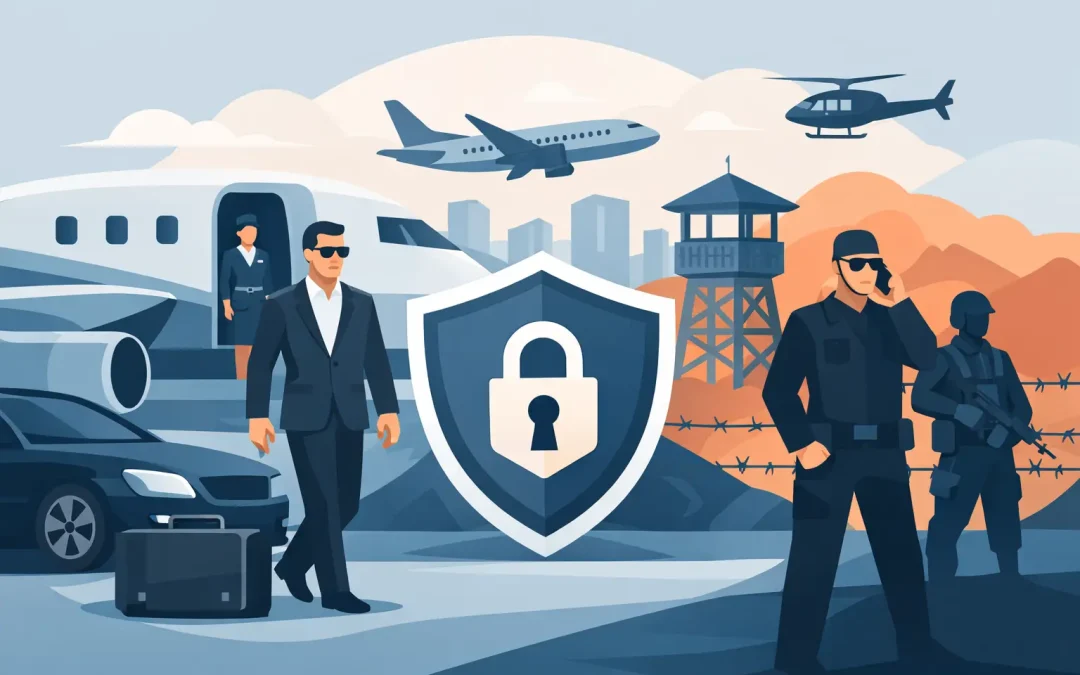
A principal does not become vulnerable only when a threat is visible. Exposure often begins earlier: a publicly shared itinerary, a predictable transfer route, an unvetted driver, an avoidable social-media post, or a meeting location selected for convenience rather than control. This VIP travel security guide is designed for executives, public figures, legal stakeholders, and families whose travel creates a higher-than-normal security, reputational, or operational profile.
The objective is not to turn every trip into a security operation. It is to apply proportionate protection based on credible facts. A board meeting in a stable financial center requires a different posture than a site visit near civil unrest, a high-profile appearance, or travel through an area with kidnapping, terrorism, stalking, or hostile-surveillance concerns.
Begin With a Threat-Led Travel Assessment
Effective protection starts before reservations are finalized. A travel assessment should establish who may pose a risk, what they could realistically do, where exposure is most likely to occur, and what consequences would follow. The answer is rarely found in a generic country-risk rating alone.
A senior executive may face activist attention tied to a corporate transaction. An entertainment figure may have a persistent stalker whose travel patterns are known. A witness, litigant, or family office principal may attract targeted scrutiny because of a dispute, wealth profile, or public association. Each circumstance changes the protective plan.
The assessment should account for the destination’s political climate, crime patterns, terrorism indicators, emergency medical capacity, transportation reliability, local law-enforcement capability, and communications environment. It should also examine the principal’s visibility, travel companions, public schedule, personal habits, and digital footprint. A city can be broadly safe while a specific hotel, district, venue, or ground route presents an unacceptable exposure.
Intelligence Must Be Current, Not Decorative
Country briefings and travel alerts are useful starting points, but they do not replace local verification. Conditions can shift rapidly after a demonstration, arrest, border closure, weather event, labor action, or credible threat report. For elevated travel, intelligence should be current enough to affect decisions about arrival times, routes, venues, and protective staffing.
Human-source reporting has particular value when official information is delayed, incomplete, or shaped by political considerations. The most useful intelligence is actionable: whether a road is operating, whether a venue can be secured, whether a public event is likely to draw confrontation, and which local resources can be trusted if plans change.
Secure the Itinerary Before It Becomes Public
Most protective failures are not dramatic. They are administrative. Too many people receive the full itinerary, travel details are forwarded through unsecured channels, and schedule changes are announced casually. That creates an unnecessary map of a principal’s movements.
Distribute information on a need-to-know basis. The executive assistant may require the full schedule; a meeting host may only need an arrival window. Drivers, hotel personnel, event organizers, and local partners should receive only the details necessary to perform their role. Use verified contact methods and establish a process for confirming last-minute changes, especially changes involving airport pickup, accommodations, or meeting locations.
Avoid publishing travel in real time. This applies to principals, family members, assistants, and corporate communications teams. A photograph from an airport lounge can reveal a terminal, travel direction, companion, and approximate timeline. A location-tagged image from a hotel can compromise the remainder of the trip.
It is also wise to maintain flexibility. Reserve alternate flights where the risk justifies it, identify a secondary hotel, and avoid schedules so rigid that the principal must travel at known times along known routes. Flexibility is not waste. It is an operational option when intelligence changes.
Protect the Most Exposed Moments of Travel
Airports, curbside areas, hotel entrances, conferences, restaurants, and vehicle transfers are predictable points of exposure. They bring together crowds, congestion, cameras, and limited control over the surrounding environment. A sound plan gives these transitions more attention than the time spent inside a secure office.
Airport movement should be coordinated in advance, with verified transportation and a clear handoff between responsible parties. The principal should not be left searching for a driver, negotiating transportation at the curb, or communicating travel details to unknown intermediaries. Where available and appropriate, private aviation facilities, meet-and-assist arrangements, or controlled arrival procedures can reduce exposure. They are not always necessary, and their value depends on the destination and threat profile.
Ground transportation deserves equal scrutiny. Use professionally vetted drivers and vehicles, confirm identities through a separate channel, and avoid displaying the principal’s name on signage. Route selection should consider traffic, chokepoints, civil disturbances, crime concentrations, construction, and the availability of alternate exits. The shortest route is not always the safest route.
At hotels, select properties based on more than brand reputation. Review perimeter access, lobby control, elevator procedures, room-floor layout, emergency exits, medical support, and the ability to discreetly manage arrivals. A room should not be selected solely for its view or convenience. Consider its access points, proximity to stairwells, adjoining rooms, and distance from public gathering areas.
Build a Protective Detail Around the Actual Risk
Executive protection is not a uniformed presence standing nearby. At its best, it is advance work, observation, communications discipline, protective movement, and rapid judgment delivered without disrupting the principal’s purpose for traveling.
The appropriate posture may range from a discreet advance and secure transportation plan to a close-protection team supported by local intelligence and a protective operations center. A public keynote, contentious negotiation, politically sensitive visit, or travel with family members may justify a larger footprint. A routine business trip in a low-risk environment may require only vetted logistics, monitoring, and an emergency-response protocol.
The trade-off is clear. Too little protection leaves predictable gaps. Too much visible security can draw attention, impede business, or create friction in environments where discretion matters. The correct solution is tailored, not standardized.
Protective personnel should be selected for judgment as much as physical capability. They need the ability to recognize hostile surveillance, manage crowds without escalation, coordinate with local authorities when necessary, and make decisions that preserve both safety and dignity. In international settings, language ability, cultural fluency, and trusted in-country relationships are often decisive.
Establish Communications and Medical Contingencies
A traveler can have excellent transportation and security coverage yet still be exposed if nobody knows how to respond when communications fail. Before departure, establish primary and backup contact methods, check-in expectations, escalation thresholds, and a 24-hour point of contact authorized to make decisions.
Devices should be protected with strong access controls, current software, and an agreed response if a phone or laptop is lost, searched, or compromised. For sensitive travel, a clean device with only necessary data may be more prudent than carrying a principal’s full corporate or personal digital life across a border.
Medical planning should be specific. Confirm the nearest capable hospitals, identify relevant allergies and medications, carry required documentation, and understand evacuation options. In some regions, the appropriate response to a serious medical event is stabilization followed by transfer, not reliance on the nearest facility. The same principle applies to security incidents: know where the principal can go, who can assist, and who has authority to authorize movement.
A VIP Travel Security Guide Requires Rehearsal
A plan that exists only in a briefing document will fail under pressure. Key participants should understand their responsibilities before wheels-up: who verifies transportation, who monitors developments, who communicates with the principal, and who activates emergency support.
Rehearsal does not need to be theatrical. A short pre-departure discussion can test the essentials. What happens if the driver does not arrive? If a protest blocks the route? If a family member becomes separated? If the principal receives a threatening message? If an event is canceled and the crowd does not disperse?
For high-consequence travel, a professional security partner can integrate intelligence, advance work, vetted local assets, and protective coverage into one accountable plan. West Coast Detectives International approaches these assignments as a prevention mission, combining factual reporting with field-ready protective judgment.
The best travel security is often invisible. It gives the principal room to conduct business, meet people, and move with confidence because the team has already identified the pressure points, preserved alternatives, and prepared for the moment when an ordinary itinerary stops being ordinary.
