
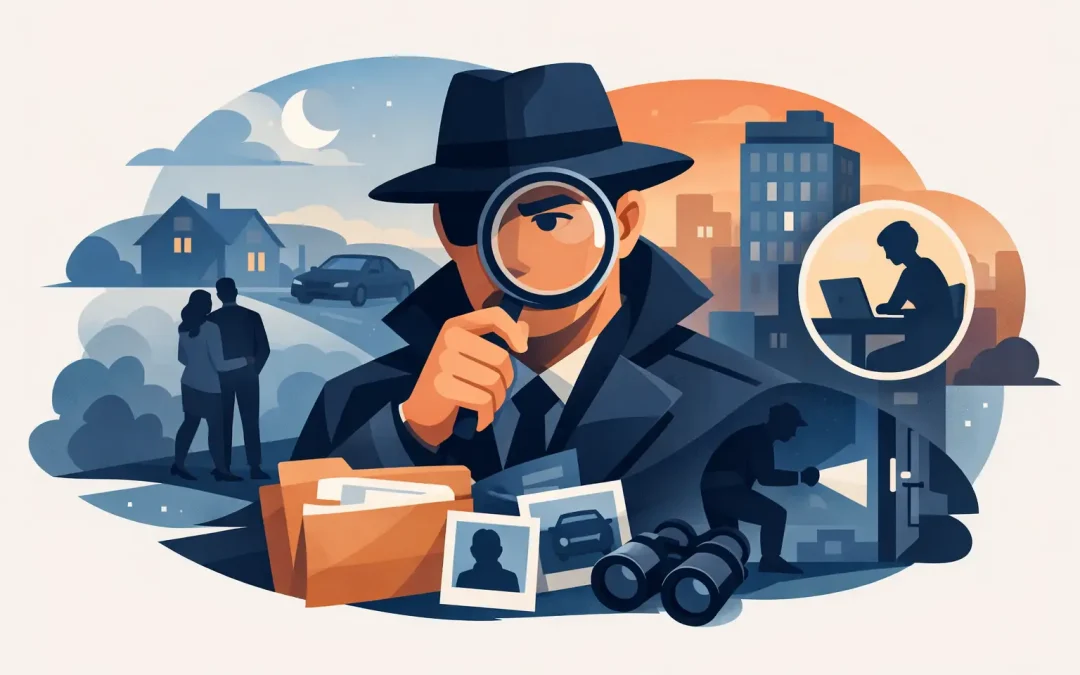
Why and When to Hire a Private Investigator – Act FAST Before Problems Explode!
At West Coast Detectives International, I hear it all the time: “I wish I’d called you a year ago!”
Business losses piling up. Suspicious activity at home. A partner acting strange. An employee you just can’t trust.
Millions of people right now are sitting on problems, hoping they’ll magically disappear. But here’s the truth: delaying only makes it worse — and way more expensive!
Human nature wants to wait and “see what happens.” Don’t do it. The longer you wait, the harder and costlier it becomes for even the best investigators to get results.
Time is not on your side.
I also hear the horror stories: people who hired a PI, dropped a big retainer, and then couldn’t get calls returned or solid results. That’s why you’ve got to choose wisely and quickly.
At West Coast Detectives International, our 104-year legacy proves we treat every case — big or small — with total urgency, rock-solid integrity, and relentless communication. We don’t just take your money and disappear. We deliver facts, real solutions, and peace of mind.
Bottom line: If something feels off in your business, your home, or your life — don’t wait. The right private investigator can save you time, money, and massive stress.
Following are key things to consider when hiring a private investigator — so you pick a proven winner the first time!
A threat does not become less serious because it is inconvenient to discuss. A partner’s unexplained financial activity, a hostile former associate, a disputed corporate relationship, or a questionable overseas contact can all carry legal, reputational, and personal consequences. In those moments, private investigator services are not about curiosity. They are about establishing facts, preserving options, and protecting people before a problem hardens into a crisis.
What private investigator services actually cover
Many people still associate investigators with routine surveillance or domestic casework. That work exists, but serious private investigator services extend much further. The real function is risk reduction through lawful fact-finding, discreet fieldwork, source development, analysis, and reporting that can stand up to scrutiny.
For a private client, that may mean addressing stalking, harassment, infidelity concerns, family security issues, or verifying whether someone in their circle is misrepresenting who they are. For a corporation, it may involve due diligence ahead of a transaction, internal misconduct inquiries, executive threat assessment, fraud-related investigation, or intelligence support before entering a new market. For legal teams, it often means locating witnesses, testing claims, identifying inconsistencies, or gathering background material that sharpens strategy.
The common thread is not the type of client. It is the need for reliable information gathered with discretion and professional judgment.
Why high-stakes clients use private investigator services
In lower-risk situations, public records and internal reviews may be enough. In higher-risk matters, they rarely tell the full story. Records can be outdated, manipulated, incomplete, or silent on the question that actually matters: what is happening now, who is involved, and how likely is the risk to escalate?
This is where experienced investigators provide value. They do not simply collect data. They evaluate credibility, reconcile contradictions, identify patterns, and understand how a small anomaly can point to a larger exposure. A travel itinerary may appear routine until it intersects with a known threat environment. A business partner may appear legitimate on paper while their operational footprint tells a different story. A harassment complaint may sound isolated until surveillance, witness work, and digital review reveal persistence and proximity.
The strongest investigative work is both tactical and strategic. It answers the immediate question while also helping the client decide what to do next.
The difference between information and intelligence
Anyone can assemble fragments. Professional investigators are engaged to produce something more useful: verified, contextualized, actionable findings.
That distinction matters. Raw information can create false confidence. Intelligence requires validation, sourcing discipline, and awareness of how evidence may be interpreted by counsel, executives, family offices, or security teams. It also requires restraint. Not every lead is meaningful, and not every fact should trigger a reaction before it is checked.
For clients operating under reputational pressure, restraint is part of the service.
The cases where discretion is not optional
Some assignments are sensitive because they involve money. Others are sensitive because they involve safety, public standing, or geopolitical complexity. In those environments, discretion is not a courtesy. It is an operational requirement.
Consider pre-transaction due diligence involving a foreign counterparty, concerns about executive targeting during international travel, or a personal matter involving a high-visibility individual. A careless inquiry can alert the wrong people, damage a negotiation, provoke retaliation, or generate unnecessary exposure. The method matters as much as the answer.
This is why sophisticated firms build assignments around need-to-know handling, lawful evidence collection, controlled reporting, and field awareness. In some cases, speed is the priority. In others, patience is what protects the client. There is no honest one-size-fits-all model.
Domestic issues can carry enterprise-level risk
Clients sometimes underestimate personal matters because they begin close to home. A stalking case may look private until it affects an executive’s movement patterns, family routines, staff safety, or public appearances. A contentious domestic dispute can evolve into reputational leverage. An unvetted romantic or business relationship can become an access point to finances, travel plans, or confidential information.
The line between personal exposure and organizational exposure is often thin. That is one reason senior decision-makers and prominent individuals turn to investigators who understand both protection and inquiry.
What to look for in a serious investigative firm
Not all investigative providers operate at the same level. Some are suited to narrow local assignments. Others are built for layered matters that involve travel risk, hostile actors, complex due diligence, litigation support, or international components. Choosing the right partner starts with understanding the environment you are operating in.
Experience matters, but the type of experience matters more. A firm that has handled sensitive protective assignments, worked in complex jurisdictions, supported government or NGO stakeholders, and understands threat management will approach a case differently from a vendor built around standard surveillance volume. Operational maturity shows up in planning, legal awareness, source handling, reporting discipline, and the ability to adapt without losing control of the mission.
Clients should also pay attention to whether the firm asks the right questions at the outset. A capable investigator will want to know the objective, timeline, decision points, legal sensitivities, and what outcome would actually help the client. If the conversation focuses only on tactics and price, something is missing.
Global reach is useful only if it is credible
Many firms claim international capability. That claim means little without real infrastructure, vetted field assets, and practical knowledge of how investigations unfold across borders. Language barriers, local customs, legal restrictions, corruption risks, and hostile environments can all undermine an assignment if the team is not prepared.
A credible global investigative operation combines local access with central oversight. It knows when to rely on HUMINT, when to use technical tools, when to coordinate with legal counsel or security personnel, and when not to force an inquiry that could compromise the client. In international work, judgment is often the most valuable asset in the room.
The role of technology – and its limits
Modern investigations benefit from advanced tools, digital research capabilities, database access, and analytical platforms. These can accelerate timelines and expose patterns that would otherwise stay hidden. But technology is an aid, not a substitute for field sense.
A digital footprint can suggest a relationship, but it may not prove intent. Records can indicate ownership, but not control. Online activity can imply location, but not context. Experienced investigators know when a desktop lead is enough and when it must be tested through interviews, surveillance, local inquiries, or corroboration from trusted sources.
This is particularly true in matters involving deception. People who present risk often work deliberately to create a misleading digital and paper trail. That is why serious investigative work still depends on human judgment, source evaluation, and disciplined verification.
When speed helps – and when it hurts
Clients often arrive under pressure. They need answers before travel, before a board decision, before litigation, before a public event, or before a threat advances. Fast response can be critical. Early action can preserve evidence, identify vulnerabilities, and prevent a manageable problem from becoming an operational emergency.
But speed alone is not a strategy. A rushed inquiry can contaminate a witness pool, trigger countermeasures, or create facts that are hard to walk back. The right pace depends on the objective. If the immediate need is safety, action may come first and fuller investigation second. If the matter concerns deception, fraud, or hidden associations, patience may be what produces defensible results.
The best investigative teams know how to move quickly without becoming careless.
Why trust is central to private investigator services
At this level, clients are not purchasing a commodity. They are confiding exposure. They may be sharing names, travel plans, vulnerabilities, legal concerns, internal disputes, or family issues that cannot be mishandled. Trust is earned through discretion, factual reporting, and the discipline to separate evidence from assumption.
That is also why presentation matters. Findings should be clear, sober, and useful. No theatrics. No inflated claims. No blurring of confirmed facts with speculation. Whether the client is an executive, attorney, family office, or individual facing a personal threat, they need reporting they can act on with confidence.
For organizations such as West Coast Detectives International, the standard is not whether an investigator can gather information. It is whether that information is developed lawfully, tested carefully, and delivered in a form that supports real decisions under pressure.
Private investigator services are most valuable when the stakes are high and the facts are not yet clear. If you are facing uncertainty with legal, financial, reputational, or personal security consequences, the right investigative approach does more than answer questions. It restores room to maneuver, which is often the first step toward regaining control.
