
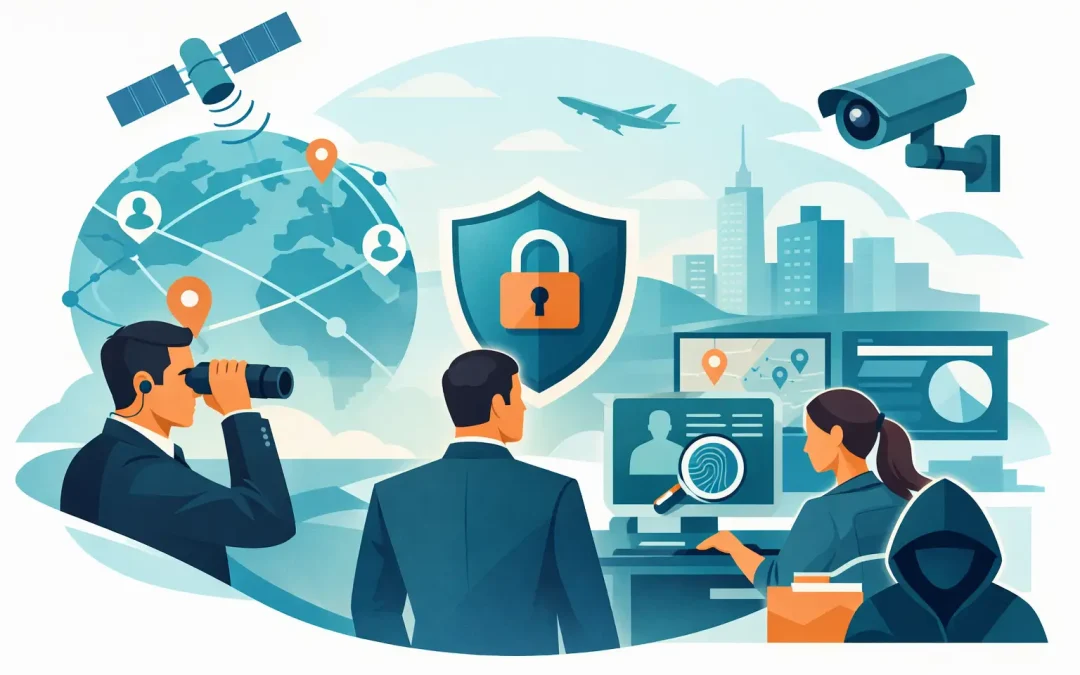
In my 50 years on the front lines of high-risk security, I’ve learned one truth the hard way: Intelligence doesn’t just protect lives — it saves them.
When your clients’ lives are on the line in hostile environments, HUMINT (Human Intelligence) isn’t just valuable — it’s everything. Real eyes and ears on the ground have repeatedly turned potential disasters into quiet victories.
Let me take you back to one of those heart-stopping moments.
We were responsible for a family of 25 touring London. The next day’s plan was simple: a big shopping day at the world-famous Harrods. But that night, our local intelligence network — plugged directly into Scotland Yard — dropped a bombshell. Credible intelligence revealed a serious bomb threat targeting Harrods the very next day.
We didn’t hesitate. Plans were scrapped instantly. The family was redirected to a completely different location while the city held its breath.
The next day, the nightmare became reality. A bomb detonated at Harrods.
Without that timely intelligence, that family of 25 would have been right in the middle of the blast.
That single piece of human intelligence didn’t just change an itinerary — it saved two dozen lives.
In today’s world, where threats are more sophisticated, lone actors strike without warning, and martyrdom ideologies fuel unpredictable violence, preventive intelligence isn’t a luxury. It’s survival.
As we unpack the critical world of Protective Intelligence in future posts, I’d love your support! If this hit home, drop a like, share it with someone who needs to see this, and subscribe — and don’t forget to hit the notification bell so you never miss what’s coming next.
Today, preventive intelligence isn’t just important — it’s a lifesaver in a world racing toward chaos.
Threats have evolved into something far more dangerous: smarter, faster, and deadlier. Fanatical actors driven by martyrdom ideologies are willing to die for their cause, while lone wolves can strike without warning, turning ordinary days into nightmares in seconds.
In this new reality, proactive intelligence is no longer a “nice-to-have.” It is the ultimate difference between life and death.
Ready to dive deeper? Below are some of my hard-earned thoughts on the real power of Protective Intelligence.
A threat rarely arrives without warning. It usually starts as a pattern – a name that appears too often, a hostile message that shifts in tone, unusual interest in travel plans, a former associate testing boundaries, or online chatter that feels insignificant until it no longer is. Protective intelligence services exist to identify those signals early, assess their meaning, and turn fragmented concern into an informed security posture.
For high-profile individuals, corporate leaders, legal stakeholders, NGOs, and government-facing organizations, that distinction matters. Security teams can respond to an incident. Protective intelligence is designed to help prevent one. It brings together investigative tradecraft, behavioral assessment, open-source review, human source reporting, travel risk analysis, and ongoing threat monitoring so decisions are based on facts rather than assumptions.
What protective intelligence services are meant to solve
At a professional level, protective intelligence is not rumor collection and it is not generic monitoring. It is a structured process for identifying credible threats, understanding who or what is driving them, and advising on practical protective measures before exposure escalates.
That can involve an executive receiving fixation-driven communications from an unknown party, a public figure facing stalking concerns, a company preparing for a contentious termination, or a nonprofit operating in a region where civil unrest and extremist activity can change quickly. In each case, the question is not simply whether a threat exists. The more pressing question is what kind of threat it is, how likely it is to develop, what indicators support that judgment, and what action should be taken now.
This is where many organizations make costly mistakes. They either underreact because the available information seems incomplete, or overreact and impose expensive protective measures without a grounded threat picture. Protective intelligence services help close that gap.
The difference between intelligence and physical security
Physical security is visible. It includes drivers, executive protection agents, access control, secure transport, venue screening, and emergency response. Those functions are essential, but by themselves they are reactive. They become most effective when informed by intelligence.
Protective intelligence provides the context behind security decisions. It helps determine whether a client needs a larger protective footprint or a more discreet posture. It can show whether online hostility is performative or escalating toward action. It can reveal whether a protest risk is localized and manageable or linked to wider organized activity. It can also identify vulnerabilities that are not obvious from a site survey alone, such as personal routines, public records exposure, insider grievances, or travel patterns that create predictable openings.
In serious matters, intelligence and protection should not operate in separate lanes. They should support the same mission.
What protective intelligence services typically include
The exact scope depends on the client, the threat environment, and whether the assignment is preventive or crisis-driven. A mature protective intelligence function usually combines several disciplines.
Threat identification and assessment
This is the core of the work. Investigators and analysts gather information from available reporting, direct-source inquiries, social media review, public records, prior case history, law enforcement liaison where appropriate, and other lawful channels. The goal is to determine credibility, capability, intent, access, and timing.
A threat is not judged by tone alone. Some subjects speak loudly and do nothing. Others say very little and move closer. Experience matters because threat assessment is rarely about one alarming message. It is about pattern recognition, behavioral indicators, and context.
Protective surveillance and exposure review
Many clients are vulnerable in ways they do not fully see. Their home address may be easier to locate than expected. Their travel movements may be inferable from public appearances, social posts, or staff routines. A family office, legal team, or executive assistant may unknowingly widen the exposure surface.
Protective intelligence reviews where personal, operational, and reputational vulnerabilities exist, then recommends methods to reduce predictability and tighten information control.
Travel risk and location intelligence
Travel creates compressed timelines and shifting variables. Routes, hotels, meeting venues, local crime patterns, political tension, terrorism risk, and medical contingencies all affect exposure. For executives and principals moving across domestic and international environments, pre-travel intelligence is often the difference between routine movement and avoidable disruption.
This work may include route and site analysis, destination threat briefings, local partner validation, event-related risk review, and contingency planning. In unstable regions, current human-source insight can be more valuable than generalized reporting.
Fixated person and stalking investigations
Some of the most persistent threats come from individuals driven by obsession, grievance, ideology, or personal instability. These cases require discipline. Overstating the threat can inflame the situation. Understating it can place a principal, family member, or staff member at real risk.
Protective intelligence in these matters involves documenting contact patterns, assessing escalation markers, identifying access points, mapping known associates, and coordinating a response strategy that may involve legal counsel, security personnel, internal stakeholders, and law enforcement.
Why high-stakes clients need more than monitoring
Technology can collect data. It cannot replace judgment. A dashboard may flag mentions, keywords, or geolocated posts, but software does not understand motive the way an experienced investigator does. It does not interview a source, test a discrepancy, recognize deception, or place a threat in the context of prior behavior.
That is why effective protective intelligence services combine digital capability with investigative experience and field awareness. HUMINT still matters. So does local knowledge. So does the ability to distinguish a nuisance from a credible actor and then explain that distinction clearly to decision-makers who may need to act fast.
For boards, legal teams, executive offices, and family principals, the real value is not data volume. It is decision-quality intelligence.
When protective intelligence should begin
Too often, clients seek support after a breach, confrontation, or public incident. By that point, options are narrower. The better time to start is before a leadership change, before a termination, before sensitive litigation, before a public campaign, before travel into a complicated environment, or before a principal’s visibility increases.
Preventive engagement allows for baseline assessments, exposure mapping, and protective planning without the pressure of a live incident. It also gives the client a clearer chain of command. When a concern does emerge, roles are already defined, reporting lines are established, and escalation protocols are not being invented in real time.
There is also a reputational advantage in early action. Quiet prevention is less disruptive than visible reaction.
What a credible provider looks like
Not every security vendor is equipped to deliver protective intelligence well. The work requires discretion, lawful investigative capability, nuanced threat analysis, and operational maturity. It also requires restraint. A credible provider does not dramatize risk to justify larger deployments. Nor do they reduce complex threat pictures to simplistic labels.
Clients should expect a provider to ask disciplined questions about exposure, adversaries, timelines, travel, known incidents, family considerations, public profile, and business sensitivities. They should also expect clear written reporting, practical recommendations, and the ability to integrate with executive protection, legal counsel, HR leadership, or crisis management teams.
In more complex environments, international reach matters. So does counter-terrorism understanding, source validation, and the ability to work across jurisdictions without losing control of confidentiality. Firms such as West Coast Detectives International are often engaged in these matters because clients need more than surface-level review. They need seasoned investigative judgment paired with operational readiness.
The trade-off: visibility versus discretion
Protective measures are never one-size-fits-all. A prominent executive may need a visible security posture to deter approach behavior. Another client may require a low-profile model that preserves normalcy and limits public attention. Protective intelligence helps inform that balance.
There are always trade-offs. More visibility can discourage some actors while attracting scrutiny from others. More privacy can preserve comfort but reduce deterrence. A sound intelligence picture helps clients choose deliberately rather than emotionally.
That is especially true when family, reputational concerns, and cross-border travel are involved. Security that ignores the client’s real-life operating needs often fails, even when it looks comprehensive on paper.
Why this work matters
Protective intelligence services are ultimately about time – gaining enough of it to think clearly, prepare properly, and intervene before risk hardens into harm. The best outcomes in this field are often quiet ones. A trip proceeds without incident. A fixated subject is identified before approach. A vulnerability is corrected before it is exploited. A leadership team makes a difficult move with eyes open.
That is the standard serious clients should expect: factual intelligence, discreet execution, and protective decisions grounded in evidence. When the stakes include personal safety, corporate continuity, or public exposure, early knowledge is not a luxury. It is part of the defense.
