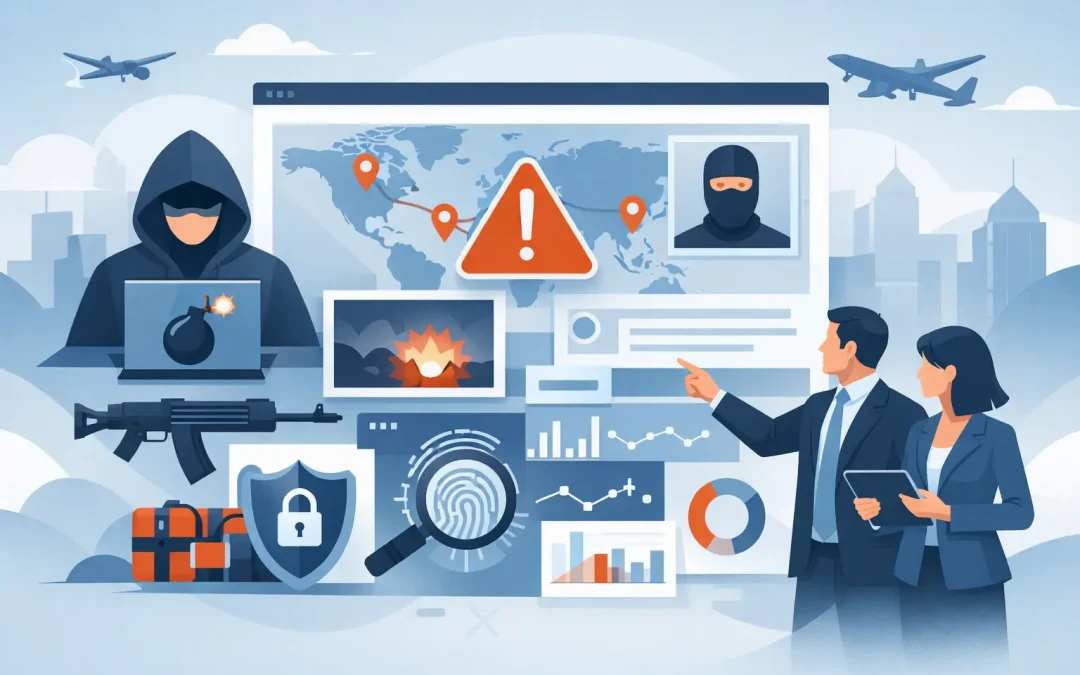
by plittle@westcoastdetectives.us | Jun 16, 2026 | Blog
Photo Created by Phil Little
ACTION ALERT: TERRORISM THREAT BRIEFING THAT DELIVERS REAL RESULTS! ?
Listen up, leaders — this is the edge you’ve been waiting for!
After 50 high-octane years leading West Coast Detectives International, I’ve learned one unbreakable truth: Clients don’t need recycled headlines — they need sharp, actionable intelligence that keeps them steps ahead of the threat!
Public news gives you the “what.” We deliver the full picture — the hidden drivers, the shifting connections, and the real-world impact on your people, operations, and travel plans.
Does this emerging threat change your security posture today? Do you need immediate adjustments to your executive protection or route planning? Or is this something we monitor aggressively while you stay focused on business?
That’s the difference between a generic summary and a West Coast Detectives Intelligence Brief that actually matters.
Terrorism threats evolve by the hour, not by the week. Our global network of trusted sources, combined with decades of hard-won HUMINT and on-the-ground experience across hotspots worldwide, gives us the depth public reporting simply can’t touch.
Yes, it takes serious time, relentless updates, and elite resources to deliver this level of clarity. High-velocity executives used to instant results sometimes underestimate what real threat assessment demands — and that’s exactly why we set the expectations up front.
At West Coast Detectives International, we believe in total transparency before any project launches. You’ll know exactly what goes into crafting a briefing that doesn’t just inform — it empowers decisive action.
Prevention beats reaction every single time. We’ve been mastering this for over a century as the “Little FBI,” blending legendary tradecraft with cutting-edge 21st-century tools.
Ready to move from reactive worry to confident, proactive security?
Let’s lock in your personalized terrorism threat assessment today.
West Coast Detectives International — Protecting what matters most, with energy, precision, and unstoppable results!
Contact us now — your team’s safety can’t wait. ?
A late advisory issued after business hours can change a travel profile, disrupt an event plan, or force a reroute for an executive team already in motion. That is why terrorism threat briefing updates are not a routine information product. For serious decision-makers, they are a time-sensitive operating tool that can influence movement, posture, staffing, venue security, and duty-of-care obligations within hours.
For government offices, NGOs, multinational firms, legal teams, and high-profile individuals, the central question is not whether threat reporting exists. It is whether the reporting is current, credible, and specific enough to support action. Too many briefings are built from recycled headlines, broad risk labels, and passive language that does little to help a principal, traveler, or security lead decide what to do next.
What terrorism threat briefing updates should actually deliver
A credible briefing update should do more than state that a country, city, or sector faces elevated risk. Most experienced operators already assume a baseline level of instability in certain regions. The real value lies in narrowing the problem. What is changing now, who is driving that change, what targets are being discussed or surveilled, and how quickly could an environment shift from manageable to unacceptable?
That level of clarity matters because terrorism risk is rarely static. It moves with political events, anniversaries, prosecutions, military actions, sectarian flashpoints, online incitement, and copycat momentum. A briefing that was accurate on Monday may be operationally stale by Wednesday. Executive travel, public-facing appearances, aid operations, and sensitive meetings require updates that reflect live conditions rather than a generic country snapshot.
The best briefings also separate capability from intent. A group may have inflammatory rhetoric but limited logistics. Another may have reduced public messaging yet retain the ability to stage a low-complexity attack against soft targets. Those are very different situations, and they demand different protective responses.
Why headline-driven reporting is not enough
Open-source reporting has value, but it often arrives after the fact or without the field context required to judge significance. A media report may note an arrest, a weapons seizure, or an online claim of responsibility. What it often misses is whether the arrest disrupted a serious network, whether the seizure indicates pre-operational activity, or whether the claim is credible, opportunistic, or false.
That gap between information and judgment is where many organizations become exposed. Security teams can be flooded with alerts and still lack a reliable basis for action. Overreacting carries costs. Underreacting can carry far greater ones. The discipline lies in interpreting the signal correctly.
This is also where regional nuance matters. The same threat language can mean very different things in Western Europe, the Sahel, the Levant, or parts of South Asia. Local policing capacity, border permeability, militant freedom of movement, public sentiment, and infrastructure resilience all affect the operational picture. A serious briefing update accounts for those variables rather than treating every jurisdiction as if the threat matrix were interchangeable.
Terrorism threat briefing updates for executives and travelers
For executive principals and corporate travelers, risk usually appears in practical terms. Can the trip proceed as planned? Does the route need to change? Should the venue be hardened? Is a low-profile ground movement still appropriate? Is local security adequate, or does the operating environment now require additional protective personnel and advance work?
Those questions cannot be answered with broad phrases like increased vigilance advised. They require judgment based on target relevance, timing, geography, and exposure. A luxury hotel district may remain functional while nearby symbolic government sites, transportation nodes, houses of worship, or Western-branded commercial spaces become more sensitive. A conference may be viable in one part of a city and inadvisable in another.
For family offices, entertainment figures, and other public personalities, the picture can become even more complex. Public visibility, predictable schedules, and digital exposure can elevate risk beyond what a standard country brief suggests. In those cases, a terrorism threat briefing update should be integrated with personal threat management, itinerary control, and protective intelligence rather than treated as a stand-alone product.
What separates a useful briefing from a generic one
The difference is usually found in sourcing, analysis, and operational relevance. A generic product compiles publicly available material, assigns a color-coded risk level, and stops there. A useful update identifies what has changed, evaluates source reliability, explains likely scenarios, and clarifies what actions should be considered now.
That does not mean every update must predict an attack. Serious intelligence work is disciplined enough to say when the picture is incomplete. In fact, one mark of credibility is restraint. Inflated warnings erode trust, exhaust budgets, and create complacency over time. Responsible briefings acknowledge uncertainty while still helping clients make defensible decisions.
They also reflect the reality that threat environments are layered. Terrorism risk can overlap with civil unrest, organized crime, kidnap exposure, cyber-enabled targeting, and insider compromise. If a briefing isolates terrorism from every adjacent threat, it may miss the way real incidents develop on the ground.
How decision-makers should use terrorism threat briefing updates
A briefing update should feed a decision cycle, not sit in an inbox as a record of concern. The first step is to determine whether the update changes exposure for a specific person, mission, route, facility, or event. If the answer is yes, the next question is proportionality. Does the development justify added monitoring, a posture shift, physical hardening, schedule changes, or cancellation?
There is no single rule that fits every organization. A humanitarian team, a publicly traded company, and a celebrity principal may all face the same regional warning but require different responses. Their visibility, tolerance for disruption, support infrastructure, and legal obligations differ. The point of a good update is not to produce a universal answer. It is to support a defensible one.
The most effective organizations also avoid treating briefings as isolated documents. They integrate them into travel approvals, executive protection planning, site assessments, event security, and crisis management procedures. When reporting is tied to preexisting action thresholds, teams move faster and with less confusion.
The value of field-informed intelligence
Threat reporting is strongest when analytical work is informed by real-world access, local understanding, and experienced judgment. That may include human source reporting, liaison awareness, regional expertise, protective field feedback, and direct familiarity with how militant or extremist activity manifests in a specific area.
This matters because terrorism does not affect every client in the same way. A diplomatic delegation, a legal witness, a journalist, and a corporate board member can enter the same city under very different risk conditions. One may be largely incidental to the threat picture. Another may be symbolically relevant. Field-informed intelligence helps make that distinction.
For this reason, many high-stakes clients rely on specialist partners rather than commodity alert services. Firms such as West Coast Detectives International are valued not simply for passing along warnings, but for applying investigative discipline, global awareness, and protective judgment to the facts at hand. That distinction is critical when decisions involve principal safety, reputational exposure, and operational continuity.
When an update should trigger immediate review
Not every development requires a major security adjustment. Some do. Immediate review is warranted when there is a credible threat against a target category relevant to your people or operations, evidence of pre-attack surveillance, an uptick in hostile propaganda tied to a specific date or grievance, coordinated arrests indicating an active cell, or a sudden breakdown in local security response capacity.
It is also warranted when planned travel depends on symbolic locations, major transportation hubs, high-visibility accommodations, or public event exposure. Even if intelligence remains fragmentary, the combination of timing and vulnerability can justify a revised plan.
The trade-off is familiar. Cancel too quickly, and operations suffer. Wait too long, and options narrow. That is why decision-makers need updates that are timely, sober, and operationally precise rather than merely alarming.
The discipline behind credible updates
Good terrorism threat briefings are built on verification, context, and a clear understanding of what the client must decide. They are not written to impress. They are written to reduce uncertainty as much as the facts allow.
For serious clients, that standard matters. A board, principal, agency, or family office does not need dramatic language. It needs a realistic reading of threat conditions, a clear sense of relevance, and enough confidence in the reporting to act without hesitation when the situation demands it.
The practical test is simple. After reading the update, does the responsible party know what changed, how it affects current exposure, and what should be reconsidered now? If not, the briefing may be informative, but it is not yet operational.
Threat conditions will continue to shift with little notice. The organizations that manage them best are not the ones collecting the most alerts. They are the ones working from intelligence that is current, disciplined, and close enough to the ground to matter when timing is tight.

by plittle@westcoastdetectives.us | Jun 15, 2026 | Blog
At West Coast Detectives International, we don’t wait for tragedy—we strike first with prevention.
As President and CEO, I knew our approach to protecting people at risk had to change—and fast. That wake-up call hit like thunder on July 18, 1989, when a obsessed stalker murdered rising young actress Rebecca Schaeffer in cold blood right at her own front door.
She was living in a typical apartment. The entry camera was broken. When her doorbell rang, she simply looked out, saw someone, and opened the door. Before she could react, the stalker shot and killed her.
Hollywood was shaken to its core. The outcry was immediate: “How could this happen?”
Even more devastating? Threats had been received at the studio beforehand—but they were dismissed as a mere nuisance. That single failure proved deadly.
That tragic day changed everything for everyone in the business of protecting lives. Law enforcement and leading private protection firms like West Coast Detectives International realized a new, proactive, preventive approach was no longer optional—it was urgent and essential.
Right away, LAPD brought together top law enforcement professionals and elite private agencies. West Coast Detectives International was proudly selected as one of the core partners. In 1989, the Threat Unit was born.
Since that pivotal moment, we have turned “handling threats the moment they appear” into an art and a science. No threat is too small. Every warning sign is taken seriously—immediately.
Today, we stand as the go-to experts for rapid, decisive threat response and prevention.
Following, you’ll discover some of the powerful tools, strategies, and hard-won lessons we at West Coast Detectives International have developed and refined over decades to keep our clients safe from threats—before they ever escalate.
Prevention is always less costly than enforcement. At West Coast Detectives International, we live that truth every single day—with urgency, excellence, and unwavering commitment to protecting what matters most: your life and peace of mind.
Ready to stay ahead of the danger? We’re here and ready to act.
A stalking case rarely starts with what most people expect. It is often written off as persistence, an awkward fixation, a messy breakup, a disgruntled former employee, or an overactive fan. By the time decision-makers ask how to assess stalking threats, the pattern has usually already matured into repetition, entitlement, and boundary violation.
That delay is costly. Stalking is not defined by a single alarming moment. It is defined by behavior over time – behavior that communicates fixation, access-seeking, grievance, or control. For executives, public-facing professionals, legal stakeholders, and private individuals under pressure, the central task is not to guess what a subject is thinking. It is to evaluate what the subject is doing, how that behavior is changing, and how close they are getting to the target.
How to assess stalking threats without guessing
The most reliable assessments begin with a simple discipline: separate fear, assumptions, and public appearance from observable facts. A person can seem polite, educated, calm, or socially competent and still present a serious stalking risk. Another may appear chaotic or unstable and yet lack the intent, focus, or capability to move beyond nuisance behavior. The distinction matters.
Threat assessment is therefore behavioral, not theatrical. Investigators and security professionals look for patterns: repeated unwanted contact, circumvention of blocks, surveillance behavior, digital intrusion, third-party approaches, gifts, implied monitoring, territorial language, and signs of grievance or ownership. What matters is not whether each act seems minor in isolation. What matters is whether the total picture shows persistence, escalation, and disregard for boundaries.
A sound assessment also depends on chronology. When did the behavior begin? What triggered it? Has frequency increased? Has the stalker shifted from communication to proximity, or from proximity to confrontation? Cases often become more dangerous when a subject feels ignored, exposed, humiliated, replaced, or deprived of access. Major life events such as divorce filings, terminations, litigation, protective orders, media attention, and new relationships can accelerate the threat picture.
The indicators that change a stalking case
Not every stalking case carries the same level of danger. Some remain harassment-based. Others move toward abduction, assault, workplace confrontation, reputational attack, or homicide. The job is to identify which indicators change the case from concerning to urgent.
First, assess fixation. A subject who continues despite clear rejection, legal notice, blocked channels, or intervention is showing more than poor judgment. Persistence after consequences is one of the clearest warning signs because it shows that social and legal restraints are losing effect. If the subject reorganizes their efforts after each barrier, the case is becoming more operational.
Second, assess access. Does the subject know the target’s residence, office, schedule, travel patterns, children’s school, gym, house of worship, or regular routes? Have they appeared in person, followed vehicles, contacted reception staff, or approached family, assistants, colleagues, or neighbors? A subject with increasing physical or social access is more dangerous than one limited to erratic online messaging.
Third, assess escalation. Escalation can be obvious, such as threats, forced entry attempts, or weapon references. It can also be quiet: more frequent messages, broader channel use, late-night drive-bys, repeated deliveries, use of aliases, spoofed numbers, or sudden appearance in locations not publicly disclosed. Escalation often looks like adaptation.
Fourth, assess grievance and entitlement. Many stalkers are not simply seeking contact. They believe they are owed contact, owed explanation, owed affection, owed revenge, or owed recognition. That belief system can turn a blocked communication channel into a personal insult and a simple boundary into a perceived act of aggression. Once a subject begins framing themselves as wronged, betrayed, or forced to act, risk rises.
Fifth, assess capability. Capability includes money, transportation, technical skill, physical confidence, prior surveillance experience, criminal history, access to weapons, and willingness to travel. A subject does not need formal training to be dangerous, but capability affects speed and reach. An aggrieved former intimate partner with daily access presents one profile. A geographically distant obsessive stranger with money, time, and digital tradecraft presents another.
How to assess stalking threats in context
Context changes the meaning of the same behavior. Ten unwanted messages from a stranger are concerning. Ten unwanted messages from a former partner who has keys, knows the children’s routines, and has previously ignored court orders are more serious. A fan mailing letters to a public figure is one issue. That same individual posting the target’s hotel, approaching staff, and appearing at private events is another.
This is why stalking assessment cannot be reduced to a checklist. The relationship between subject and target matters. So do triggering events, the target’s public visibility, the subject’s stressors, and the operational environment. A high-profile executive with a published speaking calendar faces a different exposure model than a private citizen whose threat actor is local and familiar with the home address.
Digital behavior also deserves careful treatment. Many modern stalking cases blend online and in-person conduct. Password reset attempts, account probing, hidden tracking devices, impersonation, false complaints, doxxing, and location inference through social media all increase concern. Digital conduct should not be dismissed as less serious simply because it occurs through screens. In many cases, it is the reconnaissance phase.
Evidence quality matters more than volume
Clients under stress often arrive with hundreds of screenshots, fragments of email, and anecdotal reports from friends or staff. That material may be useful, but raw volume is not the same as usable evidence. To assess stalking threats effectively, information has to be organized into a timeline with dates, times, channels, locations, witnesses, and associated actions.
A disciplined case file should show what happened, when it happened, how the subject made contact, whether the contact was unwanted, what response was given, and what happened next. If there were gifts, voicemails, surveillance sightings, vehicle descriptions, suspicious deliveries, or access attempts, each should be logged precisely. Patterns become visible when information is structured.
This matters for three reasons. First, it sharpens risk assessment. Second, it improves coordination with counsel, law enforcement, corporate security, human resources, or family office staff. Third, it prevents memory drift. In stalking matters, small details that seem unimportant early can later become highly significant.
What organizations and families often miss
The most common failure is treating stalking as a personal annoyance rather than a threat management issue. That approach creates blind spots. Reception teams may be uninformed. Residential staff may not know what vehicles to watch for. Executive assistants may continue engaging the subject in hopes of de-escalation. Family members may post travel or location details that close protective gaps.
Another common failure is overreliance on a single remedy. A cease-and-desist letter, trespass warning, protection order, or block list can be useful, but none should be mistaken for a full strategy. In some cases, direct legal action reduces risk. In others, it escalates grievance. It depends on the subject’s psychology, history, and current trajectory.
Protective planning should match the actual case. That may include residential security review, workplace access control, route variation, travel coordination, digital hardening, staff briefing, evidence preservation, and discreet surveillance detection measures. The goal is not to dramatize the situation. It is to reduce access, remove predictability, and create decision advantage.
When a stalking case becomes urgent
Certain developments justify immediate action. A subject who begins appearing unexpectedly in private locations has crossed a serious threshold. So has a subject who references weapons, self-harm, murder-suicide, children, or a final meeting. Silent presence can be as concerning as explicit threat language, especially when combined with prior fixation.
Urgency also rises when the stalker broadens the target set. Contacting children, parents, romantic partners, domestic staff, assistants, or colleagues is often an effort to force engagement and demonstrate reach. Attempts to damage employment, trigger public embarrassment, or manipulate court or custody matters may signal a campaign rather than isolated harassment.
A subject who believes time is running out warrants particular attention. Pending divorce, imminent termination, bankruptcy, criminal charges, or public disgrace can compress decision-making and increase volatility. In those windows, subjects may act less for gain than for retaliation, control, or notoriety.
The value of professional assessment
The question is not whether a target feels uncomfortable. In stalking cases, discomfort is usually obvious. The harder question is whether the behavior is stabilizing, intensifying, or approaching an action point. That is where experienced threat assessment becomes decisive.
A professional review brings distance, methodology, and operational judgment. It weighs behavior, capability, access, motive, and change over time. It also addresses the practical problem many clients face: how to protect a person without amplifying the threat or disrupting business, family life, reputation, or travel unnecessarily.
For high-stakes clients, a stalking assessment should never be reduced to intuition alone. It should produce a clear picture of risk, realistic scenarios, and protective options tied to the subject’s actual behavior. Firms such as West Coast Detectives International approach these matters as intelligence-led protection problems, not public-relations exercises.
The right next step is usually not dramatic. It is disciplined: document accurately, assess behavior in context, tighten access, and act before the subject sets the pace.

by plittle@westcoastdetectives.us | Jun 15, 2026 | Blog
HEY, LISTEN UP – YOUR LIFE OR YOUR CLIENT’S COULD DEPEND ON THIS RIGHT NOW! ?
In my 50+ years crushing it in military, law enforcement, intelligence, and global private investigations, surveillance detection isn’t optional — it’s a total game-changer that can literally mean the difference between life and death!
We’re talking real-world skills that separate the prepared from the vulnerable. When you or your client are on assignment or facing potential exposure, you’ve got to spot the threat fast.
Quick, High-Impact Vehicle Surveillance Detection Moves:
- The Classic Three Right Turns — Make three quick right turns and loop back onto your original route. If the same vehicle is still glued to you… you’ve got company! Boom — instant red flag.
- The Curb Pull-Over — Suddenly pull to the side and watch your rearview mirror like a hawk. If a car behind you slams on the brakes or jerks to the curb to match you… game over, you’re being tailed.
Car surveillance is way easier to shake or confirm than professional foot surveillance. Forget the Hollywood spy novels — real operators are ghosts, but these proven tactics still cut through the noise and deliver results.
The Real Deal for Clients & Companies
When a client or executive senses exposure, it’s not time to guess — it’s time for a full-spectrum Threat Detection Protocol. We combine vehicle tactics, foot surveillance countermeasures, technical sweeps, HUMINT, and every discipline in the playbook.
After thousands of real-world cases over five decades, here’s the truth I hammer home to every client:
“An ounce of prevention is worth TONS of painful, expensive cleanup!”
Don’t wait until the heat is on. Bring in the professionals NOW — sooner is always smarter, safer, and cheaper.
West Coast Detectives International has been the trusted shield for executives, companies, and high-net-worth individuals for over 100 years. We don’t just react — we prevent.
What about YOU? Drop your own surveillance detection stories, favorite techniques, or close-call moments in the comments below! Have you ever used the three-right-turn trick? Spotted a tail during a critical moment? Share it — let’s swap battle-tested knowledge and keep everyone sharp!
Stay vigilant, stay ahead, and stay SAFE out there! ?
Phil Little President & CEO, West Coast Detectives International Prevention is always less costly than enforcement.
A principal notices the same sedan twice in one week outside separate meetings. An executive assistant reports unusual questions from a new vendor. A family office sees social media details mirrored in anonymous messages. This is where counter surveillance detection methods move from theory to operational necessity.
For high-risk individuals and organizations, surveillance is rarely obvious. It is patient, adaptive, and often designed to blend into ordinary traffic, routine contact, or digital breadcrumbs. The purpose of detection is not to create alarm. It is to establish facts, identify patterns, and determine whether a client is facing casual curiosity, competitive intelligence activity, stalking behavior, pre-incident threat development, or a coordinated hostile effort.
What counter surveillance detection methods are designed to do
At a professional level, detection is not limited to spotting someone with a camera across the street. Effective counter surveillance detection methods are built to answer harder questions. Is the activity persistent or incidental? Is it linked to a known dispute, litigation matter, executive movement, domestic concern, or travel schedule? Does it suggest reconnaissance for theft, harassment, abduction, extortion, reputational attack, or physical harm?
That distinction matters because the response changes with the threat. An isolated suspicious sighting may justify documentation and quiet monitoring. Repeated pattern-based observation around a residence, office, school route, or protective movement requires a far more structured response. Good detection work reduces guesswork. It replaces assumptions with timelines, vehicle descriptions, behavioral indicators, and corroborated observations.
This is also where inexperienced approaches fail. Many people assume surveillance means a single obvious follower. In practice, sophisticated operators rotate personnel, use innocuous cover activity, exploit public information, and rely on predictable routines. The better the hostile actor, the less dramatic the signs appear at first.
Behavioral indicators matter more than gadgets
Technology has a role, but behavioral analysis remains central. Skilled surveillance detection starts with anomaly recognition. Who appears repeatedly in places where there is no reasonable explanation for repetition? Which vehicles are present across unrelated locations? Who seems interested in arrival and departure times rather than the stated purpose of a visit?
Context is everything. A parked vehicle near an office means little by itself. The same vehicle appearing near a residence, then near a legal meeting, then near a family destination begins to matter. A person lingering in a hotel lobby may be waiting for a rideshare, or they may be conducting foot surveillance. The difference usually emerges through disciplined observation over time, not instant conclusions.
That is why professionals build baselines. They learn what normal looks like around a client’s residence, office, commute, and travel profile. Once normal activity is understood, deviations become easier to evaluate. Without a baseline, every stranger feels suspicious. With one, investigators can separate noise from signal.
The core counter surveillance detection methods used in the field
The most effective field methods combine planning, observation, route analysis, and discreet verification. Static observation is one piece. It helps establish who and what is present around a fixed location. Mobile surveillance detection adds a different layer by examining whether suspicious persons or vehicles remain associated with the principal across movement.
Route analysis is especially important. Surveillance teams often depend on predictable movement and repeated schedules. When travel patterns are reviewed carefully, exposure points become visible. The concern is not only whether someone is being watched. It is whether their routine makes them easy to watch.
Variation, however, is not a cure by itself. Random changes can create confusion for the client and protective team without actually confirming anything. Purposeful route and schedule adjustments, executed with discipline, are more useful because they help test whether suspicious parties persist through changes that should break incidental overlap.
Foot surveillance detection requires a different skill set than vehicle-based detection. Dense urban environments, airports, hotels, conference venues, and public events allow hostile observation to hide in crowds. In these settings, professionals look at pace matching, repeated line-of-sight positioning, unusual interest in access points, and body language that reflects monitoring rather than participation.
Residential and workplace assessments also matter. Surveillance often begins with location study, not active trailing. An actor may map entry points, note security habits, identify cameras, learn household patterns, or observe staff behavior before escalating. Detection at this stage can interrupt a problem before it becomes more aggressive.
Why digital exposure now supports physical surveillance
Physical surveillance rarely exists in a vacuum. Public records, social media posts, business biographies, event announcements, and geotagged content can all sharpen hostile targeting. A family member’s casual post can reveal travel timing. A conference appearance can confirm hotel zones and arrival windows. A public filing can expose home ownership details or corporate relationships.
For that reason, modern counter surveillance detection methods increasingly include open-source exposure review. This is not the same as broad cyber defense, though the two can overlap. The goal here is practical: determine what an adversary could learn easily enough to support location-based observation or approach.
The trade-off is obvious. Public visibility may be commercially necessary for executives, public figures, and organizations that depend on media presence or stakeholder access. The answer is not disappearing from view. The answer is controlling what is published, when it appears, and how much operational detail it reveals.
Detection has limits, and false positives are common
A serious article on this subject should say plainly that not every concern indicates hostile surveillance. People revisit coffee shops. Delivery vehicles repeat routes. Neighbors notice each other. Employees can misread ordinary behavior when tensions are already high. If every anomaly is treated as proof, security judgment erodes quickly.
This is why structured reporting matters. Time, location, weather, direction of travel, vehicle identifiers, clothing, behavior, and the sequence of events all help test whether a concern is real. Vague fear is difficult to act on. Documented patterns can be assessed, corroborated, and escalated when warranted.
There is also a legal and operational boundary. Counter surveillance does not mean confronting suspicious persons recklessly or engaging in conduct that creates liability. Poorly handled confrontations can destroy evidence, escalate danger, and interfere with later law enforcement action. In high-risk matters, restraint is not weakness. It is tradecraft.
When professional intervention is justified
The threshold for bringing in professional support is lower than many clients assume. If observation appears repeated across locations, if a known threat actor has motive and access, if children or family members may be exposed, or if business activity involves litigation, termination, political sensitivity, wealth visibility, or travel into unstable areas, professional assessment is prudent.
Experienced teams do more than watch for followers. They integrate detection with threat management, advance planning, executive protection, travel security, and investigative review. That wider view matters because surveillance is often a symptom of a larger campaign. The question is not only who is watching. It is why, for whom, and what comes next.
For multinational corporations, this can involve labor tensions, activist targeting, insider leaks, or competitive intelligence concerns. For prominent individuals, the driver may be stalking, coercive fixation, paparazzi escalation, domestic conflict, or social engineering around staff and residences. The method of observation may look similar across cases. The intent can be completely different.
Building a sensible detection posture
A credible detection posture starts with disciplined routines inside the protective environment. Staff should understand reporting channels, visitor verification, and what details should never be shared casually. Travel, meeting locations, and family movements should be compartmentalized on a need-to-know basis. Public-facing communications should be reviewed for operational exposure, especially when they reveal timing.
It also helps to conduct periodic reviews of routes, pickup and drop-off habits, residential visibility, office access control, and event procedures. Small changes can reduce exposure substantially. Tinted glass and cameras may have value, but information discipline and trained observation usually deliver the greater return.
Where risk is elevated, formal surveillance detection operations may be appropriate before major events, sensitive meetings, contentious legal actions, overseas travel, or public appearances. Firms with real field experience, including organizations such as West Coast Detectives International, approach this work as part of a broader protective and intelligence mission rather than as a standalone gadget exercise.
What matters most is judgment. The right response is rarely panic and rarely passivity. It is the disciplined middle ground: observe carefully, document precisely, test patterns intelligently, and act early enough to stay ahead of the threat. In security work, the clients who fare best are often the ones who take the first warning seriously before it becomes a headline.

by plittle@westcoastdetectives.us | Jun 13, 2026 | Blog
Dfference Between Executive Protection and Bodyguards: The High-Stakes Evolution of Keeping People Safe!
The world has exploded with change over the last 50 years — and the game of personal protection has leveled up BIG TIME! Back when I first dove into the private sector at West Coast Detectives International, if a client needed safeguarding, we rolled out classic bodyguards. You know the type: big, imposing guys built like tanks. Clients often demanded the largest presence possible, thinking sheer size and muscle would stop any threat cold.
But as society ramped up in violence, with too many young people growing up without solid ethics or respect for others and their property, becoming a victim turned into a daily risk. Then the internet and digital tools hit like a lightning strike — suddenly anyone could dig up home addresses, travel routes, and personal details in seconds. The old “stand there and look tough” approach? It wasn’t cutting it anymore.
The wake-up call that changed everything came in 1989 with the tragic death of actress Rebecca Schaeffer. A obsessed stalker tracked her down by hiring a private investigator who never asked the critical question: “Why do you need this address?” That negligence led to heartbreak and forced the entire industry to hit the reset button.
Out went the old-school bodyguard model. In came Threat Management and modern Executive Protection — smarter, faster, and far more proactive!
Following find some of the tools and techniques I have learned over the last 50 years in keeping people safe.
A principal lands in a foreign capital after a board dispute goes public, activists have posted the travel itinerary online, and a family member is receiving threatening messages. In that environment, executive protection versus bodyguards is not a matter of branding. It is the difference between visible presence and a full protective strategy built to prevent the next problem before it arrives.
Many clients use the terms interchangeably. That is understandable. Both roles exist to protect people. But they are not the same service, and confusing them can produce expensive gaps in coverage. A bodyguard may be appropriate for a limited assignment where visible deterrence is the main objective. Executive protection is a broader discipline that combines advance work, intelligence, threat assessment, logistics, and discreet close protection under one operational plan.
For high-profile individuals, corporate leaders, legal stakeholders, NGOs, and public-facing families, that distinction matters. Risk rarely appears as a single physical confrontation. It develops through patterns – travel vulnerabilities, predictable routines, hostile surveillance, online exposure, workplace disputes, custody conflicts, political unrest, insider leaks, and reputational flashpoints that create real-world security consequences.
What executive protection versus bodyguards really means
At the simplest level, a bodyguard is often understood as the person physically present near the client. The assignment may focus on standing post, escorting a client into a venue, riding in the same vehicle, or providing an obvious security presence at public appearances. Some bodyguards are highly capable professionals with military or law enforcement backgrounds. The issue is not whether they are competent. The issue is scope.
Executive protection is a protective system, not just a person. It begins before the client moves. It considers who may present a threat, what vulnerabilities exist, how travel and scheduling affect exposure, which locations require advance review, and what contingencies should be in place if conditions change. The close protection agent is one part of that structure, but never the whole of it.
This is why serious protective work often operates quietly. The strongest measure is not always the largest guard at the door. In many cases, it is the team that identified a route issue before departure, adjusted venue access before arrival, screened a meeting participant, and altered movement patterns before anyone hostile could exploit them.
The bodyguard model: visible protection, narrower mission
A traditional bodyguard assignment tends to center on immediate presence. That can be useful in specific circumstances. A celebrity entering a crowded venue may need visible deterrence. A client dealing with a recent confrontation may want a clear signal that access is controlled. A public event with media attention may justify a plainly seen security posture.
But the bodyguard model is often reactive by design. It addresses what is happening in front of the client in real time. If the assignment has little advance intelligence, weak route planning, minimal coordination with local contacts, and no structured threat review, the protection remains limited even if the guard is physically impressive.
That does not make bodyguard services ineffective. It means they are best suited to certain environments. Short-duration appearances, lower-complexity movements, and assignments where deterrence is the primary goal may not require a full executive protection framework. The mistake is assuming that visible presence alone is enough for complex or evolving threats.
Executive protection: prevention, planning, and control
Executive protection is built around prevention. The protective team studies the principal’s routines, public exposure, business activity, travel plans, known disputes, and family considerations. It evaluates both direct threats and secondary risks such as civil unrest, labor actions, cyber-enabled stalking, protest activity, insider compromise, and local crime conditions.
That planning phase matters because attackers, harassers, and hostile actors rarely rely on dramatic tactics alone. They look for predictability. They exploit timing, access points, and information leakage. A mature executive protection program reduces those openings through layered controls.
Those controls may include protective intelligence, site assessments, route selection, secure transportation coordination, residential security review, event access management, liaison with counsel or internal corporate stakeholders, and contingency planning for medical incidents or emergency extraction. In higher-risk environments, executive protection also intersects with travel risk management and counter-surveillance measures.
The result is a service that protects mobility, continuity, and decision-making, not just physical safety in the narrowest sense. That distinction is especially important for executives who cannot simply stop traveling, cancel meetings, or disappear from public view.
Why clients often underestimate the difference
Part of the confusion comes from pop culture. The bodyguard is easy to visualize. Executive protection is less visible precisely because it is designed to reduce drama, not create it. When a trip goes smoothly, a difficult appearance passes without incident, or a threat never gains proximity, the protective work can look uneventful from the outside.
Another reason is procurement. Some organizations buy security the way they buy staffing. They compare hourly rates, headcount, and visible coverage. That approach may work for basic guarding. It is far less effective for principal protection. A lower-priced assignment can become very costly if the provider lacks advance capability, intelligence discipline, or the judgment to adapt when circumstances change.
There is also a reputational element. Many high-level clients do not want to look protected. They want to remain accessible to boards, investors, staff, media, or guests without broadcasting fear. Executive protection addresses that concern better than a conspicuous bodyguard model because discretion is part of the operating method.
When a bodyguard may be enough
There are assignments where a bodyguard is the right fit. A short public appearance, a straightforward escort after a known disturbance, or a temporary visible presence during a narrow time window may not require a larger protective architecture. If the environment is controlled, the route is simple, the client profile is stable, and there is no credible ongoing threat stream, a bodyguard can be a practical solution.
Even then, quality matters. The right professional should have sound judgment, restraint, communication discipline, and the ability to read behavior early. Physical capability alone is not enough. A poor bodyguard can escalate tension, damage a client’s reputation, or miss pre-incident indicators because the role has been reduced to muscle rather than observation.
When executive protection is the smarter decision
If the principal faces repeat exposure, travels frequently, manages controversy, operates internationally, or has family and business interests that create layered risk, executive protection is usually the more appropriate model. The same is true when there are stalking concerns, litigation, employee termination issues, hostile social media attention, political sensitivity, or concerns about terrorism, kidnapping, extortion, or targeted harassment.
These are not rare edge cases. For many executives and public figures, risk is cumulative. One factor alone may seem manageable. Several together change the assignment entirely. A contentious merger, a leaked travel plan, an overseas itinerary, and an aggrieved former associate can turn an ordinary week into a protective operation that requires planning well beyond close physical presence.
This is where firms with investigative depth hold an advantage. Protective work improves when the team can develop factual intelligence, verify claims, identify patterns, and understand who or what is driving the threat picture. West Coast Detectives International approaches protection from that broader operational perspective, where prevention is informed by intelligence rather than guesswork.
The real comparison is not image versus image
In practice, executive protection versus bodyguards is not a comparison between two costumes. It is a comparison between two operating philosophies. One centers on proximity. The other centers on risk management.
A strong bodyguard may deter an approach. A strong executive protection program may keep the approach from becoming possible in the first place. That difference affects scheduling, transportation, family security, venue access, overseas movement, and the principal’s ability to continue working without unnecessary disruption.
There is, however, a trade-off. Executive protection is more resource-intensive. It requires planning time, better coordination, and usually a more sophisticated provider. Not every client needs that level of support every day. The right decision depends on exposure, predictability, geography, threat history, and the consequences of failure.
For serious clients, the better question is not, Do I need a bodyguard or executive protection? It is, What risks am I actually carrying, and what level of protection matches them without creating unnecessary visibility or cost?
That question deserves a professional answer grounded in intelligence, discretion, and field-tested judgment. When the stakes involve personal safety, operational continuity, and reputation, the right protective model should be chosen before an incident forces the issue.

by plittle@westcoastdetectives.us | Jun 11, 2026 | Blog
Ready to Master the Art of Elite Executive Protection?
IF you are a client needing Protection or an agency providing proteciton sevices check out some of the tools and techniques we have learned at West Coast Detectives International.
In today’s high-stakes world, where threats can strike from any direction at any moment, protecting high-risk executives isn’t just a job—it’s a high-octane mission that demands razor-sharp strategy, unbreakable vigilance, and world-class expertise!
Whether you’re safeguarding visionary CEOs navigating volatile international deals, high-profile dignitaries in unfamiliar territory, or entrepreneurs facing targeted risks, the difference between a smooth journey and a potential crisis comes down to one thing: proactive, battle-tested executive protection.
Buckle up! This comprehensive guide is your ultimate playbook—packed with proven tactics, cutting-edge best practices, and real-world insights to keep your principals safe, secure, and thriving no matter what challenges lie ahead. Let’s turn potential danger into confident success and elevate your protection game to legendary levels!
The adventure in elite security starts right here. ?
A protection failure rarely begins with the visible incident. It usually starts earlier – with an ignored threat, an unvetted route, a public schedule, a domestic conflict dismissed as private, or a trip approved without current intelligence. Any serious executive protection guide should begin there, because effective protection is not about appearances. It is about prevention, judgment, and disciplined preparation.
For corporate leaders, public figures, legal stakeholders, and prominent families, the risk picture has changed. Exposure now comes from more than physical proximity. It can be driven by online hostility, activist targeting, insider leaks, grievance-based violence, stalking, contentious litigation, political tension, or international instability. In that environment, executive protection is not a luxury service. It is a risk management function.
What an executive protection guide should actually cover
Many people still misunderstand executive protection as a visible bodyguard presence. That narrow view misses the real work. Professional protection begins with advance planning, threat identification, logistics control, and information discipline. The personnel assigned to a principal matter, but the structure around them matters more.
A sound protection program looks at the principal’s lifestyle, business role, travel patterns, family exposure, digital footprint, and known adversaries. It also accounts for the tempo of daily life. A CEO moving between headquarters, public events, board meetings, and overseas travel requires a different posture than an entertainment figure facing stalking concerns or a family office principal dealing with reputation-sensitive risk.
That is why protection should never be sold as a fixed package. The right footprint depends on threat level, visibility, geography, and consequences if an incident occurs. Too little coverage creates preventable gaps. Too much can interfere with business, family life, and public optics.
Threat assessment comes before deployment
Before placing agents, vehicles, or travel protocols, the first task is to understand the threat. That means distinguishing between vague concern and demonstrated risk. Some clients need a short-term posture around a triggering event such as a termination, lawsuit, media exposure, breakup, or hostile negotiation. Others require a standing protective strategy because their profile, assets, or public role make them durable targets.
A credible threat assessment examines known individuals of concern, prior incidents, digital chatter, travel destinations, residential vulnerabilities, workplace access, and family routines. It also looks at patterns. Has the principal become more visible recently? Is there a contentious corporate action underway? Has online rhetoric shifted from criticism to fixation? Has a former employee, intimate partner, or business rival shown escalation behavior?
This step is often where experienced investigative capability separates a serious protection provider from a generic security vendor. Good executive protection is informed by intelligence. It is not just manpower on site.
The difference between inconvenience and danger
Not every disruption is a security threat. Paparazzi, aggressive autograph seekers, and social media criticism may create stress without indicating imminent harm. On the other hand, a single motivated individual with personal grievance, time, and access can present real danger even without broad visibility.
The job is to identify who has intent, who has capability, and who has opportunity. Those three factors rarely carry equal weight, and they change quickly. That is why threat management must stay active rather than static.
Advance work is where protection succeeds or fails
The public tends to focus on the visible moment of escort. Professionals focus on the hours and days before movement. Route reviews, venue surveys, ingress and egress planning, local medical capability, alternate transportation, airport handling, driver vetting, communications discipline, and contingency options are not extras. They are the foundation.
For domestic assignments, advance work may involve residential security review, office access control, schedule confidentiality, and coordination with internal staff. For international travel, the standard is higher. The team may need current country intelligence, civil unrest reporting, crime pattern analysis, airport risk review, hotel floor selection, secure ground transport, and emergency extraction planning if conditions deteriorate.
In higher-risk jurisdictions, executive protection cannot operate in isolation. It must integrate local knowledge, legal considerations, cultural realities, and reliable on-the-ground assets. This is where global experience matters. A polished security presence without local intelligence can create false confidence.
The executive protection guide to travel risk
Travel is where even disciplined organizations become vulnerable. Schedules are compressed, routines break down, and principals often push for speed over control. A proper executive protection guide treats travel as a separate risk category because movement creates exposure at every transition point.
Airports, hotel lobbies, curbside arrivals, conference venues, restaurants, and publicized meetings all introduce predictability. So do social posts, staff chatter, and itineraries circulating beyond those who genuinely need them. Many travel-related incidents are enabled by information leakage rather than surveillance tradecraft.
Effective travel protection begins with limiting what is shared and with whom. It continues with vetted transportation, layered routing, secure accommodations, and realistic contingency planning. If a principal insists on public dining, late changes, or social spontaneity, the team must adjust. Protection cannot become so rigid that it breaks the client relationship, but it also cannot simply yield to convenience.
That tension is common in executive work. The best teams know how to protect the principal without turning every movement into a visible operation.
Family travel and private life require equal attention
One of the most common mistakes in protection planning is treating family movements as lower risk because they are private. In reality, spouses, children, and household staff often present softer access points. School routines, domestic employees, social calendars, and residence-related vendors can all expand the attack surface.
Protective planning should account for the principal’s full environment, not just the boardroom or stage entrance. That requires discretion and maturity. Families do not need theater. They need a calm, competent structure that preserves normal life while reducing exposure.
Executive protection is not separate from investigations
A mature program connects protection with investigative support. If a principal is being stalked, threatened, extorted, defamed, or targeted by an insider, the answer is not simply to add more visible coverage. The source of risk must be identified, documented, and managed.
That may involve background work, social media attribution, due diligence, witness development, pattern analysis, or coordination with legal counsel and law enforcement where appropriate. In some cases, the issue is reputational and physical at the same time. A hostile former associate may expose private information, mobilize online harassment, and attempt in-person contact. Treating these as separate problems is a mistake.
This is why experienced firms integrate intelligence, investigations, and protection rather than offering each function in a silo. West Coast Detectives International has long operated in that higher-trust environment, where executive protection is informed by factual reporting, field awareness, and preventive action.
Choosing the right protection posture
Not every client needs the same model. Some require a close protection detail with daily movement support. Others need low-visibility residential coverage, event-specific protection, travel security for a defined trip, or an intelligence-led advisory layer that activates only when indicators change.
The right question is not, “How many agents do we need?” It is, “What problem are we solving, and what would failure cost?” For a multinational executive entering a politically unstable region, the answer may center on travel risk, local unrest, and secure movement. For a prominent individual facing stalking, the answer may center on pattern disruption, residence hardening, and investigative threat management. For a corporation, the concern may be executive conference exposure, activist confrontation, or insider-enabled access.
A capable provider will discuss trade-offs plainly. High visibility can deter some threats while drawing attention in other settings. Tight scheduling discipline improves control but may frustrate the principal. Armed capability may be appropriate in some jurisdictions and impossible in others. Technology can improve awareness, but it does not replace protective judgment.
What sophisticated clients should expect
At the high end of executive protection, clients should expect more than personnel with impressive resumes. They should expect planning discipline, discretion, adaptability, and clear reporting. They should expect a team that understands business continuity as well as physical safety.
That means concise briefings, realistic contingency plans, and protective professionals who can work around boards, family offices, legal teams, chiefs of staff, estate managers, and international counterparts without drama. It also means knowing when not to overreact. Security that interferes with the principal’s work, relationships, or public role can become its own liability.
The strongest programs are measured by what never happens. The threat never gets close. The route changes before the protest forms. The unstable individual is identified before contact escalates. The trip is adjusted before local conditions worsen. That kind of success is quiet, but it is not accidental.
A final standard for any executive protection guide
If a protection plan begins and ends with visible presence, it is incomplete. Serious executive protection starts with intelligence, advances through planning, and holds under pressure because the groundwork was done properly. For high-risk clients, that is the standard worth insisting on – discreet, informed, and ready before the first sign of trouble appears.