
What Is Threat Assessment? ACT NOW — Lives Are on the Line!
At West Coast Detectives International, we didn’t just study threat assessment — we helped build it from the front lines after tragedy struck.
When actress Rebecca Schaeffer was brutally murdered by a stalker, LAPD immediately created the Threat Management Unit — and we were there as founding partners. That single case changed everything. It lit a fire under us to stop treating potential threats as “minor” and start acting with speed, precision, and total commitment.
Threat Management is NOT a standard risk assessment or security audit (though we use some of the same powerful tools).
This is high-stakes human behavior territory. We’re dealing with unstable individuals, people battling serious mental health challenges, and stalkers who don’t follow any checklist. Every case is unique. That’s why we bring in forensic psychiatrists immediately — to decode the mind of the threat, read the warning signs others miss, and build a real-time strategy that actually works.
Here’s the truth that demands urgency: Every single threat must be taken seriously. Less than 1% escalate to violence… but that 1% destroys lives forever. The Schaeffer case proved what happens when “minor” threats are ignored. We flipped the script: assume danger until proven otherwise, monitor aggressively, and neutralize the risk before it explodes.
At West Coast Detectives International, we deploy the proven tools and battle-tested tactics we helped pioneer — combined with cutting-edge intelligence, surveillance, and expert psychological insight — to stay steps ahead of the threat.
Prevention isn’t optional — it saves lives. It protects your family, your executives, your clients, and your peace of mind.
Don’t wait for tragedy to force action. If you’re facing a potential stalker, obsessive threat, or concerning behavior, contact West Coast Detectives International right now. We move fast, we move smart, and we’ve been protecting people in these exact high-pressure situations for decades.
Act today. Prevent tomorrow. West Coast Detectives International — Threat Management Experts Since the Beginning.
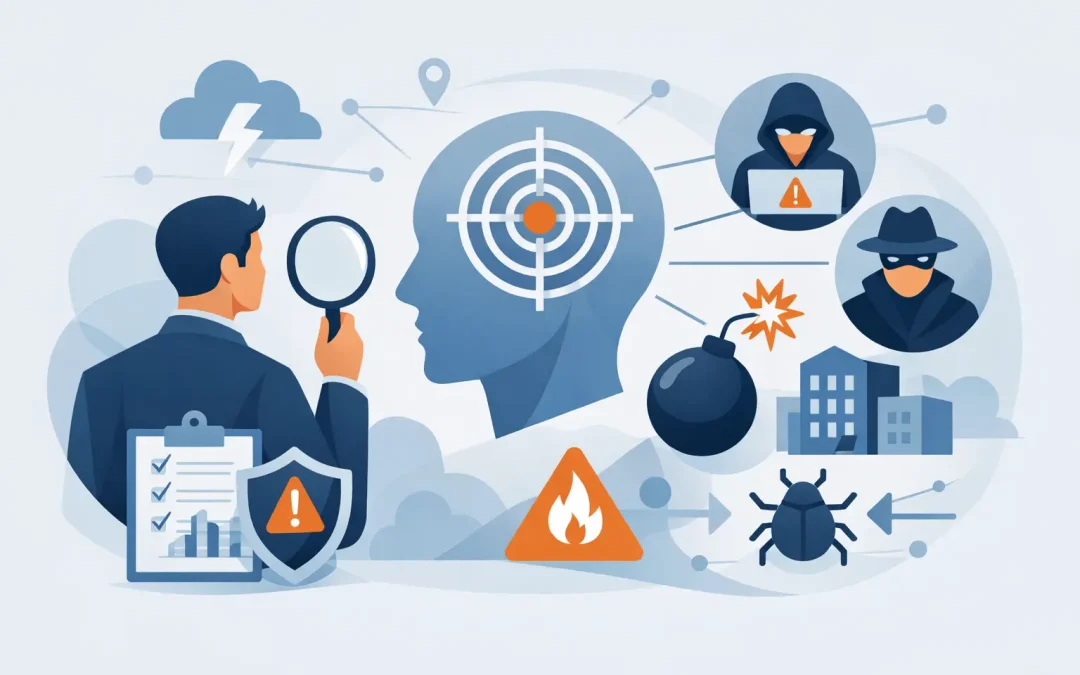
A threat assessment is a structured process used to identify, evaluate, and prioritize a potential threat before it becomes an incident. In professional security and investigative work, it is not guesswork and it is not a generic feeling that something seems off. It is a disciplined review of facts, behavior, context, motive, capability, access, and vulnerability. The objective is simple – determine what the threat actually is, how credible it may be, who or what is exposed, and what protective action is justified.
That sounds straightforward. In practice, it rarely is.
What Is a Threat Assessment in Practical Terms?
At its core, a threat assessment asks four questions. Who is making the threat or displaying concerning behavior? What do they intend to do? Are they capable of doing it? And how exposed is the intended target?
Those questions matter because not every threat is explicit, and not every explicit threat is credible. Some of the most serious cases begin with indirect indicators – fixation, stalking behavior, grievance narratives, repeated boundary violations, surveillance, or attempts to gather personal information. On the other hand, some individuals make dramatic statements with little ability or access to act.
A proper assessment separates noise from danger. It relies on evidence, pattern recognition, and experienced judgment. For high-profile individuals, corporations, NGOs, and legal stakeholders, that distinction can affect travel decisions, event planning, executive protection posture, reporting obligations, and crisis communications.
Threat Assessment Is Not the Same as a Security Survey
Clients often use several risk-related terms interchangeably, but they are not identical. A security survey usually examines physical weaknesses such as doors, cameras, alarm coverage, and access control. A risk assessment often looks more broadly at operational exposure, likelihood, and impact across a business or environment.
A threat assessment is more targeted. It focuses on a specific threat source, concerning actor, hostile communication, emerging pattern, or credible scenario. The emphasis is on threat behavior and intent, not just protective infrastructure. If a company receives an extortion demand, if an executive is being stalked, or if a family office is worried about a former insider, the central issue is not only where the cameras are placed. The central issue is who the adversary is, what they want, and whether they are moving closer to action.
That difference affects response. A client may need enhanced access control, but they may also need discreet surveillance detection, digital footprint reduction, interview work, background development, travel adjustments, or coordination with counsel and law enforcement.
The Core Elements of a Professional Threat Assessment
A credible threat assessment is built on verified information. Professionals begin by collecting and organizing all available facts: messages, call logs, social posts, prior incidents, witness accounts, travel details, litigation history, employment disputes, and any known relationship between the subject and the target.
From there, the analysis usually turns to intent, capability, access, and triggers.
Intent concerns whether the person has communicated a desire to intimidate, harm, disrupt, embarrass, or coerce. Capability looks at whether they have the means to carry out the threat, whether through proximity, resources, weapons access, technical skill, insider knowledge, or support from others. Access examines how close they can get to the target physically, digitally, socially, or through routine patterns. Triggers are destabilizing events that may increase risk, such as termination, legal setbacks, public humiliation, relationship breakdown, financial collapse, or ideological escalation.
Context matters just as much as content. A single message saying, “You will regret this,” may be low concern in one setting and high concern in another. If it comes from a stranger with no identifiable path to the target, the risk picture may be limited. If it comes from a former employee who knows schedules, family names, office access points, and current grievances, the picture changes immediately.
Why Experience Matters in Threat Assessment
Threat assessment is not a checklist exercise. It requires trained judgment.
Two cases can look similar on paper and demand very different responses. One subject may be volatile but disorganized, making them more prone to impulsive contact than sustained action. Another may present calmly, communicate very little, and still pose the greater danger because they are patient, focused, and operationally careful.
This is where experienced investigative and protection professionals add value. They know how to interpret behavioral leakage, distinguish fantasy from preparation, identify escalation indicators, and test whether facts hold up under scrutiny. They also understand the consequences of overreaction. Flooding a situation with visible security, making premature accusations, or mishandling communications can intensify fixation or expose the client to legal and reputational complications.
In higher-stakes environments, assessment is rarely done in isolation. It may involve protective teams, intelligence analysts, legal counsel, HR leadership, travel security planners, and, when appropriate, law enforcement liaison. The best work is coordinated, discreet, and calibrated to the facts.
What Is a Threat Assessment Used For?
The use cases are broader than many clients expect. Threat assessments are commonly conducted when an executive receives repeated threats, when a public figure is being stalked, or when a company suspects insider hostility after a termination or dispute. They are also used before major travel, public appearances, sensitive testimony, contentious litigation, labor actions, or controversial business decisions.
In corporate settings, a threat assessment may support workplace violence prevention, executive security planning, and incident response. For prominent individuals and families, it may shape residential security measures, school route planning, event attendance decisions, and online exposure reduction. For NGOs or international organizations, it can inform field movement, local threat posture, and protective protocols in unstable regions.
The point is not to generate paperwork. The point is to drive action that fits the level of risk.
What a Threat Assessment Can and Cannot Do
A sound assessment can help prevent harm, reduce uncertainty, and give decision-makers a factual basis for next steps. It can show whether a threat appears credible, whether escalation is underway, and whether protective measures should be visible, discreet, temporary, or sustained.
It cannot predict the future with certainty.
That is an important distinction. Security professionals can identify indicators, assess probability, and recommend mitigation. They cannot promise that a subject will or will not act. Anyone claiming otherwise is selling false confidence. Serious threat work is about informed judgment under imperfect conditions.
This is also why reassessment matters. Threat conditions change. A subject may lose interest, be interrupted, relocate, become more unstable, gain new access, or shift tactics from direct communication to surveillance or proxy contact. An assessment should be updated as new intelligence comes in.
The Role of Discretion and Documentation
In sensitive matters, discretion is not cosmetic. It is operational.
High-profile clients, corporate boards, and legal teams often need to manage a threat without creating additional exposure. That means documenting facts carefully, preserving evidence, limiting unnecessary internal circulation, and controlling who contacts the subject. A poorly handled internal response can contaminate evidence, alarm the wrong people, or prompt the subject to accelerate.
Professional documentation also matters if the situation later requires restraining orders, workplace action, insurance reporting, travel modifications, media response planning, or formal coordination with authorities. Facts documented early and accurately tend to matter most when the pressure rises.
For that reason, many clients turn to specialized firms with investigative depth and protective capability under one roof. West Coast Detectives International operates in that space, where threat evaluation is tied directly to factual intelligence, field verification, and practical security response.
When to Request a Threat Assessment
The right time is usually earlier than people think. If a threat has become persistent, personal, fixated, or operationally specific, delay creates risk. The same is true when a person begins testing boundaries, gathering information, appearing unexpectedly, or referencing schedules, family members, residences, or travel.
There does not need to be a weapon displayed or an overt promise of violence to justify an assessment. In many serious cases, the warning signs appear first as pattern, not spectacle.
A disciplined threat assessment gives clients something rare in security matters: clarity. Not perfect certainty, but a defensible understanding of what is known, what is likely, and what should happen next. When reputations, continuity, safety, and human life are on the line, that clarity is not an administrative exercise. It is the basis for sound protection.
