
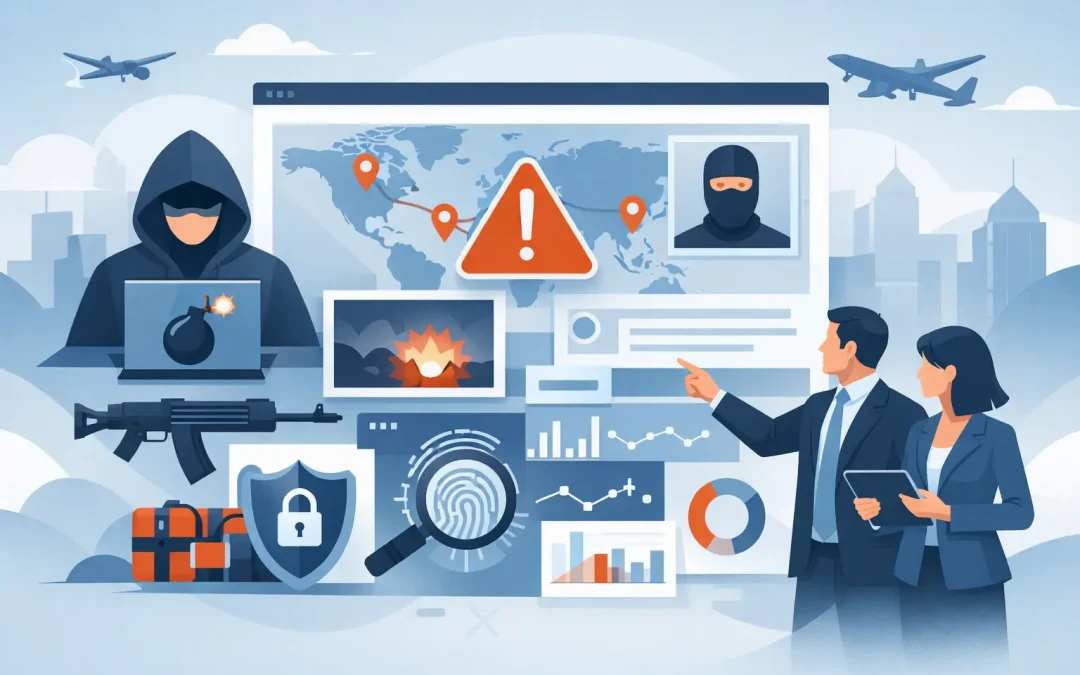
Photo Created by Phil Little
ACTION ALERT: TERRORISM THREAT BRIEFING THAT DELIVERS REAL RESULTS! ?
Listen up, leaders — this is the edge you’ve been waiting for!
After 50 high-octane years leading West Coast Detectives International, I’ve learned one unbreakable truth: Clients don’t need recycled headlines — they need sharp, actionable intelligence that keeps them steps ahead of the threat!
Public news gives you the “what.” We deliver the full picture — the hidden drivers, the shifting connections, and the real-world impact on your people, operations, and travel plans.
Does this emerging threat change your security posture today? Do you need immediate adjustments to your executive protection or route planning? Or is this something we monitor aggressively while you stay focused on business?
That’s the difference between a generic summary and a West Coast Detectives Intelligence Brief that actually matters.
Terrorism threats evolve by the hour, not by the week. Our global network of trusted sources, combined with decades of hard-won HUMINT and on-the-ground experience across hotspots worldwide, gives us the depth public reporting simply can’t touch.
Yes, it takes serious time, relentless updates, and elite resources to deliver this level of clarity. High-velocity executives used to instant results sometimes underestimate what real threat assessment demands — and that’s exactly why we set the expectations up front.
At West Coast Detectives International, we believe in total transparency before any project launches. You’ll know exactly what goes into crafting a briefing that doesn’t just inform — it empowers decisive action.
Prevention beats reaction every single time. We’ve been mastering this for over a century as the “Little FBI,” blending legendary tradecraft with cutting-edge 21st-century tools.
Ready to move from reactive worry to confident, proactive security?
Let’s lock in your personalized terrorism threat assessment today.
West Coast Detectives International — Protecting what matters most, with energy, precision, and unstoppable results!
Contact us now — your team’s safety can’t wait. ?
A late advisory issued after business hours can change a travel profile, disrupt an event plan, or force a reroute for an executive team already in motion. That is why terrorism threat briefing updates are not a routine information product. For serious decision-makers, they are a time-sensitive operating tool that can influence movement, posture, staffing, venue security, and duty-of-care obligations within hours.
For government offices, NGOs, multinational firms, legal teams, and high-profile individuals, the central question is not whether threat reporting exists. It is whether the reporting is current, credible, and specific enough to support action. Too many briefings are built from recycled headlines, broad risk labels, and passive language that does little to help a principal, traveler, or security lead decide what to do next.
What terrorism threat briefing updates should actually deliver
A credible briefing update should do more than state that a country, city, or sector faces elevated risk. Most experienced operators already assume a baseline level of instability in certain regions. The real value lies in narrowing the problem. What is changing now, who is driving that change, what targets are being discussed or surveilled, and how quickly could an environment shift from manageable to unacceptable?
That level of clarity matters because terrorism risk is rarely static. It moves with political events, anniversaries, prosecutions, military actions, sectarian flashpoints, online incitement, and copycat momentum. A briefing that was accurate on Monday may be operationally stale by Wednesday. Executive travel, public-facing appearances, aid operations, and sensitive meetings require updates that reflect live conditions rather than a generic country snapshot.
The best briefings also separate capability from intent. A group may have inflammatory rhetoric but limited logistics. Another may have reduced public messaging yet retain the ability to stage a low-complexity attack against soft targets. Those are very different situations, and they demand different protective responses.
Why headline-driven reporting is not enough
Open-source reporting has value, but it often arrives after the fact or without the field context required to judge significance. A media report may note an arrest, a weapons seizure, or an online claim of responsibility. What it often misses is whether the arrest disrupted a serious network, whether the seizure indicates pre-operational activity, or whether the claim is credible, opportunistic, or false.
That gap between information and judgment is where many organizations become exposed. Security teams can be flooded with alerts and still lack a reliable basis for action. Overreacting carries costs. Underreacting can carry far greater ones. The discipline lies in interpreting the signal correctly.
This is also where regional nuance matters. The same threat language can mean very different things in Western Europe, the Sahel, the Levant, or parts of South Asia. Local policing capacity, border permeability, militant freedom of movement, public sentiment, and infrastructure resilience all affect the operational picture. A serious briefing update accounts for those variables rather than treating every jurisdiction as if the threat matrix were interchangeable.
Terrorism threat briefing updates for executives and travelers
For executive principals and corporate travelers, risk usually appears in practical terms. Can the trip proceed as planned? Does the route need to change? Should the venue be hardened? Is a low-profile ground movement still appropriate? Is local security adequate, or does the operating environment now require additional protective personnel and advance work?
Those questions cannot be answered with broad phrases like increased vigilance advised. They require judgment based on target relevance, timing, geography, and exposure. A luxury hotel district may remain functional while nearby symbolic government sites, transportation nodes, houses of worship, or Western-branded commercial spaces become more sensitive. A conference may be viable in one part of a city and inadvisable in another.
For family offices, entertainment figures, and other public personalities, the picture can become even more complex. Public visibility, predictable schedules, and digital exposure can elevate risk beyond what a standard country brief suggests. In those cases, a terrorism threat briefing update should be integrated with personal threat management, itinerary control, and protective intelligence rather than treated as a stand-alone product.
What separates a useful briefing from a generic one
The difference is usually found in sourcing, analysis, and operational relevance. A generic product compiles publicly available material, assigns a color-coded risk level, and stops there. A useful update identifies what has changed, evaluates source reliability, explains likely scenarios, and clarifies what actions should be considered now.
That does not mean every update must predict an attack. Serious intelligence work is disciplined enough to say when the picture is incomplete. In fact, one mark of credibility is restraint. Inflated warnings erode trust, exhaust budgets, and create complacency over time. Responsible briefings acknowledge uncertainty while still helping clients make defensible decisions.
They also reflect the reality that threat environments are layered. Terrorism risk can overlap with civil unrest, organized crime, kidnap exposure, cyber-enabled targeting, and insider compromise. If a briefing isolates terrorism from every adjacent threat, it may miss the way real incidents develop on the ground.
How decision-makers should use terrorism threat briefing updates
A briefing update should feed a decision cycle, not sit in an inbox as a record of concern. The first step is to determine whether the update changes exposure for a specific person, mission, route, facility, or event. If the answer is yes, the next question is proportionality. Does the development justify added monitoring, a posture shift, physical hardening, schedule changes, or cancellation?
There is no single rule that fits every organization. A humanitarian team, a publicly traded company, and a celebrity principal may all face the same regional warning but require different responses. Their visibility, tolerance for disruption, support infrastructure, and legal obligations differ. The point of a good update is not to produce a universal answer. It is to support a defensible one.
The most effective organizations also avoid treating briefings as isolated documents. They integrate them into travel approvals, executive protection planning, site assessments, event security, and crisis management procedures. When reporting is tied to preexisting action thresholds, teams move faster and with less confusion.
The value of field-informed intelligence
Threat reporting is strongest when analytical work is informed by real-world access, local understanding, and experienced judgment. That may include human source reporting, liaison awareness, regional expertise, protective field feedback, and direct familiarity with how militant or extremist activity manifests in a specific area.
This matters because terrorism does not affect every client in the same way. A diplomatic delegation, a legal witness, a journalist, and a corporate board member can enter the same city under very different risk conditions. One may be largely incidental to the threat picture. Another may be symbolically relevant. Field-informed intelligence helps make that distinction.
For this reason, many high-stakes clients rely on specialist partners rather than commodity alert services. Firms such as West Coast Detectives International are valued not simply for passing along warnings, but for applying investigative discipline, global awareness, and protective judgment to the facts at hand. That distinction is critical when decisions involve principal safety, reputational exposure, and operational continuity.
When an update should trigger immediate review
Not every development requires a major security adjustment. Some do. Immediate review is warranted when there is a credible threat against a target category relevant to your people or operations, evidence of pre-attack surveillance, an uptick in hostile propaganda tied to a specific date or grievance, coordinated arrests indicating an active cell, or a sudden breakdown in local security response capacity.
It is also warranted when planned travel depends on symbolic locations, major transportation hubs, high-visibility accommodations, or public event exposure. Even if intelligence remains fragmentary, the combination of timing and vulnerability can justify a revised plan.
The trade-off is familiar. Cancel too quickly, and operations suffer. Wait too long, and options narrow. That is why decision-makers need updates that are timely, sober, and operationally precise rather than merely alarming.
The discipline behind credible updates
Good terrorism threat briefings are built on verification, context, and a clear understanding of what the client must decide. They are not written to impress. They are written to reduce uncertainty as much as the facts allow.
For serious clients, that standard matters. A board, principal, agency, or family office does not need dramatic language. It needs a realistic reading of threat conditions, a clear sense of relevance, and enough confidence in the reporting to act without hesitation when the situation demands it.
The practical test is simple. After reading the update, does the responsible party know what changed, how it affects current exposure, and what should be reconsidered now? If not, the briefing may be informative, but it is not yet operational.
Threat conditions will continue to shift with little notice. The organizations that manage them best are not the ones collecting the most alerts. They are the ones working from intelligence that is current, disciplined, and close enough to the ground to matter when timing is tight.
