
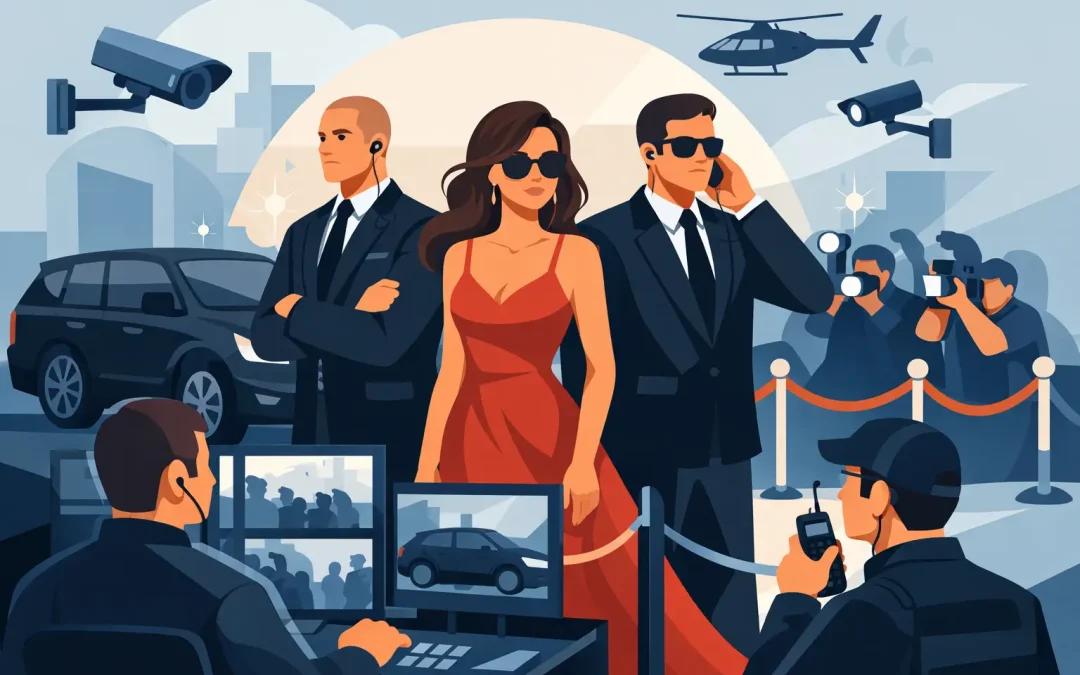
How to Handle Event Security for Celebrities – Fast, Smart, and Bulletproof
Early in my law enforcement and private security career, I learned one critical truth: there is no such thing as a boilerplate security plan that works for every celebrity event.
Every detail is unique, high-stakes, and demands immediate action. The moment you get the call, you treat it like the individual high-threat operation it is — starting right now with aggressive intelligence gathering to identify every possible risk before it can strike.
At West Coast Detectives International, our celebrity protection game completely transformed. Clients used to call asking for the biggest bodyguard they could find. That changed fast. Following years of real-world experience, I built and scaled our elite Threat Management Unit — a dynamic, intelligence-driven force that evolves with every new threat, trend, and tactic out there.
Bottom line: There are zero shortcuts in this business. Never assume any protective assignment is “simple” or “easy.” The moment you let your guard down, that’s when danger strikes. Every event demands razor-sharp preparation, real-time adaptability, and relentless execution.
We stay ahead of the threats so our clients can shine — safely.
What about you? Drop your best lessons and war stories from the protection world below — I’d love to hear how you’ve handled the heat in the field! Let’s swap hard-earned tactics and keep raising the standard together.
Stay sharp, stay proactive, and let’s protect what matters! ?
A celebrity does not need a large public appearance to face a serious security problem. A charity gala, product launch, film premiere, private after-party, or courthouse arrival can create the same exposure if access control is weak, intelligence is stale, or the security team is operating on assumptions. Event security for celebrities is not about visible muscle alone. It is about advance knowledge, disciplined planning, and quiet control over variables that change by the minute.
High-profile clients attract a different category of risk than standard event guests. The threat picture may include fixated persons, aggressive paparazzi, overzealous fans, opportunistic criminals, ideological actors, disgruntled former associates, and digital stalkers who know more than they should. In some cases, the greatest weakness is not outside the perimeter. It is credential abuse, insider leakage, poor venue coordination, or a last-minute schedule change pushed through without a security review.
What event security for celebrities actually requires
The most common mistake in celebrity protection is treating the assignment like crowd management with better suits. That approach fails because the client is not simply attending an event. The client is moving through a layered risk environment that begins well before arrival and often continues after departure.
A professional operation starts with intelligence. That means understanding the venue, neighborhood, arrival routes, emergency exits, local law enforcement posture, likely media presence, and any known threat actors connected to the client or the event. It also means identifying pressure points. Red carpets, underground parking, green rooms, step-and-repeat areas, loading docks, service corridors, and hotel elevators all create different vulnerabilities.
The second requirement is command discipline. Too many event teams have personnel on site but no real command structure. Protective agents, venue security, event management, drivers, and publicists may all be working from different assumptions. When that happens, small disruptions escalate fast. A functioning security plan defines who has authority, how changes are approved, and what the extraction decision looks like before pressure starts building.
Discretion matters as much as strength. A visible detail can deter some threats, but excessive visibility can also amplify attention, create congestion, and interfere with the client’s objectives. For many celebrities, the event itself has commercial value. They need to be seen, photographed, and available within controlled limits. Security that dominates the room can be as damaging as security that fails.
Threats are rarely limited to the event floor
Security planning often focuses on the ballroom, theater, or venue entrance. In practice, the exposure begins earlier. Travel from residence or hotel to venue is often predictable. Staging areas can be compromised by leaks. Parking structures are common weak points because they combine poor visibility, choke points, and mixed access.
Hotels present another problem. A celebrity may be protected at the event, then exposed in lobbies, private dining rooms, spas, elevators, or valet zones. The same applies to after-parties and informal gatherings, where standards often drop because the setting feels private. In reality, loosely controlled private events can produce worse security outcomes than public venues because guest vetting and perimeter control are weaker.
Digital exposure also affects physical security. Real-time social posts, leaked itineraries, staff photos, geotagged content, and ride information can collapse a carefully built protective plan. Event security for celebrities now requires a working understanding of how online visibility shapes on-the-ground risk. The fastest route to a compromised movement plan is a staff member posting from backstage before the principal has departed.
The advance work decides the outcome
A strong event operation is built before the principal steps into the vehicle. The advance should include a venue assessment, route review, principal-specific threat briefing, credential review, staff coordination, and contingency planning. If the event is significant, a rehearsal or live walk-through is often warranted.
Venue assessment is not a box-checking exercise. Security professionals should know where crowds can form, which doors are actually usable, whether emergency exits are alarmed or blocked, where cameras are placed, and how quickly the principal can be moved to a hardened or at least controlled location. It also helps to understand the venue culture. Some sites run disciplined operations. Others are chaotic, image-driven environments where access rules disappear the moment a recognizable face arrives.
Credentialing deserves special scrutiny. Counterfeit badges, borrowed wristbands, and informal guest-list additions are common pathways for access abuse. A well-run operation limits who can approach the principal, who can enter prep areas, and who can authorize last-minute exceptions. If everyone has override authority, then no one is really controlling access.
Transportation planning is equally important. Primary and alternate routes should be established in advance, but they must also be realistic. The shortest route is not always the safest, and the most secure route may be impractical if it causes the principal to miss a required appearance. This is where experienced judgment matters. Protection is always balancing risk against operational need.
Close protection must fit the client, not the ego of the team
Some clients need a hard perimeter and tightly managed movement. Others require a lower profile posture that preserves public interaction while still controlling approach angles and extraction options. Neither model is automatically correct. It depends on the client’s threat profile, public role, recent incidents, fan behavior, venue design, and the purpose of the appearance.
An actor at a film premiere, a recording artist at a nightclub appearance, and a public figure at a fundraising event present very different security equations. The audience, energy, alcohol presence, media interest, and ingress patterns change the protective design. A generic package does not solve that.
The best close protection teams understand how to maintain control without creating friction with managers, stylists, publicists, and production staff. That requires professionalism and restraint. Protective personnel who argue, posture, or improvise access rules in front of stakeholders create their own problems. Authority must be clear, but it should be exercised with discipline.
Why coordination failures cause most event incidents
In many celebrity incidents, the breach was not caused by an unstoppable threat. It was caused by a preventable communication failure. The principal exits through the wrong door because the driver was repositioned without notice. A fan gets too close because event staff opened a line to move VIP guests. A photographer enters a restricted corridor because someone assumed another team had cleared it.
This is why unified communication matters. One command lead should maintain contact with the protective detail, driver, venue lead, and event representative. Changes to timing, route, holding area, or guest access should move through that channel. Radio traffic should be clear and controlled. If the environment does not support radios, then secure alternative communication must be arranged in advance.
Medical readiness also deserves more attention than it often gets. Not every event needs a full medical footprint, but every serious plan should account for injury, panic, collapse, or a crush scenario. If a principal, guest, or staff member goes down in a dense crowd, seconds matter. The extraction route for a medical emergency is not always the same route used for a dignitary movement.
When to scale up security
Not every appearance requires a large detail, but some conditions justify a higher level of protection. Recent threats, contentious publicity, custody disputes, active stalking cases, politically charged appearances, international travel, unstable crowd environments, and poorly controlled venues all increase the need for more substantial planning and staffing.
Scale should be driven by facts, not optics. A low-profile literary event may warrant serious security if the client has an active threat issue. A highly publicized entertainment event may require less than expected if the venue is controlled, the client has no known threat indicators, and movement is tightly managed. The point is not to overbuild every assignment. It is to match resources to real exposure.
This is where a firm with investigative depth offers an advantage. Security decisions improve when they are informed by current threat intelligence, behavioral indicators, and factual pre-event analysis rather than appearance alone. West Coast Detectives International operates from that principle. Protection is strongest when advance intelligence and field execution work as one system.
The standard should be calm control
The public often assumes good security looks dramatic. In reality, the best event operation is usually the one nobody notices. The principal arrives on time, moves as planned, engages as required, and departs without confusion. Crowds are managed, access remains controlled, and the team adjusts to changes without visible strain.
That level of performance comes from experience, not theatrics. It comes from knowing when to harden the posture, when to reduce the footprint, and when to say no to a request that introduces unnecessary risk. For celebrities, the goal is not simply to get through the event. It is to protect personal safety, privacy, reputation, and freedom of movement without turning the appearance into a security spectacle.
A well-protected event still feels like an event. That is the mark of a mature operation, and it is what high-profile clients should expect.
