
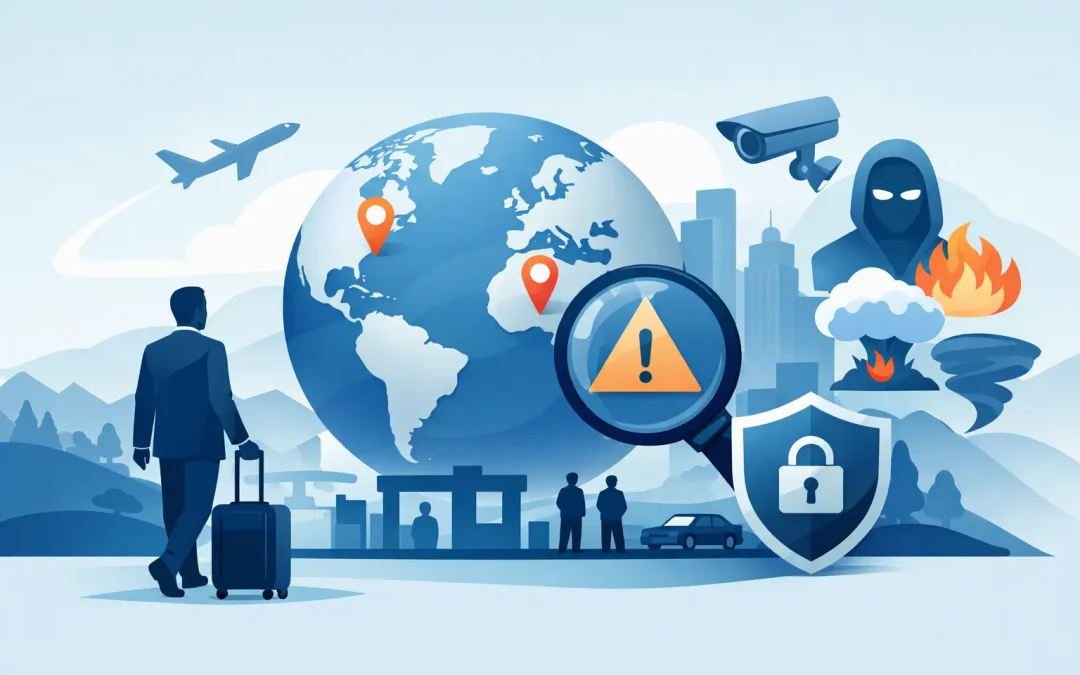
A senior executive lands in a capital city for a two-day meeting. The itinerary appears routine: airport transfer, hotel, boardroom, departure. Yet the real risk picture may include a protest route that changes by the hour, a local kidnapping pattern targeting affluent visitors, compromised hotel Wi-Fi, an online disclosure of the traveler’s location, or a medical evacuation route that no longer functions as planned. Global travel threat trends are no longer confined to conventional travel warnings. They are layered, fast-moving, and often personal.
For corporations, NGOs, government personnel, legal teams, and high-profile individuals, travel security cannot be treated as an administrative task completed when tickets are issued. It is an intelligence and protection function. The objective is not to eliminate every uncertainty. It is to identify material threats early, make sound decisions under changing conditions, and ensure that the traveler has credible support on the ground.
Global Travel Threat Trends Are Becoming More Interconnected
The most significant change in international travel risk is convergence. Political instability can create criminal opportunity. Armed conflict can disrupt commercial aviation, border access, fuel supplies, and medical care well beyond the immediate area of fighting. A public controversy or commercial dispute can become a personal threat when an executive’s identity, schedule, or location is exposed online.
This convergence matters because a destination assessed as broadly safe may still present a serious exposure for a particular traveler. A company representative involved in a sensitive negotiation faces a different risk profile than a tourist. A public figure may attract unwanted attention in a country with low violent crime. A legal professional carrying evidence or attending a contentious proceeding may face surveillance, theft, or coercion risks that ordinary travelers do not.
Risk assessments must therefore move beyond country-level color coding. They should account for the traveler’s profile, purpose of travel, public visibility, affiliations, route, accommodation, local contacts, and ability to leave quickly if circumstances deteriorate.
Political Volatility and Civil Unrest Can Shift Without Warning
Demonstrations, labor actions, election-related unrest, and sudden government restrictions are among the most operationally disruptive travel threats. Many gatherings remain peaceful. The danger lies in assuming that a peaceful event will remain peaceful, or that a protest affecting one district will not interrupt access to an airport, hotel, office, or hospital.
Travelers often encounter the practical consequences before they encounter direct violence. Roads close. Mobile networks slow or fail. Ride services disappear. Curfews are imposed with limited notice. Police activity changes normal traffic patterns, while crowds can make an otherwise secure route unusable.
The appropriate response depends on proximity and purpose. A traveler with no essential business near an affected area should avoid it. A team whose assignment requires movement through a volatile environment needs current route intelligence, vetted transportation, a reliable communications plan, and a clear authority structure for deciding when to pause or depart. Improvisation is rarely a protective strategy.
Conflict Risk Extends Beyond Active War Zones
Conflict-related risk is not limited to destinations formally designated as war zones. Neighboring countries can experience refugee flows, border restrictions, heightened policing, supply shortages, cyber activity, or retaliatory violence. Airspace closures and altered flight paths may affect travel far from the original flashpoint.
For organizations, the concern is continuity as much as physical safety. Can personnel communicate? Is there a functioning medical capability? Are secure ground transfers available? Does the traveler have documents, funds, medications, and an alternate departure option if commercial transport is interrupted? These are operational questions, not theoretical ones.
Criminal Threats Are More Targeted and More Informational
Street crime remains a concern in many locations, but sophisticated travelers increasingly face targeted theft, express kidnapping, fraud, surveillance, and social engineering. Criminal groups do not need to know every detail of a target’s life. A visible watch, a branded vehicle, a public conference appearance, or an unsecured social media post can be sufficient to identify opportunity.
Business travelers are particularly vulnerable when their movements are predictable. Airport arrivals, hotel lobbies, conference venues, upscale restaurants, and nightlife districts are places where criminals can observe behavior and build a profile. The threat may be financial rather than violent: theft of a laptop, device compromise, credential harvesting, or a fraudulent payment request timed to coincide with a traveler’s absence from the office.
Hotel selection deserves more scrutiny than star ratings and convenience. A suitable property should be evaluated for access control, room location, emergency exits, vehicle approach, surrounding environment, and the reliability of its response during an incident. The closest hotel to a meeting may not be the best choice if it limits movement or exposes the traveler’s routine.
Digital Exposure Has Become a Physical Security Issue
The separation between cyber risk and personal security is steadily disappearing. A compromised phone can reveal location data, contacts, travel plans, and commercial information. A spoofed message may redirect a traveler to an unsafe pickup point. Public posts can disclose a real-time itinerary to people who have no legitimate need to know it.
Travelers should assume that unfamiliar networks, charging stations, QR codes, and urgent messages require scrutiny. This does not mean avoiding technology. It means using it with discipline. Corporate devices should be configured for travel, sensitive data should be minimized, multi-factor authentication should not rely solely on an inaccessible phone number, and reporting procedures should be understood before departure.
High-profile travelers require additional care. Publicity schedules, paparazzi interest, litigation, relationship disputes, and persistent unwanted contact can generate risks that do not appear in standard destination reporting. A tailored threat review can determine whether protective presence, controlled transportation, discrete advance work, or itinerary adjustments are warranted.
Medical and Infrastructure Disruption Remain Decisive Factors
A security plan that overlooks medical capability is incomplete. Illness, accidents, and chronic health events can become critical when local emergency care is limited, roads are blocked, or language barriers delay treatment. Environmental conditions such as extreme heat, flooding, severe storms, poor air quality, and infectious disease activity can compound the problem.
Infrastructure failure also changes the risk equation quickly. Power outages affect elevators, access systems, communications, and fuel availability. Flooding can isolate districts and close airports. A strike can suspend public transportation and leave travelers dependent on unvetted alternatives. The question is not whether every disruption can be predicted. It is whether the traveler has practical options when normal systems fail.
What Mission-Ready Travel Planning Looks Like
Effective travel risk planning is proportionate. An executive visiting a stable city for a private meeting does not necessarily require the same protective posture as a team entering a politically sensitive region. Excessive security can draw attention, impede business, and waste resources. Insufficient preparation can leave an organization without choices when conditions change.
A defensible plan normally addresses five areas:
- A current assessment of destination, traveler, and assignment-specific threats.
- Vetted transportation, accommodations, local contacts, and alternate routes.
- Communications procedures, including check-ins, emergency contacts, and escalation authority.
- Medical preparation, document security, contingency funds, and evacuation considerations.
- Real-time monitoring that can convert information into a decision before an incident reaches the traveler.
The final point separates static travel advice from protective intelligence. A report prepared a week before departure may establish a baseline, but it cannot account for a sudden demonstration, a developing threat against a facility, or a route closure on the day of movement. Relevant intelligence must be current, verified, and connected to someone empowered to act.
The Value of Local Human Intelligence
Public reporting and automated alerts are useful, but they have limits. They may be delayed, incomplete, or unable to distinguish a broad disruption from a threat affecting a specific hotel, route, neighborhood, or individual. On-the-ground human intelligence provides context: whether an area is actually passable, whether a protest is expanding, whether a local contact is credible, and whether a security concern is routine or exceptional.
This is where experienced investigative and protective resources matter. West Coast Detectives International approaches travel security as a tailored operational assignment, drawing on investigative judgment, international contacts, threat management, and protective planning rather than issuing generic safety advice. The right level of support depends on the assignment, but the standard should remain the same: factual intelligence, clear recommendations, and discretion.
Travel will always involve uncertainty. The responsible course is not to surrender mobility or treat every destination as hostile. It is to recognize that a traveler’s exposure is shaped by more than geography. Before the next departure, ask the question that matters most: if the plan changes at midnight, who has the facts, who can make the decision, and who can get the traveler safely to the next point?
