
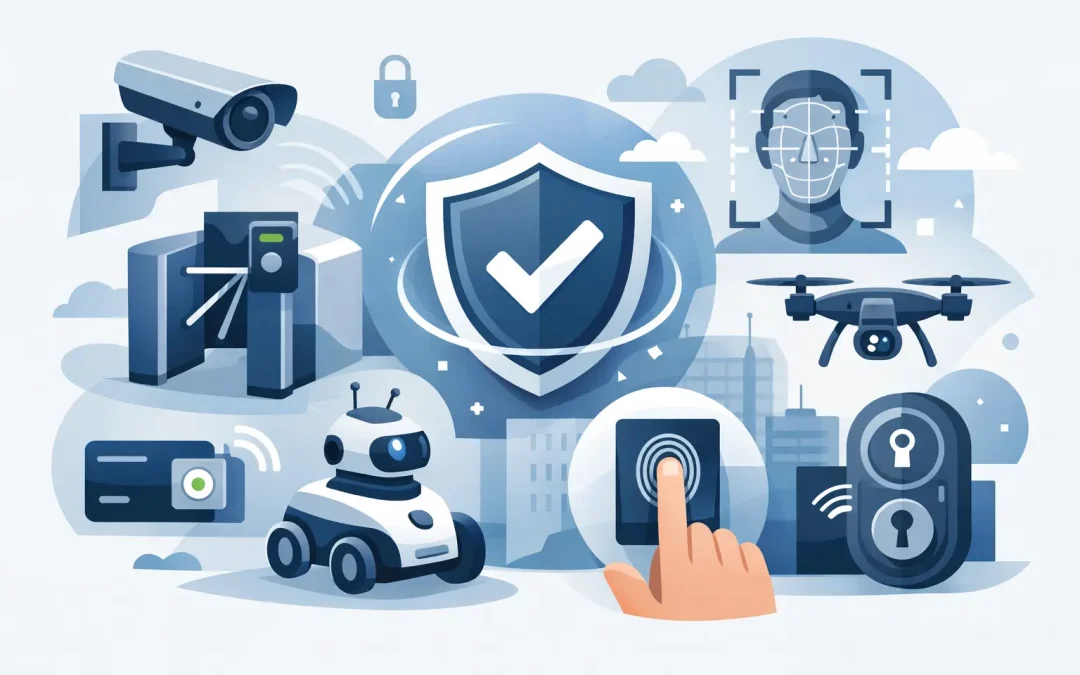
Since the very beginning of my career in the military, law enforcement, intelligence, and global security, I’ve witnessed technology transform our world at breakneck speed — and it’s been nothing short of revolutionary.
In the early days, it was all about boots on the ground: physical bodies watching, patrolling, and reporting. When I took command of West Coast Detectives International, the agency was massive — over 1,500 employees, many of them uniformed security personnel. Looking back, I’m still stunned by the incredible quality of people we had protecting businesses and clients… all while earning just $1.75 an hour. Back then, our real profits came from the high-level Investigative divisions.
Security itself was basic: lights, fences, and guards making rounds, clocking in at checkpoints. But as we headed into the 1980s, the quality of available security personnel began to sharply decline. That forced a decisive shift — I downsized the traditional security division and pivoted hard toward more professional, intelligent approaches.
Then technology exploded. I aggressively embraced it, pushing our team to develop cutting-edge tools and systems in-house. What started as a few innovations quickly evolved into powerful, ever-expanding platforms.
Today, we stand at a critical moment. The threats are faster, smarter, and more dangerous than ever. But so are our capabilities.
What follows are my hard-earned thoughts on where we are right now — and how we can urgently harness the full power of modern technology to protect lives, safeguard property, and stay ahead of those who would do harm.
A camera that records an incident after the fact is no longer enough. For corporate leaders, security directors, family offices, and organizations operating across borders, the real question is whether physical security technology trends are improving prevention, decision-making, and response under pressure. The market is crowded with products, but serious protection work still comes down to one standard – does the technology produce actionable intelligence when time, reputation, and safety are on the line?
The most significant changes in physical security are not about replacing trained personnel. They are about giving security teams better visibility, faster verification, and stronger control in environments where threats move quickly and often cross from digital warning signs into physical exposure. That matters whether the assignment involves executive protection, a corporate campus, a residential estate, a logistics facility, or travel planning for personnel entering an unstable region.
Physical security technology trends that are changing protection work
The strongest trend in the market is the shift from passive hardware to intelligence-led systems. Cameras, sensors, access control readers, and monitoring platforms are being tied together so they can support real decisions instead of generating endless footage and false alarms. The difference is substantial. A well-designed security program now aims to identify abnormal behavior early, verify risk in real time, and direct personnel to act with precision.
That shift favors clients who think strategically. Buying devices is easy. Building a security architecture that fits operational risk, legal constraints, and reputation concerns is harder. The organizations seeing the best results are not chasing gadgets. They are aligning technology with threat management, travel risk, protective intelligence, and site-specific vulnerabilities.
1. AI-assisted video analytics are becoming operational tools
Video analytics has matured beyond simple motion detection. Advanced systems can now flag loitering, perimeter breaches, tailgating, abandoned objects, directional movement, and unusual patterns that would otherwise be missed in a live monitoring environment. In high-traffic facilities, that can reduce the burden on operators who would never realistically catch every anomaly across dozens or hundreds of feeds.
The benefit is speed, but the trade-off is calibration. AI is only useful when it is trained and tuned to the actual environment. A logistics center, a private residence, a school, and an executive office tower all produce different normal patterns. Poor setup leads to alert fatigue. Proper setup creates earlier warnings and better allocation of personnel.
For high-risk clients, the practical value is often in verification. An alert tied to video analytics can help determine whether a suspicious approach is a nuisance, a protest risk, a stalking concern, or a developing attack path.
2. Access control is moving toward identity intelligence
Badge systems alone no longer meet the standard for many sensitive sites. Access control is increasingly tied to layered identity management, including mobile credentials, biometric verification, behavioral rules, and time-based access permissions. This is especially relevant for organizations managing contractors, temporary staff, overseas visitors, and executives with irregular movement patterns.
The trend is not simply tighter entry. It is more precise control over who can go where, when, and under what conditions. In practical terms, that reduces insider risk, supports auditability, and limits the common problem of over-permissioned users who retain access long after business need has changed.
Biometrics are part of this trend, but they are not universally appropriate. In some environments, they improve certainty. In others, they raise legal, privacy, labor, or reputational concerns. The right decision depends on the threat profile and governance framework, not on marketing claims.
3. Cloud-managed security is improving oversight across multiple locations
For organizations with regional offices, residences, retail footprints, campuses, or global operations, cloud-managed platforms have become more attractive because they centralize visibility. Security teams can review footage, manage credentials, receive alerts, and coordinate response without relying on fragmented local systems.
That creates clear operational advantages. It supports standardization, shortens review time after incidents, and allows leadership to compare risk patterns across sites. It also helps organizations that need to maintain oversight during travel, crisis events, or after-hours incidents.
Still, cloud adoption should not be treated as automatic progress. Sensitive clients may have legitimate concerns about data residency, vendor access, outage resilience, and legal exposure. In some cases, a hybrid model is the better answer, keeping certain functions local while still gaining the management benefits of centralized oversight.
Where physical security technology trends meet real risk
The most useful technologies are the ones that close the gap between warning and action. That is why another major development is the integration of physical security with intelligence inputs and incident response workflows.
4. Sensor fusion is reducing blind spots
Single-device security fails in predictable ways. A camera may miss a corner. A fence sensor may generate a false alarm. An access event may look ordinary in isolation. When multiple data points are combined, the picture becomes more reliable. That is the value of sensor fusion.
Today, more systems are correlating inputs from cameras, door events, perimeter detection, gunshot detection, environmental sensors, vehicle data, and panic alarms. When designed correctly, this can shorten the time needed to classify an event and dispatch the right response.
For executive residences, corporate headquarters, and critical infrastructure, sensor fusion can be particularly effective because it supports layered defense. It allows teams to understand not only that something happened, but where, in what sequence, and whether it fits a broader pattern.
5. Remote guarding and virtual monitoring are becoming more credible
Remote monitoring used to carry a mixed reputation, often associated with low-cost surveillance rather than serious security work. That has changed. Better analytics, two-way audio, thermal imaging, and structured escalation protocols have made remote guarding more effective in many environments.
This does not mean remote coverage replaces on-site personnel. It means there are now situations where a remote operations center can extend coverage, verify events, issue verbal challenges, and escalate to local assets with greater efficiency than a traditional alarm-only model. For lower-traffic facilities, construction sites, warehouses, and after-hours office environments, that can be a meaningful force multiplier.
The limits are obvious. Remote teams cannot physically intervene, and not every incident can be managed at a distance. But when integrated into a broader protective plan, virtual monitoring can improve early detection while controlling cost.
6. Drone detection and counter-UAS planning are entering mainstream security discussions
A few years ago, many organizations treated drone threats as niche concerns. That is no longer realistic. Drones can be used for surveillance, disruption, smuggling, harassment, and targeted hostile activity. For corporate compounds, public events, executive movements, and critical sites, airspace awareness is becoming part of the physical security conversation.
The trend is not just in detection hardware. It includes policy development, response protocols, legal review, and coordination with local authorities. Many clients are surprised to learn that identifying a drone is easier than lawfully neutralizing one. That legal distinction matters.
The right approach depends heavily on the operating environment. A rural industrial site, a stadium, and a private estate each present different practical and legal constraints. Serious planning starts with threat assessment, not with buying equipment.
7. Security platforms are being judged by response workflow, not feature count
One of the healthiest shifts in the market is that buyers are becoming more skeptical of bloated feature sets. The best systems are now evaluated by a simpler measure – how quickly they help a trained team assess, escalate, document, and respond.
This is where many deployments succeed or fail. A platform may offer impressive analytics and dashboard views, but if it does not support clean workflows during a real incident, its value drops fast. Security leaders increasingly want systems that tie alerts to standard operating procedures, case notes, communication logs, and post-incident reporting.
That is a positive development because it brings technology back into its proper role. Tools should support command judgment, not distract from it.
What security buyers should watch next
The next phase of physical security technology trends will likely involve deeper integration between protective intelligence, travel risk monitoring, cyber indicators, and site-based security controls. The reason is straightforward. Threats rarely remain in one lane. An online fixation can become a workplace approach. A geopolitical warning can affect executive travel. A labor dispute can escalate into access control concerns and protest activity.
The organizations best positioned for this environment will be the ones that treat security technology as part of a wider intelligence and protection strategy. That means disciplined assessments, realistic testing, clear governance, and personnel who know how to interpret signals under pressure. It also means understanding that more technology does not always create more security. In some environments, complexity creates failure points.
For clients operating in high-consequence settings, the better question is not which trend is newest. It is which technology improves situational awareness, strengthens prevention, and stands up when conditions are fluid and stakes are high. That is where experienced advisory support still matters. West Coast Detectives International and firms of similar operational depth understand that protection is not built by hardware alone. It is built by combining intelligence, planning, field judgment, and the right technology for the mission.
The strongest security posture is usually not the most visible one. It is the one that identifies risk early, acts quietly, and gives decision-makers reliable facts before a situation hardens into a crisis.
