
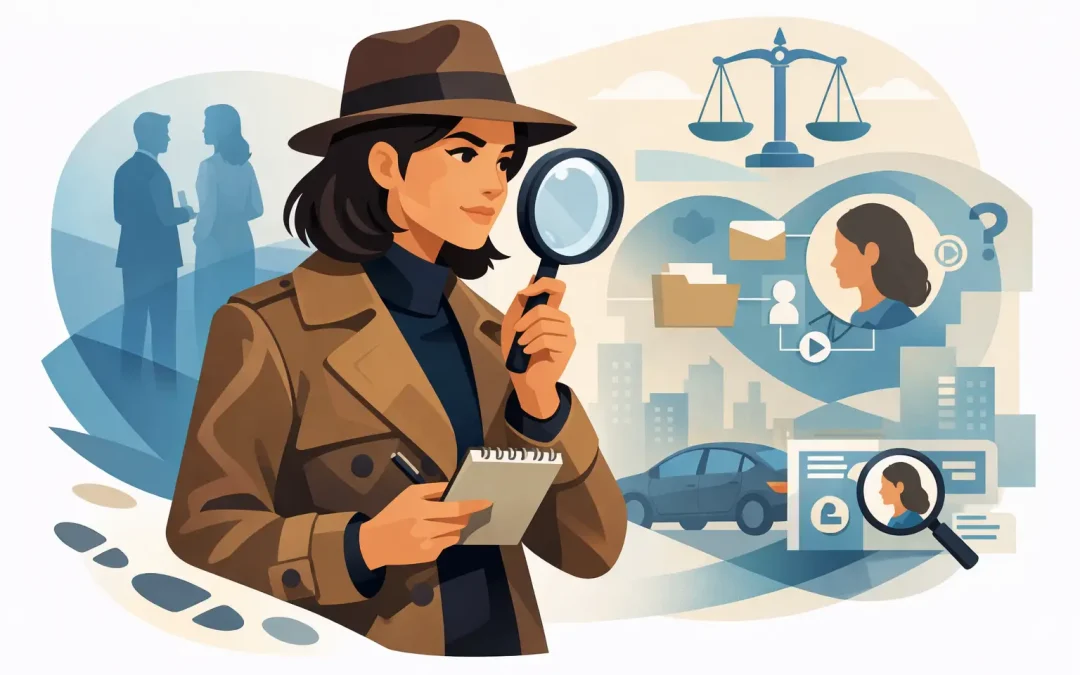
Female Agents Rock Our World! I get asked about our amazing female agents all the time — especially when I meet a sharp woman who finds out I’m a private detective and immediately lights up with: “I would make a great agent!” Then she tells me exactly why… and she’s usually right! Here’s the exciting truth: On countless assignments over the years, our female agents have smashed cases wide open that everyone else thought were unsolvable. And it’s not just about looks or charm (though that can help). Women often bring a completely different skill set — sharper intuition, better rapport-building, incredible attention to detail, and the ability to blend in where a man simply can’t. They see angles and opportunities that crack cases faster! Safety first — always. Let me be crystal clear: Our female agents never enter personal relationships or engage in any sexual activity while on assignment. Every operation is strictly professional. They’re backed up by support agents within immediate contact range, and all interactions are monitored live through professional recording equipment. Their safety and integrity are non-negotiable! When I took over West Coast Detectives International, we already had a powerhouse Women’s Division with 25 outstanding female agents — many of them talented actresses who brought serious skills and flexibility to the table. Looking back over thousands of cases, the success stories featuring our female agents are some of the most thrilling highlights in the agency’s history! Important note: The case always dictates the team. Not every investigation calls for a female agent, and many require a very specific age, background, or appearance to match the target’s world. There’s no one-size-fits-all approach — every case gets a custom strategy built for maximum success! This report is my high-energy answer to all the enthusiastic questions I receive about our female agents. They’re an unstoppable force in our agency, and I couldn’t be prouder of the incredible work they do every single day! Let’s solve some cases! ?
A surveillance team can have the right equipment, legal authority, and a clear objective – and still fail because the subject notices the wrong person at the wrong moment. That is usually where the real answer to when is a female detective more effective than a male begins. It is not a question of general superiority. It is a question of access, perception, environment, and the operational demands of a specific case.
In serious investigative work, the best operator is the one who can collect reliable facts without disturbing the target environment. Sometimes that investigator is male. Sometimes female. The deciding factor is not ideology. It is whether the assignment requires a profile, communication style, or presence that increases the probability of obtaining accurate intelligence while reducing exposure.
When is a female detective more effective than a male in the field?
A female detective is often more effective when visibility itself is the risk. In many settings, women draw less suspicion during surveillance, witness development, and social contact operations. A man sitting alone in a parked vehicle near a school, boutique hotel, playground, day spa, or family-oriented venue may be remembered quickly. A woman in the same environment may blend more naturally, particularly if the subject pool includes families, caregivers, or professional women.
That advantage is practical, not theoretical. Investigations are frequently won or lost on whether a subject feels watched. If the operative can remain unnoticed longer, the client gets more usable reporting and fewer compromised hours in the field.
The same principle applies to static observation inside mixed social environments. Coffee shops, airport lounges, medical offices, retail spaces, and residential neighborhoods all produce patterns of normal behavior. A female detective may match those patterns more convincingly in certain assignments, especially where a male presence appears out of place or overly fixed.
None of that means a woman is always less detectable. In male-dominated spaces such as some industrial yards, transport hubs, certain bars, or tightly knit street environments, a female operative may stand out more. That is why competent firms build teams around the mission rather than the assumption.
Interviews, rapport, and disclosure
Many investigations turn on conversation, not confrontation. In witness interviews, internal complaints, family disputes, harassment allegations, and sensitive background matters, people often reveal more to someone they perceive as safer, calmer, or less threatening. A female detective can be especially effective in these circumstances.
Victims of stalking, domestic abuse, sexual misconduct, coercive control, or workplace harassment may be reluctant to speak candidly with a male investigator at the outset. That hesitation does not always reflect distrust of men. It often reflects trauma, embarrassment, or fear of being misunderstood. A female detective may lower that barrier and produce fuller, more accurate accounts earlier in the process.
This matters operationally. Early disclosure shapes timelines, suspect lists, digital preservation decisions, and protective recommendations. When a client or witness speaks more freely, the investigation starts with stronger ground truth instead of partial fragments.
Female detectives can also be effective in cases involving adolescents, family systems, or emotionally charged domestic dynamics. They may be perceived as more approachable during initial contact, which can help gather nuanced information that a harder interview posture would miss. Again, the point is not that women are inherently better listeners. It is that subjects sometimes respond differently, and that difference can materially affect case outcomes.
Sensitive assignments where perception changes access
Perception matters in executive and private-client work. In high-net-worth households, reputationally sensitive environments, and cases involving nannies, household staff, personal assistants, estranged partners, or wellness providers, a female investigator may gain cooperation more efficiently because she is not immediately coded as a threat.
That can be useful in lifestyle verification, infidelity matters, insider-risk inquiries, and discreet reputation protection assignments. It can also help in pretext-adjacent legal information gathering where tone, credibility, and social ease affect whether a source keeps talking or shuts down.
The same is true in some corporate settings. During internal fact-finding around HR complaints, discrimination concerns, retaliation allegations, or misconduct reports, female investigators may elicit greater trust from employees who already feel vulnerable. A witness who fears being judged may answer in guarded phrases with one interviewer and in precise detail with another.
Female detectives in undercover and HUMINT work
Human intelligence is built on access, credibility, and patience. In selected undercover scenarios, female detectives can be extremely effective because they are underestimated. Underestimation is a tactical advantage. People speak more freely around someone they have prematurely dismissed.
In social engineering-resistant environments, this can create openings that a more overtly authoritative male presence might close. A subject may volunteer routines, names, preferences, grievances, or travel details in conversation that seems casual. The operative who appears non-threatening often hears what the more obvious investigator never will.
This is especially relevant in hospitality settings, conferences, social clubs, luxury retail environments, and relationship-driven communities where information moves through informal channels. A female detective may also be better positioned to engage spouses, girlfriends, domestic staff, reception personnel, or social contacts who are central to the intelligence picture but not reachable through formal inquiry.
That said, undercover work is where stereotypes can become dangerous if used lazily. Success depends on legend development, language skill, cultural fluency, and discipline under pressure. Gender may open the first door. Tradecraft determines whether the operation succeeds after that.
Cases involving female subjects
There are assignments where a female subject is simply more likely to trust, engage with, or confide in another woman. This is common in missing person traces, welfare concerns, runaway cases, coercion matters, and investigations involving exploitation or grooming. A female detective may build rapport faster and obtain details that a male investigator cannot access without resistance.
There is also a practical side to this in surveillance and movement tracking. Following a female subject into spaces such as salons, women-focused fitness venues, changing areas near pools or spas, or gender-skewed social spaces can create access limits for a male investigator. A female operative can preserve continuity in the observation without forcing a handoff that risks losing the subject.
For protective intelligence, this continuity matters. Gaps in movement analysis can conceal meetings, dead drops, emotional triggers, or deviations from stated routine. The right investigator keeps the picture intact.
The limits of the question
The question of when is a female detective more effective than a male is useful only if it stays tied to operational reality. The wrong way to frame it is as a contest between men and women. The right way is to ask which investigator – or investigative pairing – gives the client the best chance of obtaining verified facts while protecting discretion.
Some assignments benefit from a mixed team. A male-female surveillance unit can rotate positions, cover different venues, and adapt more naturally to fluid environments. Joint interview strategy can also be effective, with one investigator establishing comfort and the other testing consistency, detail, and timeline integrity.
High-stakes firms do not build cases around clichés. They assess the target, jurisdiction, threat environment, culture, witness profile, and desired end state. Then they select the personnel whose presence will advance the mission.
What sophisticated clients should actually ask
A better client question is not whether a female detective is better in general. It is whether the case involves one or more of the following conditions: the need to reduce suspicion, a sensitive witness profile, access to female-centered environments, trauma-informed interviewing, or social settings where underestimation creates intelligence value.
If the answer is yes, a female detective may offer a clear operational edge. If the case requires overt deterrence, physical command presence, or access to male-dominated networks, the balance may shift. In many matters, the strongest answer is a coordinated team built around experience and fit.
That is how seasoned investigative organizations approach staffing. At West Coast Detectives International, as with any serious intelligence-led practice, assignments should be built around outcome, discretion, and field reality – not assumptions about who ought to be effective.
The most effective detective is the one whose presence gets the truth without disturbing the ground it sits on. In the best investigations, that choice is never accidental.
