
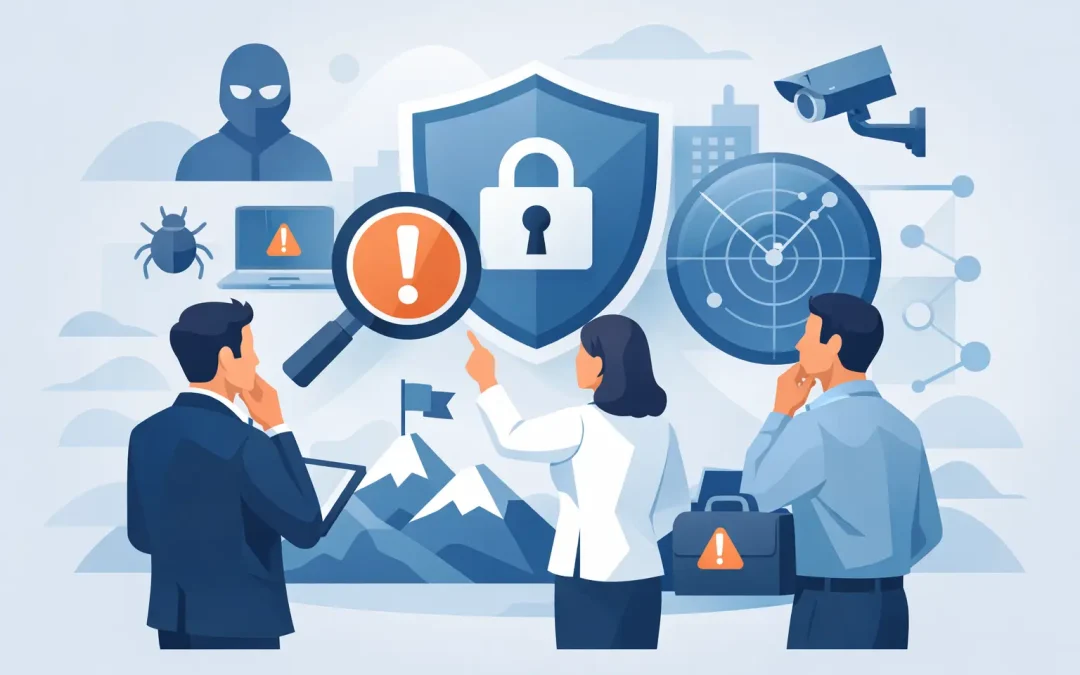
A credible threat rarely arrives as a single, obvious event. It develops through fragments: an employee complaint, hostile online commentary, unusual contact with an executive, a disputed termination, an upcoming overseas trip, or intelligence that does not yet fit a clear pattern. This corporate threat assessment guide explains how leadership teams can turn those fragments into defensible decisions before an issue becomes a crisis.
The objective is not to predict every act of violence, disruption, fraud, or reputational attack. It is to establish facts, judge intent and capability, identify vulnerabilities, and apply proportionate protective measures. For organizations with visible leaders, sensitive operations, contentious public profiles, or international exposure, that discipline is a core management responsibility.
What a Corporate Threat Assessment Is Designed to Do
A corporate threat assessment is a structured examination of a person, group, event, location, or circumstance that may create harm to people, assets, operations, information, or reputation. It goes beyond a generic security review. A security review may identify that a facility has poor access control. A threat assessment asks who may exploit that weakness, why they may act, what warning behavior exists, and what action is justified now.
The distinction matters. Organizations often overreact to alarming language while underreacting to credible behavioral indicators. A threatening email from an unknown sender may require preservation and initial review, but not necessarily a major protective deployment. By contrast, a former employee who knows a principal’s routine, has made targeted grievances, has attempted repeated contact, and has demonstrated access to weapons or restricted areas presents a materially different concern.
Threat assessment is therefore both an intelligence process and a decision-making process. It should give leaders a clear view of what is known, what remains unverified, what could change the risk picture, and who is responsible for the next action.
The Corporate Threat Assessment Guide: Start With Facts
The first discipline is separating reported information from established fact. Early reports are often incomplete, emotional, or shaped by internal assumptions. Security teams should preserve the original communication, record dates and times, identify witnesses, secure relevant video or access-control records, and document the precise source of each claim.
A useful assessment begins by defining the subject and the potential target. Is the concern centered on a current or former employee, an activist group, a competitor, a criminal actor, a disgruntled vendor, an intimate partner, or an unknown individual? Is the target a named executive, a family member, a site, an event, a travel itinerary, proprietary information, or the organization itself?
This may appear elementary, but ambiguity produces weak protective decisions. “There is a threat against the company” is not actionable. “A former contractor made two direct statements naming the chief financial officer, appeared at a controlled facility after termination, and has attempted to obtain the executive’s home address” gives an assessment team a defined starting point.
At this stage, avoid turning a concern into a label. Calling someone dangerous before evidence supports that conclusion can create legal, employment, and reputational consequences. The task is to document behavior, context, access, and escalation indicators without speculation.
Evaluate Intent, Capability, Access, and Escalation
Threat level is not determined by language alone. Some individuals make loud but non-specific statements and lack proximity, capability, or sustained focus. Others communicate little, yet conduct surveillance, research routines, test security boundaries, acquire materials, or seek personal information. The latter pattern may require immediate attention.
An effective assessment examines four connected questions:
- Intent: Has the subject expressed a grievance, fixation, revenge motive, ideological objective, financial motive, or desire to cause harm?
- Capability: Does the subject possess relevant skills, resources, associates, weapons, technical knowledge, or financial means?
- Access: Can the subject reach the person, facility, systems, event, or travel route at issue?
- Escalation: Has behavior become more frequent, specific, personal, organized, or invasive over time?
No single factor decides the case. A person may have strong motive but no apparent access. A sophisticated adversary may have capability but no verified intent. Risk rises when several factors converge, particularly when a subject demonstrates planning, target-specific knowledge, repeated boundary testing, or unwillingness to disengage after clear instruction.
The assessment should also account for stabilizing factors. A subject who accepts legal boundaries, has no history of approach behavior, and communicates through counsel may present a different risk than someone who ignores court orders, workplace restrictions, or repeated requests to cease contact. Fair assessment requires attention to both aggravating and mitigating evidence.
Look Beyond the Immediate Incident
A threat is often connected to a wider operational environment. Corporate leaders should assess whether the incident intersects with layoffs, litigation, labor disputes, controversial announcements, product recalls, political activity, regulatory action, media exposure, or a high-profile event. These conditions can increase visibility and create new opportunities for an adversary.
International operations require another layer of analysis. An executive traveling to a stable business center may face a different set of concerns than one visiting a jurisdiction with civil unrest, kidnapping risk, terrorism activity, weak emergency response, or active surveillance by commercial or state-linked interests. The itinerary, public profile, local transportation, hotel selection, meeting locations, digital exposure, and family travel all affect the risk calculation.
This is where broad intelligence and local reporting become decisive. Open-source information can reveal public posts, media coverage, litigation records, and online grievances. It does not always reveal the full picture. Credible assessment may require discreet source inquiries, local verification, records research, physical security review, or direct coordination with counsel and law enforcement.
Match Protective Measures to the Actual Risk
The right response is rarely the most visible one. A heavily armed presence may be appropriate in exceptional circumstances, but it can also disrupt operations, alarm employees, and draw attention to the principal. In other cases, a quiet change in travel arrangements, access controls, information handling, or executive routines can reduce exposure without unnecessary visibility.
Protective measures should be specific to the assessment. They may include notification protocols for reception staff, photography and distribution of a subject profile where lawful, revised visitor screening, travel route variation, secure transportation, workplace access restrictions, digital privacy measures, executive protection, or liaison with local authorities. When there is an imminent threat, emergency procedures and law enforcement notification take priority.
Every action should have an owner and a review date. A threat assessment that sits in a file without assigned tasks is not a protective program. Leadership should know who will monitor developments, who can authorize further action, how new reports will be received after hours, and what threshold triggers escalation.
Preserve Confidentiality Without Creating Blind Spots
Threat matters are sensitive by nature. Loose internal circulation can compromise an investigation, expose private information, create workplace rumors, and alert the subject. At the same time, excessive compartmentalization can leave frontline personnel unaware of a genuine concern.
The practical answer is controlled distribution. Those with a legitimate operational need should receive concise, relevant instructions. Senior decision-makers and counsel may receive the full assessment. Security personnel need enough detail to recognize behavior and follow procedures. Human resources may need direction on workplace actions, while investigators retain protected source material and sensitive findings.
Organizations should also establish a reporting culture that avoids both dismissal and panic. Employees should know where to report concerning behavior, how to preserve evidence, and why they should not confront a subject independently. Reports need prompt review, even when they ultimately prove benign. Early reporting is one of the few advantages an organization has before an incident escalates.
Reassess as Conditions Change
A threat assessment is a living record, not a one-time score. New information can lower risk as readily as it can raise it. The subject may move away, comply with boundaries, lose access, or redirect attention. Conversely, a court hearing, termination date, public appearance, travel plan, anniversary, or online campaign can alter the operational picture quickly.
Set reassessment points based on the nature of the threat. A fast-moving stalking matter may require daily review. A facility concern tied to an upcoming protest may require assessment before each event milestone. A geopolitical travel risk may require updates as conditions change on the ground. Document what changed, why it matters, and whether the protective posture remains proportionate.
For high-consequence matters, an external investigative and protective partner can provide independent judgment, field verification, and the discretion needed when internal teams face conflicts of interest or limited international reach. West Coast Detectives International approaches these assignments as operational intelligence work: factual reporting, careful source evaluation, and protective recommendations calibrated to the client’s real exposure.
The strongest corporate security decisions are often quiet ones. They are made early, based on evidence rather than fear, and revisited before circumstances force leadership into a public and costly response.
