
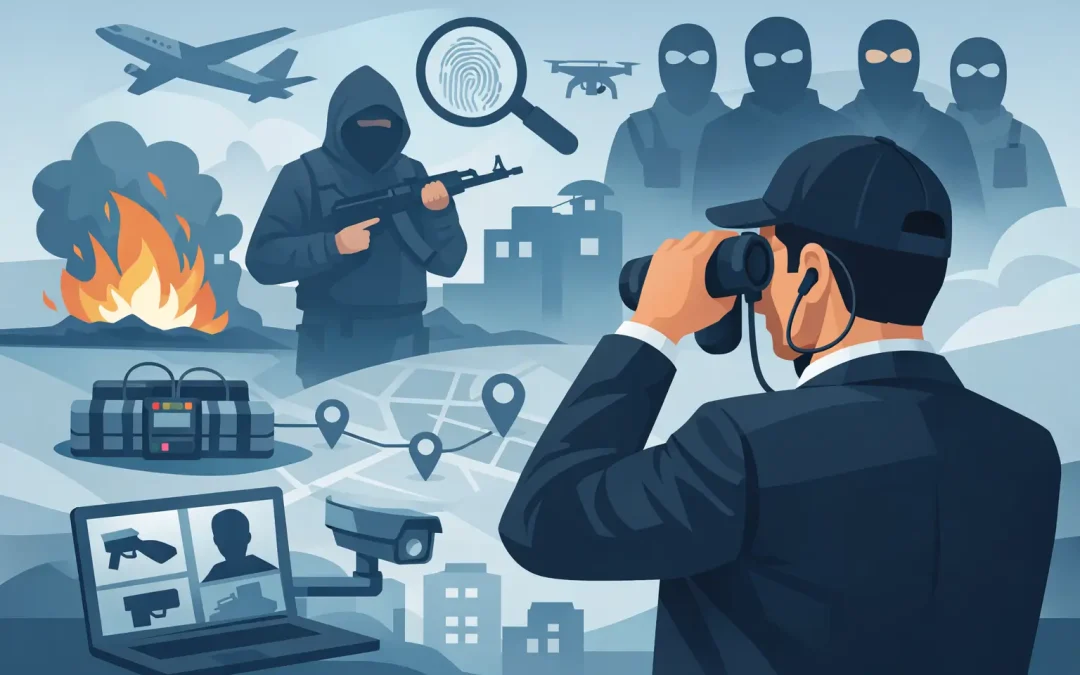
What Every Counter-Terrorism Investigator Must Hunt For RIGHT NOW in the United States
At West Coast Detectives International, I live by the hard-won lesson from my earliest days on the street: Never assume anything!
In every investigation, it’s tempting to take a quick glance and zero in on the obvious suspect. Clients repeatedly tell me, “Don’t waste time on that loyal 20-year employee—he couldn’t possibly be the problem.” Then boom—the evidence hits, and that trusted insider turns out to be the very threat we needed to stop.
The same high-stakes truth explodes in counter-terrorism inside America today. We must relentlessly pursue the religious ideologies being weaponized as tools to strike at our nation, our freedoms, and our people. But here’s the critical mistake we cannot afford to make: assuming we already know the motive before we’ve built a complete target package on the subject.
In this lightning-fast world of AI, open-source intelligence, and exploding technology, we strike first with every tech tool available—then immediately layer in rock-solid HUMINT to reveal who the target truly is, their real background, hidden networks, and true motivation.
Speed is everything. Rapidly assessing the threat level and the attacker’s level of preparation lets us make the decisive call on immediate protective action—before tragedy strikes.
At West Coast Detectives International, we’ve sharpened these battle-tested tools over 104 years of relentless global operations. We don’t wait. We don’t guess. We hunt the truth aggressively, protect lives proactively, and stay steps ahead of those who want to do us harm.
Stay vigilant. Act decisively. America needs sharp eyes and faster action—right now. Prevention is always less costly than enforcement. Let’s get to work.
For investigators working in the United States, the task is not to collect noise. It is to separate constitutionally protected activity from actionable threat indicators, distinguish rhetoric from mobilization, and document facts that can support prevention. That requires discipline. It also requires a sober understanding that terrorism-related investigations often involve overlapping motives, hybrid actors, and behavior that sits at the edge of criminal, ideological, and security concern.
What should a counter terrorism investigator be looking for in the United States?
The central question is whether an individual or network is progressing from grievance or ideology toward preparation. Investigators should be examining three moving parts at the same time: intent, capability, and opportunity. None of those categories stands on its own for long.
Intent may show up through statements, affiliations, manifestos, fixation on symbolic targets, or repeated praise for prior attacks. Capability is more concrete. It involves training, weapons access, precursor materials, financing, technical knowledge, forged documents, secure communications practices, or logistics support. Opportunity concerns target proximity, insider access, reconnaissance, travel timing, event schedules, and security vulnerabilities.
A person expressing extreme views is not automatically an operational threat. A person conducting hostile surveillance, acquiring restricted equipment, and probing access points presents a different problem entirely. Serious investigators know the distinction matters because facts matter, and because lawful inquiry must stay anchored to behavior, evidence, and risk.
Behavioral indicators matter more than labels
One of the most common mistakes in terrorism-related inquiry is overreliance on labels. Whether a subject claims allegiance to a foreign terrorist organization, a domestic extremist cause, or no formal movement at all, the operational question remains the same: what are they doing?
Behavioral indicators tend to carry more investigative value than self-description. Repeated site visits to a target area without a clear purpose, photography of ingress and egress points, timing of guard shifts, interest in HVAC systems, parking structures, loading docks, emergency exits, or executive movement routes can all point toward pre-operational planning. The same is true of abrupt operational security habits such as burner phone use, compartmentalized travel, coded language, and sudden efforts to reduce digital visibility while increasing physical movement.
Investigators should also look for acceleration. Someone who moves from consuming propaganda to contacting facilitators, from online rhetoric to procurement, or from vague anger to target-specific research is no longer static. The rate of change often tells you as much as any single act.
Financial, digital, and travel anomalies
Counter-terrorism investigations in the U.S. often advance through anomalies that look minor until they are placed in sequence. Unusual wire activity, structured cash withdrawals, unexplained remittances, purchases of dual-use materials, or the use of intermediaries for routine transactions can reveal support infrastructure. Financing does not need to be large to be operationally meaningful. Many attacks require modest resources.
Digital behavior is equally important, but investigators should avoid treating every encrypted app or anonymous account as inherently suspicious. The issue is context. Are encrypted platforms being used alongside target research, identity concealment, operational mapping, extremist networking, or guidance on weapons construction? Is there evidence of account migration after contact with known facilitators or after public enforcement activity?
Travel patterns deserve careful scrutiny. Last-minute domestic travel to sensitive locations, border-adjacent movement without a business rationale, repeated short-duration trips, unexplained international routing, or travel aligned with training, financing, or meetings can become significant. In high-risk cases, even the absence of normal travel records may matter if the subject appears to be using surrogates, false identifiers, or compartmented logistics.
Targeting indicators and hostile surveillance
If the question is what should a counter terrorism investigator be looking for based in the United States, one answer stands out above the rest: evidence that someone is moving from ideology into target selection.
Targeting indicators are often observable before execution. They can include repeated visits to the same facility, dry runs, testing employee responses, probing access control, attempts to gain contractor credentials, unusual questions about security staffing, or false pretexts to learn building routines. Critical infrastructure, houses of worship, transportation nodes, public gatherings, corporate headquarters, schools, and symbolic venues each present distinct surveillance patterns.
An experienced investigator also considers insider exposure. A threat may come not from an outside intruder, but from a vendor, temporary worker, former employee, aggrieved contractor, or ideologically aligned individual with partial access. That is why threat assessment cannot stop at the perimeter. It must include personnel vetting, access anomalies, schedule awareness, and the possibility of facilitation from within.
Ideology is relevant, but not in a simplistic way
Ideology still matters because it can shape target preference, timing, symbolism, and willingness to kill. But in practice, ideology is rarely neat. U.S.-based investigators increasingly encounter blended motives – political grievance mixed with personal instability, social isolation mixed with violent fantasy, anti-government sentiment combined with accelerationist content, or foreign influence narratives layered over local resentments.
That complexity changes how professionals assess risk. A clean ideological category may be less useful than understanding the subject’s mobilizing factors. Who or what is reinforcing the grievance? Is there a triggering event? Has the subject adopted a moral frame that justifies civilian casualties? Are they seeking significance, revenge, notoriety, or a perceived strategic effect? Those factors help explain why some individuals remain angry while others begin to operationalize violence.
Legal boundaries are part of the job
A counter-terrorism investigator in the United States must work within clear legal and constitutional limits. Protected speech, lawful assembly, and political belief are not threat indicators by themselves. The investigative threshold is crossed by conduct, material support, criminal conspiracy, credible threat behavior, or fact patterns that support reasonable suspicion and lawful inquiry.
This is not a technicality. It is the difference between professional intelligence work and indiscriminate surveillance. Good investigators protect both public safety and evidentiary integrity. If a case ultimately touches law enforcement, legal counsel, corporate leadership, or public-sector stakeholders, the underlying reporting must withstand scrutiny.
That means documentation should be precise. Dates, times, locations, statements, procurement details, surveillance observations, source evaluation, and confidence levels all matter. So does restraint. Overstating weak indicators can be as damaging as missing strong ones.
Human intelligence still makes the difference
Technology helps identify patterns, but most meaningful breakthroughs still come from people – witnesses, employees, community sources, travel contacts, vendors, former associates, and local observers who notice what systems often miss. Human intelligence remains essential because terrorism-related risk is often social before it becomes kinetic.
Someone notices an unusual line of questioning. A receptionist recalls repeated visits by the same unknown person. A driver observes surveillance behavior near a principal’s route. A colleague reports fixation, grievance, or admiration for prior attacks. A source overseas connects a domestic subject to a broader support network. These fragments are only useful when handled by investigators who know how to validate, corroborate, and place them into an operational picture.
This is where seasoned firms such as West Coast Detectives International bring value. Counter-terrorism support is not simply about gathering information. It is about producing factual, defensible intelligence that helps clients act early, lawfully, and with confidence.
What sophisticated clients should expect from the inquiry
For corporate leaders, NGOs, legal teams, and high-profile individuals, the real objective is not abstract awareness. It is decision support. An investigator should be able to tell you whether a concern reflects generalized risk, emerging threat activity, or active pre-attack behavior. Those are very different conditions and they require different responses.
In some matters, the right next step is a quiet deep-dive assessment that maps the subject’s access, communications, travel, and pattern of life. In others, the priority is protective intelligence, site hardening, executive movement adjustment, or immediate coordination with public authorities. It depends on the maturity of the threat and the quality of the evidence.
The strongest investigations do not overpromise. Sometimes the answer is that a subject is inflammatory but not yet operational. Sometimes the answer is that the risk window is closing and protective action cannot wait. The investigator’s duty is to tell the difference.
The most useful mindset is simple: look for movement, not just opinion. When intent begins to acquire capability and access, the case changes. That is the moment disciplined investigation has the greatest chance to prevent harm before a headline forces everyone to ask why the warning signs were missed.
