
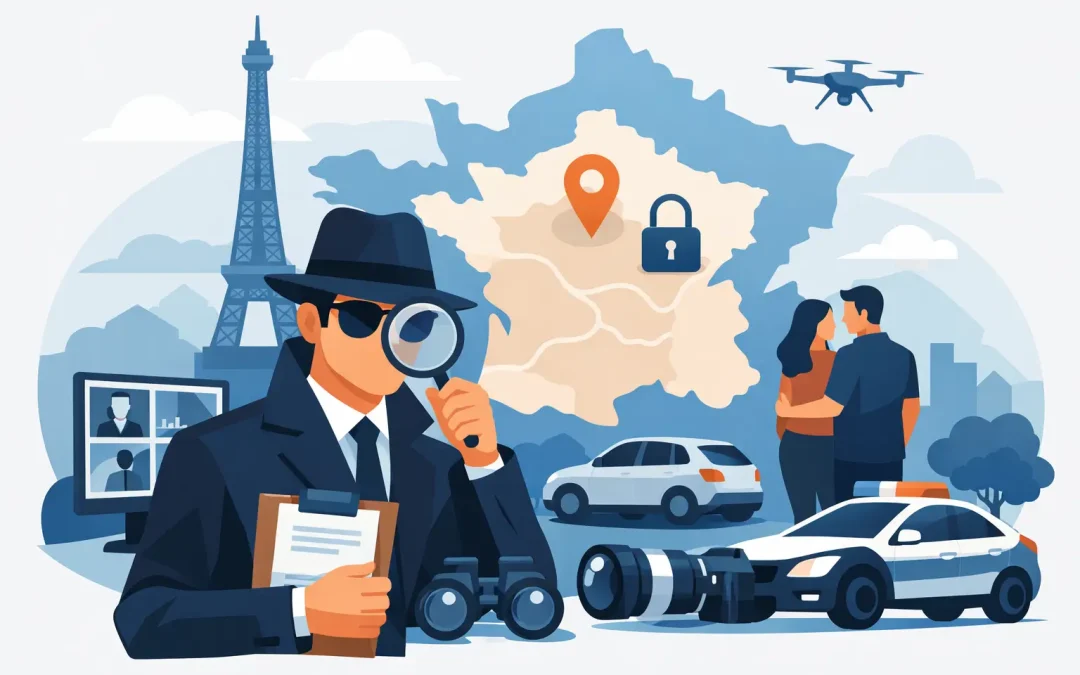
Don’t Wait Until It’s Too Late — International Investigations Demand the Right Team NOW!
Back in the early 1980s, I was right there on the ground in France helping build our first intelligence station in the country. What an exciting time! I had the incredible opportunity to work side-by-side with French police officials, learning their laws and private-sector operations firsthand. They were absolutely amazed at what we could legally accomplish in the United States — from full criminal investigations to active surveillance operations that simply weren’t possible under French regulations at the time.
We were running deep employee background checks, polygraphs, undercover placements, and tapping into extensive data resources that gave our clients powerful advantages. Many of those tools were already restricted in France back then — and they’ve only become more tightly protected over the years.
Here’s the bottom line, and why you need to act with urgency:
If you have any investigation needs in France — or anywhere else in the world — partner with trusted local operators from the start. There are three critical reasons this approach delivers fast, effective, and legal results:
- They speak the language and understand the culture — No lost-in-translation moments or cultural missteps that can derail your case.
- They know the laws and hold the proper licenses — They operate fully legally in their jurisdiction, protecting you and your interests.
- They know the streets and have the sources — Real local networks and street-level intelligence that outsiders simply can’t match.
At West Coast Detectives International, this is exactly how we operate in every country where we take on client cases. We only work with carefully vetted, proven local operators who deliver results. And on major cases, we personally send one of our experienced case supervisors to oversee the operation on the ground and report directly back to our headquarters — ensuring nothing slips through the cracks.
France or any foreign country — the same smart rules apply.
Don’t wait until a crisis hits or deadlines are closing in. International investigations move fast, and delays can be costly. Reach out early, get the right team in place, and protect what matters most.
Ready to move forward with confidence? Contact West Coast Detectives International today — we’re standing by and ready to help!
A case that looks routine on paper can become a liability the moment it crosses into France. If you are asking what should a private investigator know before starting case in France, the answer begins with one hard truth – France is not a permissive environment for casual investigative work. It is a rules-driven jurisdiction where privacy, labor protections, data handling, and evidentiary standards can quickly turn a well-meant assignment into regulatory exposure.
For corporate clients, legal teams, family offices, and principals with reputational concerns, that distinction matters. A private investigation in France is not just about finding facts. It is about obtaining usable facts through lawful, defensible methods that will withstand scrutiny from counsel, regulators, courts, and the media if a matter escalates.
What should a private investigator know before starting case in France
The first issue is legal authority. France regulates private investigative activity, and foreign investigators should not assume they can simply arrive, conduct surveillance, interview witnesses, or collect background intelligence in the same way they might in parts of the United States. Even when the underlying objective is legitimate, the method used to reach it can create the real problem.
That means the assignment should be scoped before any fieldwork begins. Who is the client of record? What is the lawful purpose? Is the matter civil, corporate, domestic, protective, or pre-litigation? Will the output be used for internal decision-making, negotiations, employment action, or court proceedings? Those answers shape the operational plan.
A serious investigator also needs to understand that France places a high value on personal privacy. Surveillance that feels standard elsewhere may be viewed far more critically. Covert collection, tracking, and photography are not simply tactical questions. They are legal and proportionality questions.
Licensing, local partnership, and who can lawfully operate
One of the most common mistakes in international work is assuming experience substitutes for local authority. It does not. France has a regulated private security and investigation environment, and local compliance is not optional. If an assignment requires activity on French soil, investigators should confirm whether the work must be conducted by a properly authorized local professional or in coordination with one.
This is where discipline matters more than speed. A client in crisis may want immediate action, but unauthorized field activity can compromise the entire engagement. In sensitive matters, it is often wiser to build the case architecture first, identify what can be done from open sources or lawful records review, and then deploy local assets only after the legal footing is clear.
For international firms, this is not a weakness. It is tradecraft. The right local partner brings more than language support. They understand regional practice, police posture, court expectations, and the difference between a tactic that is technically possible and one that is strategically foolish.
Privacy and data rules are central, not secondary
Any investigator working in France must treat personal data as a controlled asset. This is not just a European compliance talking point. It affects how you collect, store, transfer, analyze, and report information.
Names, contact details, employment history, location patterns, photographs, communications-related material, and adverse allegations may all trigger legal considerations. The source of the information matters. So does the reason for collecting it. So does where it will be stored and who will receive it.
For US-based clients, this can create friction. A corporate security team may want broad collection in the early stages of a fraud, misconduct, or due diligence matter. In France, broad collection without a tightly defined purpose can create unnecessary exposure. Good investigators narrow the collection plan, document the rationale, and avoid gathering more than the mission requires.
Cross-border transfer is another pressure point. If information gathered in France will move to US counsel, a corporate headquarters, or a family office, the transfer pathway should be considered before collection begins, not after. Evidence that cannot be lawfully moved or used has limited value.
Employment, labor, and internal investigations require extra caution
Some of the most legally sensitive French investigations involve employees, contractors, and workplace allegations. US executives are often surprised by how differently internal investigations can be perceived and handled in Europe. In France, labor rights, employee monitoring restrictions, and procedural fairness can all affect what is appropriate.
If the assignment concerns expense fraud, conflicts of interest, harassment, time theft, diversion of inventory, or a suspicious executive relationship, the investigator should not default to aggressive surveillance or informal outreach. The employer’s own policies, notice practices, and prior internal procedures may affect what can be investigated and how.
This is also where coordination with local counsel becomes critical. The question is not only whether misconduct occurred. The question is whether the evidence was collected in a manner that supports disciplinary action or litigation without creating a second dispute over privacy or process.
Surveillance in France is possible, but never casual
Clients often assume surveillance is the central tool in any private investigation. Sometimes it is. But in France, surveillance must be approached with precision and restraint.
The purpose must be clear. The duration must be justified. The target’s setting matters. Public-space observation is not the same as monitoring someone in or around locations where private life is strongly protected. Photography and video may be especially sensitive depending on context, subject matter, and intended use.
This is where seasoned operators distinguish themselves from opportunists. Good surveillance is not defined by how much footage you gather. It is defined by whether the collection was lawful, proportionate, and mission-relevant. If a case can be advanced through records, source inquiry, discreet interviews, travel pattern analysis, or corporate intelligence review, those options may be safer and more durable than defaulting to optics-heavy surveillance.
Source handling, interviews, and cultural fluency
French cases are rarely improved by blunt-force interviewing. A direct American style can be effective in some environments, but France often requires a more calibrated approach, especially when dealing with professionals, gatekeepers, administrative staff, neighbors, or subject-adjacent sources.
The investigator should know what can be asked, how identity is presented, and when a contact becomes counterproductive. Misrepresentation, pressure tactics, or overconfident outreach can close doors fast. In high-profile matters, it can also trigger complaints, reputational blowback, or defensive lawyering.
Cultural fluency matters here as much as language. Titles, formality, timing, and tone can influence whether a source engages at all. In a country where institutional structures and professional boundaries carry weight, relationship handling is part of the operational plan, not an afterthought.
Evidence that is true is not always evidence that is usable
One of the most expensive misconceptions in cross-border investigations is assuming that factual accuracy alone guarantees value. It does not. Evidence can be compelling and still be difficult to use if it was obtained improperly, documented poorly, or collected without local legal discipline.
Before a French case begins, the investigator should know the likely end use of the material. If the matter may land in court, arbitration, employment proceedings, regulatory review, or a board-level decision, reporting standards matter. Time stamps, source attribution, collection method, chain of custody, translation accuracy, and contextual notes should be built into the assignment from day one.
This is particularly important in matters involving fraud, asset tracing, marital disputes, insider threats, executive misconduct, or contested business relationships. A dramatic finding may satisfy a curious client. A defensible finding serves the client’s real interests.
Risk mapping before deployment
When considering what should a private investigator know before starting case in France, the smartest answer is this: know the risk picture before you know the route. Every assignment should begin with a disciplined pre-operational review.
That includes the client’s objective, the subject’s profile, jurisdictional limits, political or reputational sensitivity, likely legal challenges, digital exposure, and whether the matter could trigger police attention or media interest. It should also account for practical realities such as strike activity, transportation disruptions, regional differences, and whether the case touches regulated sectors, state-connected entities, or public personalities.
For high-stakes matters, mission planning should also cover protective concerns. If the subject is hostile, the matter intersects with extremism, or the client is already under threat, the investigation cannot be separated from security planning. Investigative work and protective posture often need to move together.
A firm such as West Coast Detectives International would treat that preparation phase as central, not administrative. That is the difference between gathering information and conducting an operation.
The right question is not can you investigate in France
The right question is whether the case has been designed to survive France. That means lawful authority, local coordination, privacy-aware collection, disciplined reporting, and a clear understanding of how French realities affect tactics that might be routine elsewhere.
If the assignment is important enough to justify international investigative work, it is important enough to do correctly. In France, restraint is not hesitation. It is professional control, and that is often what protects both the client and the case.
