
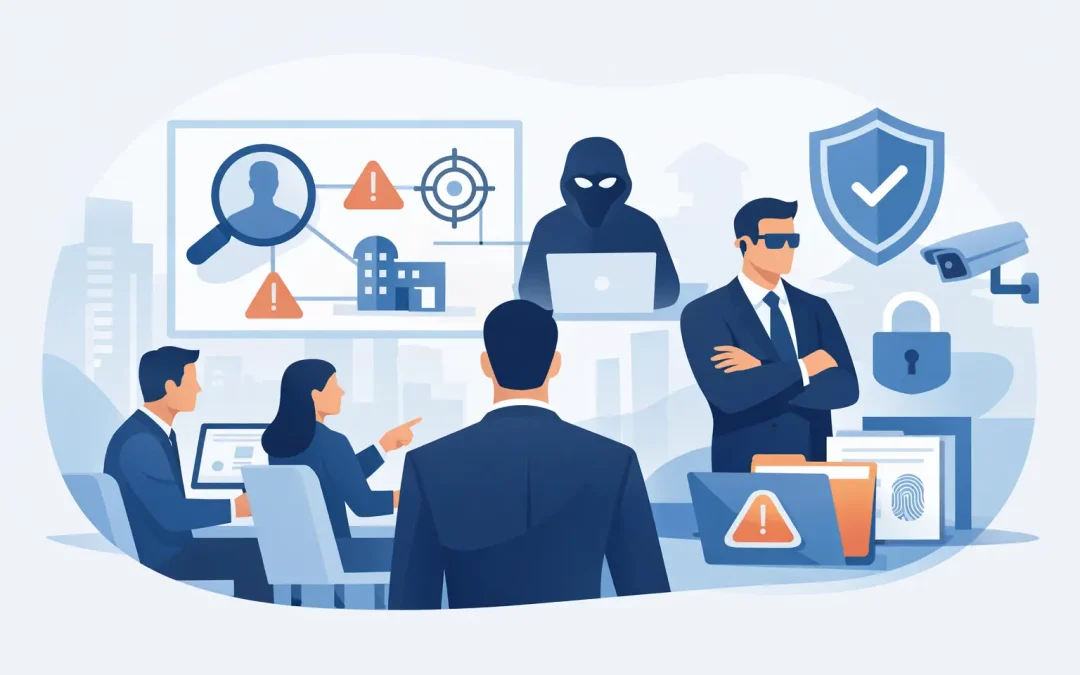
A threat rarely announces itself in a form that is easy to classify. It may begin as fixation on a senior executive, agitation from a terminated employee, hostile online chatter around a controversial deal, or irregular activity linked to a facility, event, or foreign travel plan. Corporate threat assessment services exist to bring discipline to that uncertainty – to determine what is noise, what is escalating, and what demands immediate action.
For organizations operating under public visibility, legal pressure, geopolitical exposure, or executive risk, that distinction is not academic. It affects duty of care, business continuity, reputational stability, and personal safety. The real value of a professional threat assessment is not simply identifying danger. It is establishing factual clarity early enough to prevent a manageable issue from becoming a crisis.
What corporate threat assessment services actually do
At a serious level, threat assessment is not a guard-post function and it is not a generic monitoring exercise. It is an intelligence-led process that evaluates people, behaviors, intent, capability, access, and triggering events. The objective is to understand whether a subject or situation presents a credible threat, how that threat may evolve, and what protective posture the client should adopt.
That work often sits at the intersection of security, investigations, human resources, legal, executive protection, and crisis management. A capable provider does more than collect information. It organizes facts into an actionable assessment that leadership can use under pressure.
In practical terms, corporate threat assessment services may involve behavioral threat review, investigative research, witness and source development, open-source and social media analysis, travel and event exposure review, workplace violence indicators, stalking and harassment assessment, executive targeting analysis, and coordination with legal counsel or law enforcement when necessary. In higher-risk matters, the assessment also informs immediate protective operations.
The difference between a threat and a concern
One of the most common mistakes companies make is treating every alarming signal as equally urgent or, just as dangerously, dismissing ambiguous behavior because it does not yet meet a criminal threshold. Neither approach serves leadership well.
A concern becomes a credible threat when evidence supports intent, capability, access, or a pattern of escalation. That may include repeated unwanted contact, personal grievance combined with surveillance behavior, ideological fixation, attempts to breach physical or digital boundaries, or changes in routine that suggest planning. Context matters. A single hostile message from an anonymous account is not the same as a subject who knows executive schedules, references specific locations, and has a record of violent conduct.
This is why experienced assessment work cannot rely on checklists alone. Threat is dynamic. It changes with triggering events such as litigation, termination, media exposure, shareholder disputes, layoffs, political controversy, personal relationship breakdowns, or international travel into unstable environments. The facts must be weighed in sequence, not isolation.
When organizations should engage corporate threat assessment services
The right time is usually earlier than clients expect. Waiting for overt violence, unlawful entry, or direct confrontation often means the organization has already surrendered initiative.
A mature engagement typically begins when leadership sees indicators that require independent review. That may involve a concerning employee situation, persistent harassment toward an executive or family member, suspicious intelligence around a site or event, threats linked to activism or extremism, insider hostility after a disciplinary action, or concerns about a principal traveling into a volatile region.
There are also quieter cases where the value is just as high. An acquisition may place leadership under activist scrutiny. A public-facing executive may attract online fixation. A company entering a new market may face criminal, political, or terrorism-related exposure not visible from headquarters. In such situations, the assessment is not merely reactive. It becomes part of prudent risk planning.
What a professional assessment process should include
The strongest providers start with intake discipline. They establish what is known, what is alleged, what can be verified, and what immediate vulnerabilities exist. This first stage matters because early assumptions often distort later decisions.
From there, the work typically moves into intelligence collection and corroboration. That can include background inquiries, pattern analysis, digital review, on-the-ground verification, interviews, timeline reconstruction, and examination of motive, grievance, and recent stressors. In global matters, the process may require local assets who understand regional conditions, language, culture, and informal reporting channels that are invisible to remote analysts.
Assessment then turns to judgment. This is where experience separates true specialists from commodity security vendors. The question is not simply whether something looks troubling. The question is what the evidence supports, how the risk is likely to develop, and what the client should do next. Recommendations may range from monitoring and documentation to access control changes, travel adjustment, executive protection, law enforcement liaison, internal management protocols, or a wider crisis response posture.
A written product should be clear, factual, and decision-ready. Executives and counsel do not need theatrics. They need a sober account of risk, confidence levels, operational gaps, and immediate options.
Why internal teams often need outside support
Many corporations have strong internal security leaders. Many do not have the investigative reach, field capability, or time required for a sensitive threat matter moving across jurisdictions. Even sophisticated in-house teams can benefit from an external partner when neutrality, discretion, or specialized access is essential.
There is also the matter of credibility. In high-stakes cases involving executives, board members, litigation exposure, media scrutiny, or possible violence, independent findings carry weight. An outside specialist can provide objective assessment, preserve confidentiality, and help leadership avoid the appearance of internal bias.
This becomes more important when matters extend beyond the workplace. A threat may involve a residence, family member, social event, overseas movement, reputational targeting, or hostile actors with transnational connections. At that point, the issue is no longer a narrow corporate security problem. It is a protective intelligence problem.
What to look for in corporate threat assessment services
Experience should be measured by case depth, not marketing language. A provider should understand behavioral threat indicators, investigative methodology, executive protection implications, and the realities of crisis decision-making. If international exposure is in play, global operating capability matters. If terrorism or ideologically motivated risk is relevant, that expertise should be real and demonstrated, not casually claimed.
Clients should also examine how a firm handles discretion. Sensitive assignments require controlled communication, clean reporting, lawful methods, and disciplined need-to-know practices. A threat assessment can itself become a liability if handled loosely.
It is also wise to ask how the provider turns analysis into action. Some firms can produce a memo but cannot support the next step. Others can integrate assessment with travel security, protective coverage, site review, investigative follow-up, or crisis management. That continuity is often critical when a case changes quickly.
West Coast Detectives International operates in that higher-trust category, where investigative judgment, global reach, and protective readiness must work together rather than sit in separate silos.
The trade-offs leaders should understand
Not every threat case justifies a maximal response. Overreaction can disrupt operations, create internal fear, and escalate a subject who might otherwise have remained peripheral. Underreaction carries the obvious cost of exposure. The proper response depends on evidence, timing, visibility, and the client’s risk tolerance.
There is also a legal and reputational balance to maintain. Companies must protect people without creating unnecessary records, defamatory assumptions, or employment actions unsupported by fact. This is one reason threat assessment should be tightly coordinated with counsel, HR, and senior security leadership when the matter touches internal personnel.
Another trade-off involves speed. Urgent cases require fast judgment, but speed without verification produces weak decisions. The best work moves quickly while preserving analytical discipline.
Why this service matters more now
Executives are more visible than they were a decade ago. Corporate disputes become public faster. Activism, grievance, and online hostility can move into the physical world with very little warning. International business travel carries a wider mix of criminal, political, and terrorism-related variables. At the same time, organizations are expected to show they acted responsibly when warning signs existed.
That combination has changed the stakes. Threat assessment is no longer a niche service reserved for exceptional events. For many organizations, it is now part of serious duty-of-care planning.
The strongest posture is neither fear-driven nor performative. It is prepared, informed, and capable of acting before a threat sets the tempo. When leadership has access to clear intelligence, sound judgment, and discreet operational support, uncertainty becomes manageable. And in this field, that shift often makes all the difference.
